Direct Answer:
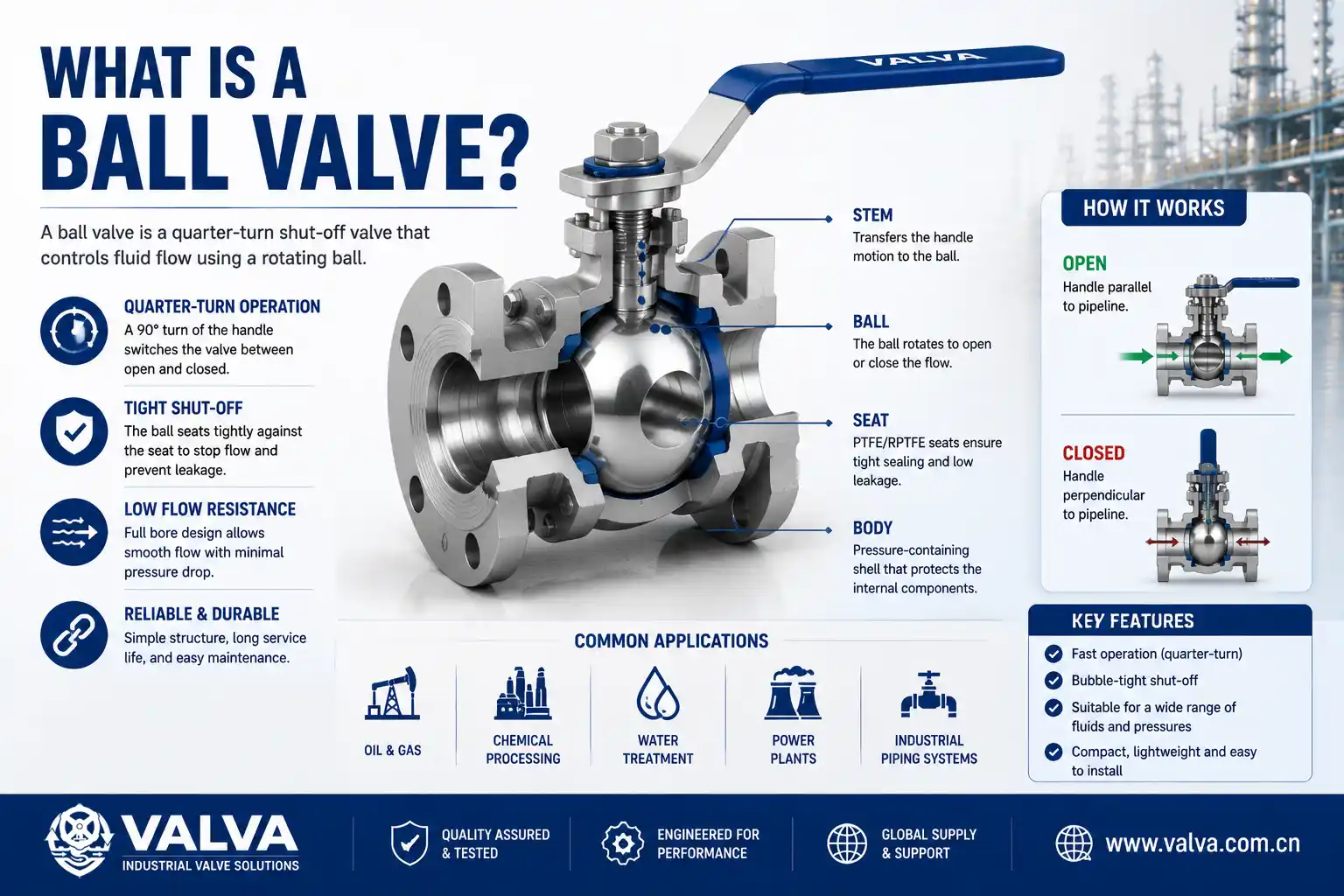
A ball valve is a quarter-turn shut-off valve that uses a rotating ball with a bore through its center to start or stop fluid flow. It is widely used in industrial piping systems because it provides fast operation, reliable sealing, low pressure drop, and long service life.
A ball valve is one of the most commonly used valves in industries such as oil and gas, chemical processing, water treatment, power generation, and manufacturing. Unlike linear-motion valves, it only requires a 90-degree rotation of the handle or actuator to fully open or close the flow path, making it efficient and easy to operate.
How Does a Ball Valve Work?
A ball valve operates using a hollow, perforated ball positioned inside the valve body.
When the bore of the ball aligns with the pipeline, fluid flows freely through the valve. Rotating the ball 90 degrees turns the solid side of the ball toward the flow path, completely blocking the passage.
This simple quarter-turn mechanism offers several advantages:
- Fast opening and closing
- Bubble-tight sealing
- Low operating torque
- Minimal flow resistance
- Easy automation with electric or pneumatic actuators
Because of its straightforward design, ball valves are suitable for both manual and automated industrial systems.
Main Components of a Ball Valve
Although designs vary, most industrial ball valves consist of the following components:
- Valve body
- Ball
- Stem
- Seats
- Seals and packing
- Handle or actuator
- End connections (flanged, threaded, welded, or socket weld)
Each component contributes to the valve’s pressure resistance, sealing performance, and operational reliability.
Types of Ball Valves
Industrial ball valves are available in several configurations depending on application requirements.
Common types include:
- Floating Ball Valve
- Trunnion Mounted Ball Valve
- Full Port Ball Valve
- Reduced Port Ball Valve
- Two-Piece Ball Valve
- Three-Piece Ball Valve
- Top Entry Ball Valve
- Metal Seated Ball Valve
- Soft Seated Ball Valve
Selecting the appropriate type depends on pipeline pressure, temperature, media characteristics, and maintenance requirements.
Advantages of Ball Valves
Ball valves have become a preferred choice for many industrial applications because they offer numerous operational benefits.
Key advantages include:
- Quick quarter-turn operation
- Excellent shut-off capability
- Low pressure loss
- Long service life
- Compact structure
- Low maintenance requirements
- Compatible with automated control systems
- Suitable for high-pressure applications
These features make ball valves ideal for both on-off isolation and automated process control systems.
Common Industrial Applications
Ball valves are widely installed across various industries due to their versatility and durability.
Typical applications include:
- Oil and gas pipelines
- Petrochemical plants
- Water treatment facilities
- HVAC systems
- Pharmaceutical manufacturing
- Food and beverage processing
- Power generation plants
- Marine engineering
Different materials such as carbon steel, stainless steel, brass, and duplex stainless steel are selected according to operating conditions.
How to Choose the Right Ball Valve
Choosing the correct ball valve involves evaluating several engineering factors.
Consider the following:
- Valve size (DN or NPS)
- Pressure class (ANSI Class 150, 300, 600, etc.)
- Temperature range
- Fluid type
- Body material
- Seat material
- End connection type
- Manual or automated operation
Working with an experienced industrial valve manufacturer helps ensure the valve meets your project’s performance and safety requirements.
Frequently Asked Questions
What is the primary purpose of a ball valve?
A ball valve is primarily used to quickly start or stop the flow of liquids or gases in industrial piping systems while providing reliable sealing and minimal leakage.
Can a ball valve regulate flow?
Although ball valves can partially regulate flow, they are primarily designed for fully open or fully closed operation. Continuous throttling may damage the valve seats unless a specially designed V-port ball valve is used.
How long does an industrial ball valve last?
A high-quality industrial ball valve can operate reliably for many years. Its service life depends on operating pressure, temperature, media, maintenance practices, and material selection.
Related Articles
Technical & Design Insights
- What Is a Ball Valve
- How Does a Ball Valve Work
- Different Types of Ball Valves
- Floating vs Trunnion Ball Valve
- Full Port vs Reduced Port Ball Valve
- Top Entry vs Side Entry Ball Valve
- V Port vs Standard Ball Valve
- What Are Ball Valves Used For
- One Piece vs Two Piece Ball Valve
- Two Piece vs Three Piece Ball Valve
- What Are the Different Types of Ball Valves