Direct Answer:
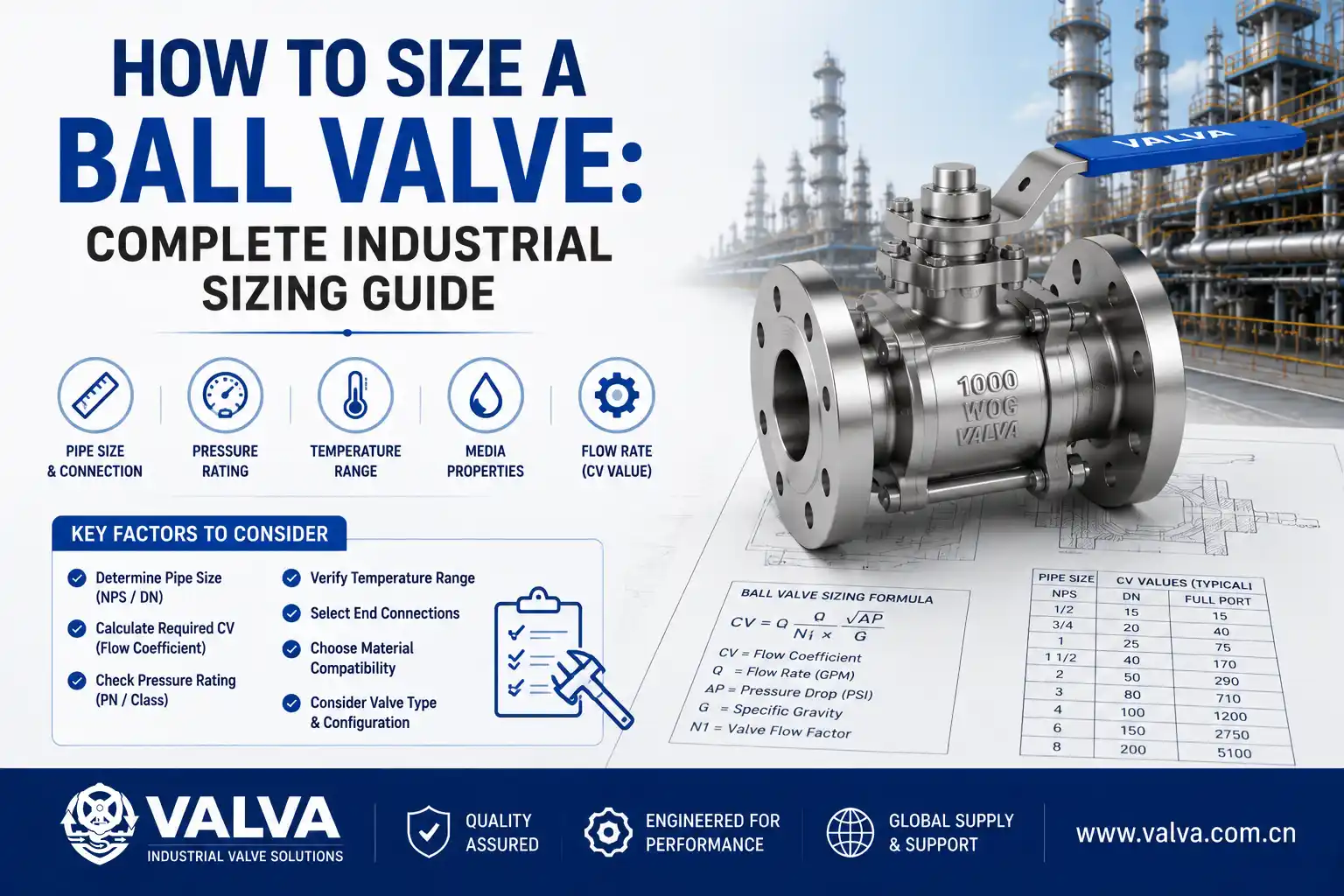
How to size a ball valve depends primarily on pipeline diameter, required flow rate (Cv/Kv value), pressure drop limitations, and fluid velocity control. Engineers must ensure the valve size matches the pipe size while also maintaining proper flow performance and preventing cavitation or excessive pressure loss.
Understanding how to size a ball valve ensures stable system performance, correct flow capacity, and long-term reliability in industrial piping systems.
Match Valve Size with Pipeline Diameter
The first step in ball valve sizing is matching the nominal pipe size (NPS or DN).
Common sizing practice includes:
- DN15–DN50 → small utility pipelines
- DN50–DN150 → standard industrial process lines
- DN150 and above → large-scale industrial transmission systems
In most cases:
- Full port ball valves match pipe inner diameter
- Reduced port valves may have smaller internal bore
Therefore, pipeline size sets the baseline for valve selection.
Understand Flow Capacity (Cv / Kv Value)
Flow capacity is one of the most important sizing parameters.
- Cv (US standard) = flow rate in GPM at 1 psi pressure drop
- Kv (metric standard) = flow rate in m³/h at 1 bar pressure drop
When sizing:
- Higher flow requirement → larger valve or full port design
- Lower flow requirement → reduced port may be acceptable
If Cv is too small:
- System becomes restricted
- Pressure drop increases
If Cv is too large:
- Flow control becomes unstable in modulation systems
Control Pressure Drop Requirements
Proper sizing must maintain acceptable pressure drop across the valve.
Key considerations:
- Low pressure drop → full port valve preferred
- High pressure drop allowed → reduced port acceptable
- Long pipelines → minimize additional resistance
Excessive pressure drop can cause:
- Pump overload
- Flow instability
- Energy loss
Therefore, engineers must balance efficiency and control accuracy.
Consider Fluid Velocity
Fluid velocity affects valve wear and system stability.
Recommended industrial limits:
- Water systems → moderate velocity (1–3 m/s typical)
- Gas systems → controlled higher velocity
- Slurry systems → lower velocity to reduce erosion
If velocity is too high:
- Seat wear increases
- Noise and vibration occur
- Cavitation risk increases
Proper valve sizing helps maintain safe velocity levels.
Choose Full Port vs Reduced Port
Valve port type directly affects sizing decisions.
Full Port Ball Valve
- Same bore as pipe
- Minimal pressure loss
- Best for cleaning pigs and flow efficiency
Reduced Port Ball Valve
- Smaller internal bore
- Lower cost
- Acceptable for non-critical systems
Full port is preferred when flow efficiency is critical.
Material and Pressure Class Influence Size Selection
Although size is mainly geometric, material and pressure class also affect design thickness.
Examples:
- Higher pressure class → thicker body → heavier valve
- Stainless steel → higher strength requirements
- Duplex steel → used for high-pressure compact designs
Thus, valve size and pressure rating must be evaluated together.
Application-Based Sizing Guidelines
Different industries apply different sizing logic:
- Water treatment → DN sized closely to pipe
- Oil & gas → Cv-based precision sizing
- Chemical systems → corrosion + flow balancing
- Slurry systems → oversized valves for wear reduction
Application conditions often override theoretical sizing.
Common Sizing Mistakes
Avoid these frequent errors:
- Selecting valve based only on pipe size
- Ignoring Cv/Kv calculations
- Using reduced port in high-flow systems
- Overlooking pressure drop impact
- Ignoring fluid velocity limitations
Proper engineering calculation is essential for safe operation.
Conclusion
In summary, how to size a ball valve requires balancing pipeline diameter, flow capacity (Cv/Kv), pressure drop, and fluid velocity. Correct sizing ensures efficient flow control, reduced energy loss, and long-term system reliability in industrial applications.
Frequently Asked Questions
Is ball valve size always equal to pipe size?
Not always.
Full port valves match pipe diameter, but reduced port valves may have smaller internal flow openings.
What happens if a ball valve is undersized?
Flow restriction occurs.
Undersized valves increase pressure drop, reduce efficiency, and may cause pump overload.
What is more important in sizing: pipe size or Cv?
Cv/Kv is more critical.
While pipe size provides a reference, flow capacity (Cv/Kv) determines actual hydraulic performance.
Related Articles
Technical & Design Insights
- What Is a Ball Valve
- How Does a Ball Valve Work
- Different Types of Ball Valves
- Floating vs Trunnion Ball Valve
- Full Port vs Reduced Port Ball Valve
- Top Entry vs Side Entry Ball Valve
- V Port vs Standard Ball Valve
- What Are Ball Valves Used For
- One Piece vs Two Piece Ball Valve
- Two Piece vs Three Piece Ball Valve
- What Are the Different Types of Ball Valves