Direct Answer:
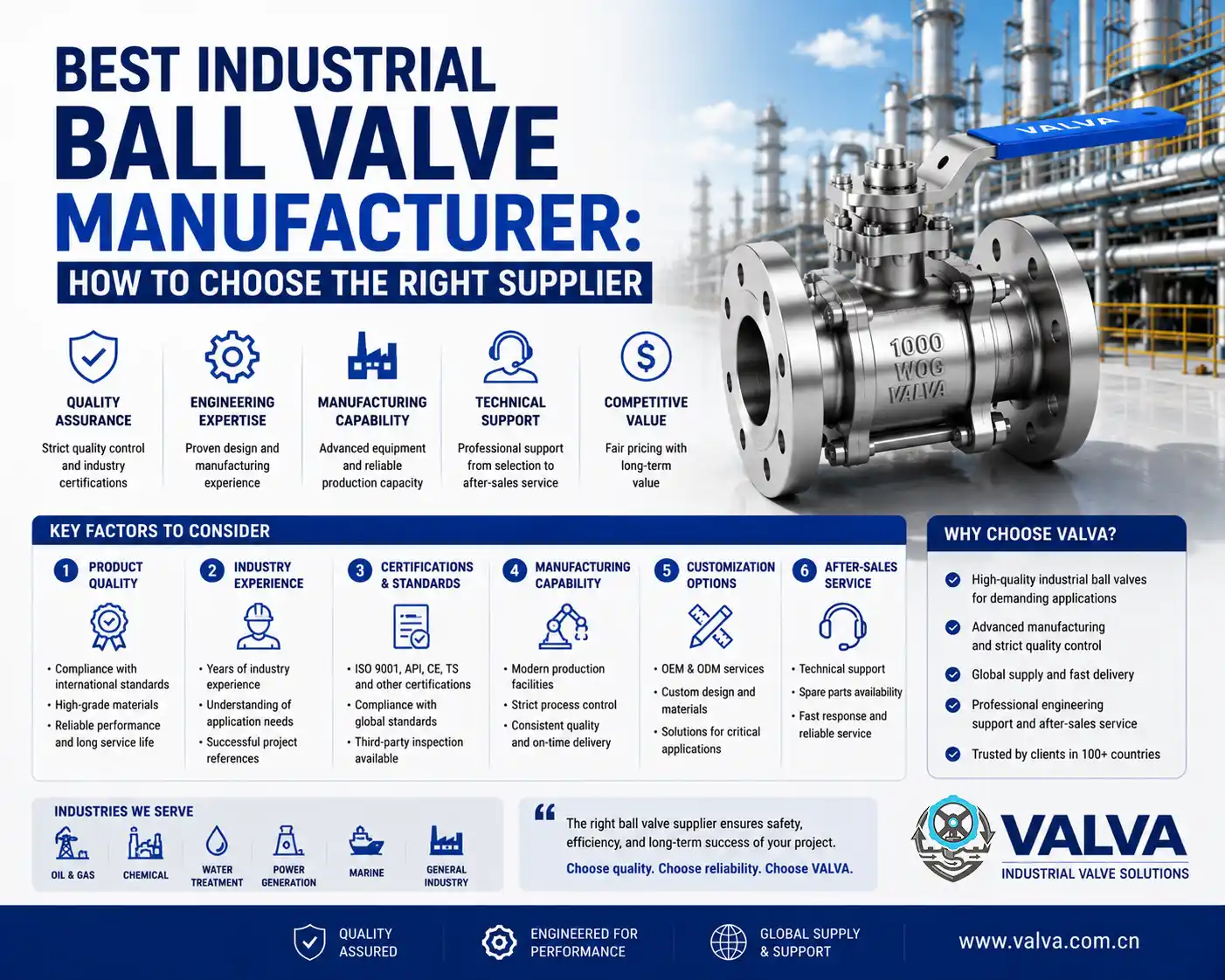
The best industrial ball valve manufacturer is a supplier that provides certified products (API, ISO, CE), consistent quality control, suitable material options, and proven production capacity for industrial applications such as oil, gas, chemical, and water systems. In practice, the “best” manufacturer is not only defined by price, but by reliability, certifications, and long-term supply stability.
What Defines the Best Industrial Ball Valve Manufacturer
A high-quality manufacturer must meet strict industrial requirements.
Key evaluation criteria include:
- International certifications (ISO 9001, CE, API 6D / API 608)
- Stable production capacity
- Strict quality control system
- Engineering and R&D capability
- Material traceability
- Pressure testing compliance (API 598)
- Long-term export experience
These factors determine whether a supplier can meet industrial-grade standards.
Manufacturing Capability and Production Scale
A strong manufacturer should have complete production control.
Important capabilities include:
- CNC machining for precision components
- Casting or forging workshops
- Assembly and testing lines
- In-house pressure testing facilities
Manufacturers with full production control provide more stable quality and shorter lead times.
Material Options and Engineering Flexibility
The best industrial ball valve manufacturers offer multiple material choices.
Common materials include:
- Carbon steel (WCB) – general industrial use
- Stainless steel (304 / 316 / 321) – corrosion resistance
- Duplex steel (2205) – high strength and chloride resistance
- Special alloys – extreme environments
A good manufacturer helps customers match materials to real working conditions.
Quality Control and Testing Standards
Reliable manufacturers follow strict inspection procedures.
Key testing standards:
- API 598 pressure testing
- Shell test and seat leakage test
- Material chemical analysis
- Dimensional inspection
- Torque and cycle testing
Strong QC systems reduce failure risk in industrial applications.
Certifications and Compliance
Certifications prove manufacturing reliability.
Important certifications include:
- ISO 9001 Quality Management System
- CE marking for European markets
- API 6D / API 608 for pipeline valves
- ISO 17292 for ball valve design standards
Certified manufacturers are preferred in global industrial procurement.
Export Experience and Global Supply Capability
The best manufacturers usually have strong export experience.
Key indicators:
- Experience with OEM/ODM orders
- Stable international logistics capability
- Documentation support (CO, test reports, MTC)
- Familiarity with global standards (ASME, EN, DIN)
This ensures smooth international procurement and delivery.
Price vs Quality Balance
A reliable manufacturer does not focus only on low cost.
Instead, they balance:
- Material quality
- Manufacturing precision
- Testing requirements
- Long-term performance
Very low-cost suppliers often reduce material quality or skip testing steps, which increases failure risk.
How to Choose the Best Supplier for Your Project
Follow this checklist:
- Verify certifications
- Request test reports
- Check material specifications
- Evaluate production capability
- Compare delivery reliability
- Assess after-sales support
A systematic evaluation ensures safe procurement decisions.
Conclusion
The best industrial ball valve manufacturer is not defined by price alone, but by certification, production capability, material control, and quality assurance. Choosing the right manufacturer ensures long-term system safety, reduced maintenance costs, and reliable industrial performance across oil, gas, chemical, and water applications.
Frequently Asked Questions
What makes a ball valve manufacturer reliable?
A reliable manufacturer has certifications like ISO and API, strict quality control, stable production capacity, and proven export experience.
Should I choose the cheapest ball valve manufacturer?
No. Low-cost manufacturers may reduce material quality or testing standards, increasing long-term failure risks.
What certifications should a ball valve manufacturer have?
Key certifications include ISO 9001, CE, API 6D, API 608, and compliance with ISO 17292 or ASME standards.
Related Articles
Technical & Design Insights
- What Is a Ball Valve
- How Does a Ball Valve Work
- Different Types of Ball Valves
- Floating vs Trunnion Ball Valve
- Full Port vs Reduced Port Ball Valve
- Top Entry vs Side Entry Ball Valve
- V Port vs Standard Ball Valve
- What Are Ball Valves Used For
- One Piece vs Two Piece Ball Valve
- Two Piece vs Three Piece Ball Valve
- What Are the Different Types of Ball Valves