
Direct Answer:
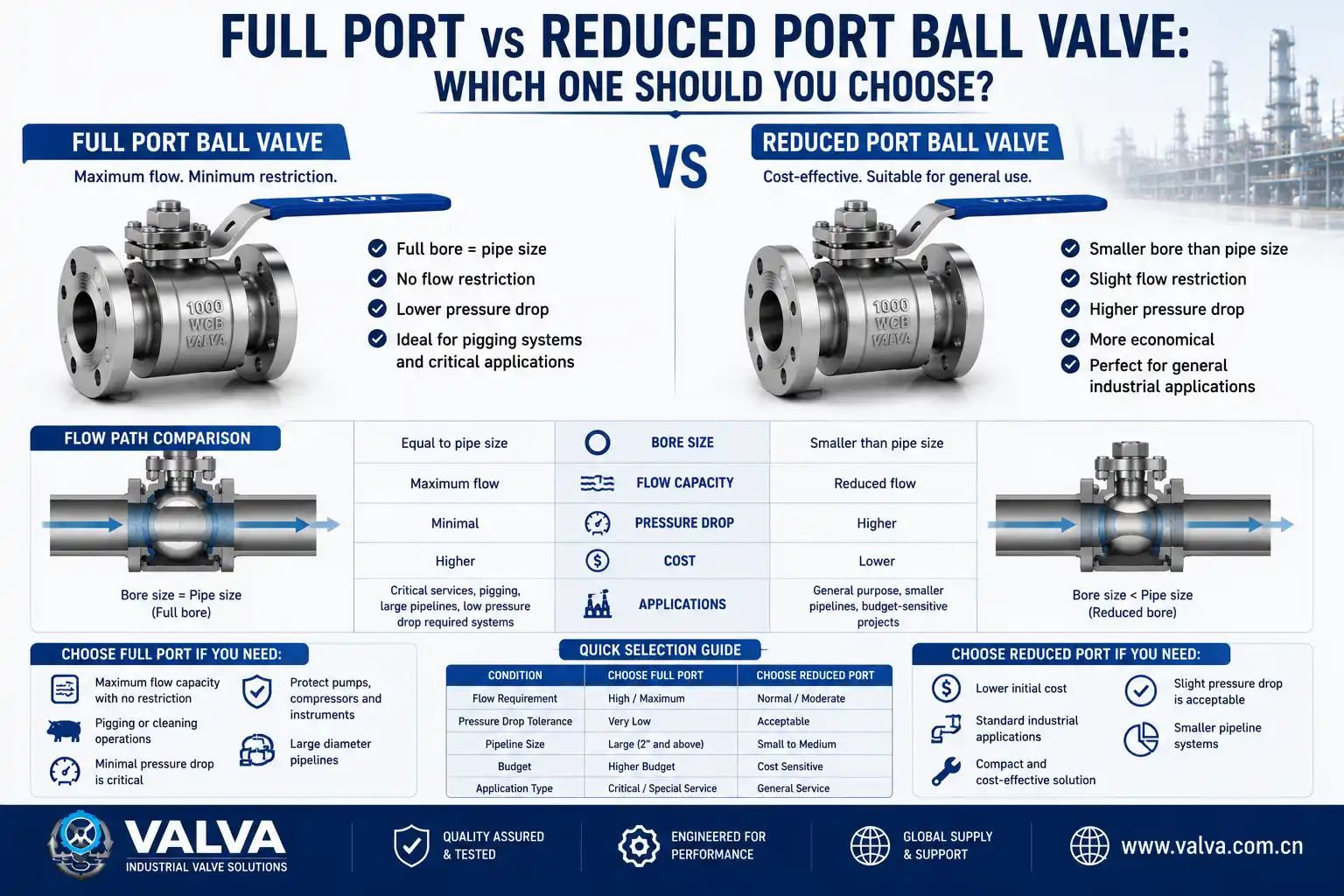
Full port vs reduced port ball valve—the key difference is the bore size. A full port ball valve has an internal bore that matches the pipe diameter, allowing maximum flow with minimal pressure loss. A reduced port ball valve has a smaller bore than the pipeline, making it more compact and cost-effective while creating a slight pressure drop.
Selecting the right valve depends on your flow requirements, pressure conditions, installation space, and budget. Understanding full port vs reduced port ball valve helps engineers and buyers make the best choice for industrial piping systems.
What Is a Full Port Ball Valve?
A full port ball valve, also called a full bore ball valve, has an internal opening that is the same diameter as the connected pipe.
When the valve is fully open, the flow path remains almost unrestricted.
As a result, full port ball valves provide:
- Maximum flow capacity
- Minimal pressure drop
- Low turbulence
- Reduced energy loss
- Easy pipeline pigging
- Improved system efficiency
Because the flow path stays consistent, industries often use full port valves in applications where maintaining flow rate is essential.
What Is a Reduced Port Ball Valve?
A reduced port ball valve, sometimes called a standard port ball valve, has a smaller internal bore than the pipe diameter.
Although the valve still provides reliable shut-off, the smaller opening slightly restricts flow.
Therefore, reduced port ball valves offer:
- Lower purchase cost
- Smaller body size
- Reduced weight
- Easier installation
- Lower actuator requirements for some applications
Consequently, many general industrial systems choose reduced port valves when a small pressure loss is acceptable.
Full Port vs Reduced Port Ball Valve: Key Differences
| Feature | Full Port Ball Valve | Reduced Port Ball Valve |
|---|---|---|
| Bore size | Same as pipe diameter | Smaller than pipe diameter |
| Flow capacity | Maximum | Slightly reduced |
| Pressure drop | Very low | Moderate |
| Turbulence | Minimal | Slightly higher |
| Energy efficiency | Higher | Slightly lower |
| Valve size | Larger | More compact |
| Weight | Heavier | Lighter |
| Cost | Higher | Lower |
| Pigging capability | Excellent | Usually not suitable |
| Typical use | Critical flow systems | General industrial service |
Flow Performance Comparison
Flow performance is one of the biggest differences between the two valve types.
A full port ball valve allows fluid to move through the pipeline without significant restriction.
As a result:
- Pump efficiency improves.
- Energy consumption decreases.
- Flow velocity remains consistent.
- Pressure loss stays very low.
In contrast, a reduced port ball valve slightly restricts the flow path.
Therefore:
- Pressure drop increases slightly.
- Flow velocity rises through the smaller bore.
- Minor turbulence develops.
For many utility systems, however, this small pressure loss has little practical impact.
Cost Comparison
Budget often influences valve selection.
Full port ball valves require more material and larger internal components.
Consequently, they generally cost more than reduced port designs.
Reduced port ball valves provide:
- Lower manufacturing cost
- Lower shipping cost
- Smaller actuators in some installations
- More economical project pricing
For non-critical applications, the cost savings can be significant.
Which Valve Is Better for Industrial Applications?
The answer depends on the operating conditions.
Choose a Full Port Ball Valve If You Need:
- Maximum flow capacity
- Minimal pressure loss
- Pipeline pigging
- High-flow process systems
- Oil and gas transmission
- Slurry or viscous media
Choose a Reduced Port Ball Valve If You Need:
- Lower equipment cost
- Compact installation
- General utility service
- Water distribution
- Compressed air systems
- Non-critical flow applications
Matching the valve design to the application improves efficiency and reduces long-term operating costs.
Common Industrial Applications
Full Port Ball Valve Applications
Industries commonly use full port ball valves in:
- Oil and gas pipelines
- Petrochemical plants
- LNG terminals
- Process piping
- Power generation
- High-flow water systems
Reduced Port Ball Valve Applications
Reduced port ball valves are widely installed in:
- Building services
- HVAC systems
- Water treatment
- Chemical processing
- Manufacturing facilities
- General industrial utilities
Because these systems often tolerate a small pressure drop, reduced port valves provide an economical solution.
How to Choose Between a Full Port and Reduced Port Ball Valve
Before selecting a valve, evaluate the following factors:
- Required flow rate
- Allowable pressure drop
- Pipe size
- Fluid characteristics
- Operating pressure
- Installation space
- Maintenance requirements
- Project budget
- Pigging requirements
- Industry standards
Considering these factors helps ensure reliable performance throughout the valve’s service life.
Conclusion
When comparing full port vs reduced port ball valve, neither design is universally better. Full port ball valves maximize flow efficiency and minimize pressure loss, making them ideal for demanding industrial applications. Reduced port ball valves offer a compact, cost-effective alternative for general service where a slight pressure drop is acceptable. Selecting the right valve depends on your system requirements, operating conditions, and budget.
Frequently Asked Questions
Does a full port ball valve increase flow?
Yes.
A full port ball valve provides a bore equal to the pipe diameter, allowing fluid to pass with minimal restriction and very low pressure loss.
Is a reduced port ball valve cheaper?
Generally, yes.
Reduced port ball valves require less material and have a more compact design, making them more economical than full port models.
Which ball valve is better for oil and gas pipelines?
Full port ball valves.
Oil and gas pipelines often require maximum flow capacity, minimal pressure drop, and pigging capability, making full port ball valves the preferred choice.
Related Articles
Technical & Design Insights
- What Is a Ball Valve
- How Does a Ball Valve Work
- Different Types of Ball Valves
- Floating vs Trunnion Ball Valve
- Full Port vs Reduced Port Ball Valve
- Top Entry vs Side Entry Ball Valve
- V Port vs Standard Ball Valve
- What Are Ball Valves Used For
- One Piece vs Two Piece Ball Valve
- Two Piece vs Three Piece Ball Valve
- What Are the Different Types of Ball Valves