
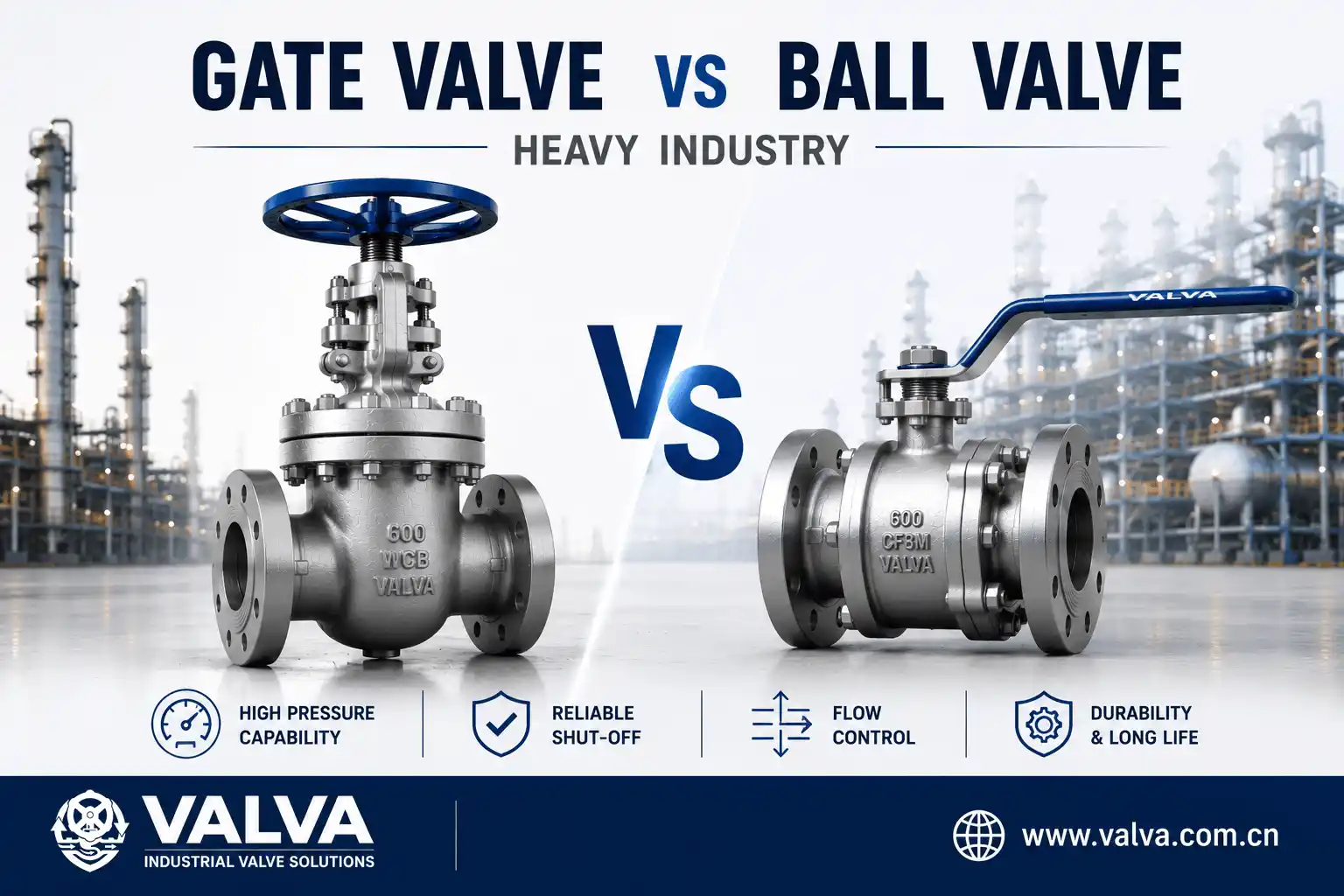
Direct Answer: In heavy industry applications, an industrial gate valve is preferred for large-diameter pipelines requiring low pressure drop and full-bore flow, while a ball valve is better suited for fast shutoff, high-cycle operation, and compact systems.
Industrial gate valve vs ball valve selection is not interchangeable in heavy-duty engineering systems. Therefore, engineers must evaluate pressure class, cycle frequency, fluid type, and maintenance strategy before finalizing valve selection. In large-scale oil, gas, chemical, and power plants, both valve types often coexist because they solve different operational problems. Consequently, choosing the wrong valve type can lead to unnecessary pressure loss, higher maintenance costs, or reduced system safety.
1. Flow Control Behavior: Isolation vs Quick Shutoff
An industrial gate valve operates as a linear isolation device. The gate moves vertically and fully exits the flow path when open, which creates a straight-through passage with minimal turbulence and extremely low pressure loss. However, it is not designed for frequent cycling or throttling.
In contrast, a ball valve uses a rotating spherical closure element. A 90-degree turn delivers instant shutoff. This makes ball valves ideal for emergency isolation and automated systems where fast response is critical.
Therefore, gate valves are optimized for long-term open/closed states, while ball valves are optimized for fast operational switching.
2. Pressure Drop and Flow Efficiency
Gate valves provide a full-bore flow path when fully open. This design minimizes friction loss and makes them ideal for long-distance pipelines transporting oil, gas, slurry, or steam.
Ball valves also offer full-bore designs, but the internal ball structure still introduces slightly higher turbulence compared to a fully retracted gate in large industrial sizes.
As a result, in ultra-large pipelines (especially above 10 inches), gate valves often outperform ball valves in maintaining long-term hydraulic efficiency.
3. Durability and Wear in Heavy Industry Conditions
In abrasive or high-pressure environments, industrial gate valves distribute sealing stress across wedge or slab seating surfaces. This allows them to handle high static pressure loads effectively.
However, frequent operation can cause seat wear due to sliding contact.
Ball valves, on the other hand, provide metal-to-seat or soft-seat rotational sealing, which reduces wear in frequent-cycle systems. But in extremely abrasive slurry conditions, the ball surface can suffer erosion over time.
Therefore:
- Gate valve → better for high-pressure static systems
- Ball valve → better for frequent operation systems
4. Maintenance and Operational Lifecycle
Gate valves generally require:
- Periodic stem lubrication
- Seat inspection
- Lower operating frequency
Ball valves typically require:
- Seal replacement after cycles
- Less torque during operation
- Easier automation integration
Therefore, ball valves reduce operator effort, while gate valves reduce long-term flow resistance and energy loss in large systems.
Industrial Selection Summary
- Choose industrial gate valves for:
- Large pipelines
- Low-frequency operation
- Minimum pressure drop systems
- Choose ball valves for:
- Fast shutoff requirements
- Automated process control
- Compact piping layouts
Frequently Asked Questions (FAQ)
Q1: Can a ball valve replace an industrial gate valve in large pipelines?
A: Not always. In large-diameter high-pressure pipelines, gate valves are often preferred because they create lower long-term pressure loss and better structural stability.
Q2: Which valve lasts longer in heavy industrial service?
A: Gate valves generally last longer in static isolation systems, while ball valves perform better in high-cycle applications but may wear faster in abrasive media.
Q3: Why are gate valves still used in modern plants?
A: Because they provide extremely low pressure drop, strong isolation capability, and excellent performance in large-scale oil, gas, and steam pipelines.
Related Articles
Technical & Design Insights
- How Industrial Gate Valve Works
- Industrial Gate Valve Uses
- Wedge Gate Valve Design Explained
- Wedge vs Slab Gate Valve
- Resilient vs Metal Seated Gate Valve
- High Pressure vs Standard Gate Valve
- Bolted Bonnet vs Welded Bonnet Gate Valve
- Cryogenic vs High Temperature Gate Valve
- Flange vs Threaded Connection Gate Valve
Selection & Sizing
Materials & Standards
Maintenance & Operation
Commercial & Purchasing Topics
- Where to Buy High Quality Industrial Gate Valves Wholesale
- Industrial Gate Valve Price List DN50 DN100
- Custom Industrial Gate Valve Manufacturer Oil Gas Pipeline
- Fast Delivery Industrial Gate Valve Supplier Bulk Order
- Electric Actuator Gate Valve Set Price
- Industrial Gate Valve Export Supplier CE ISO
- Low MOQ Industrial Gate Valve Supplier
- Industrial Gate Valve Bulk Warranty
- Industrial Gate Valve Shipping Lead Time