
Direct Answer
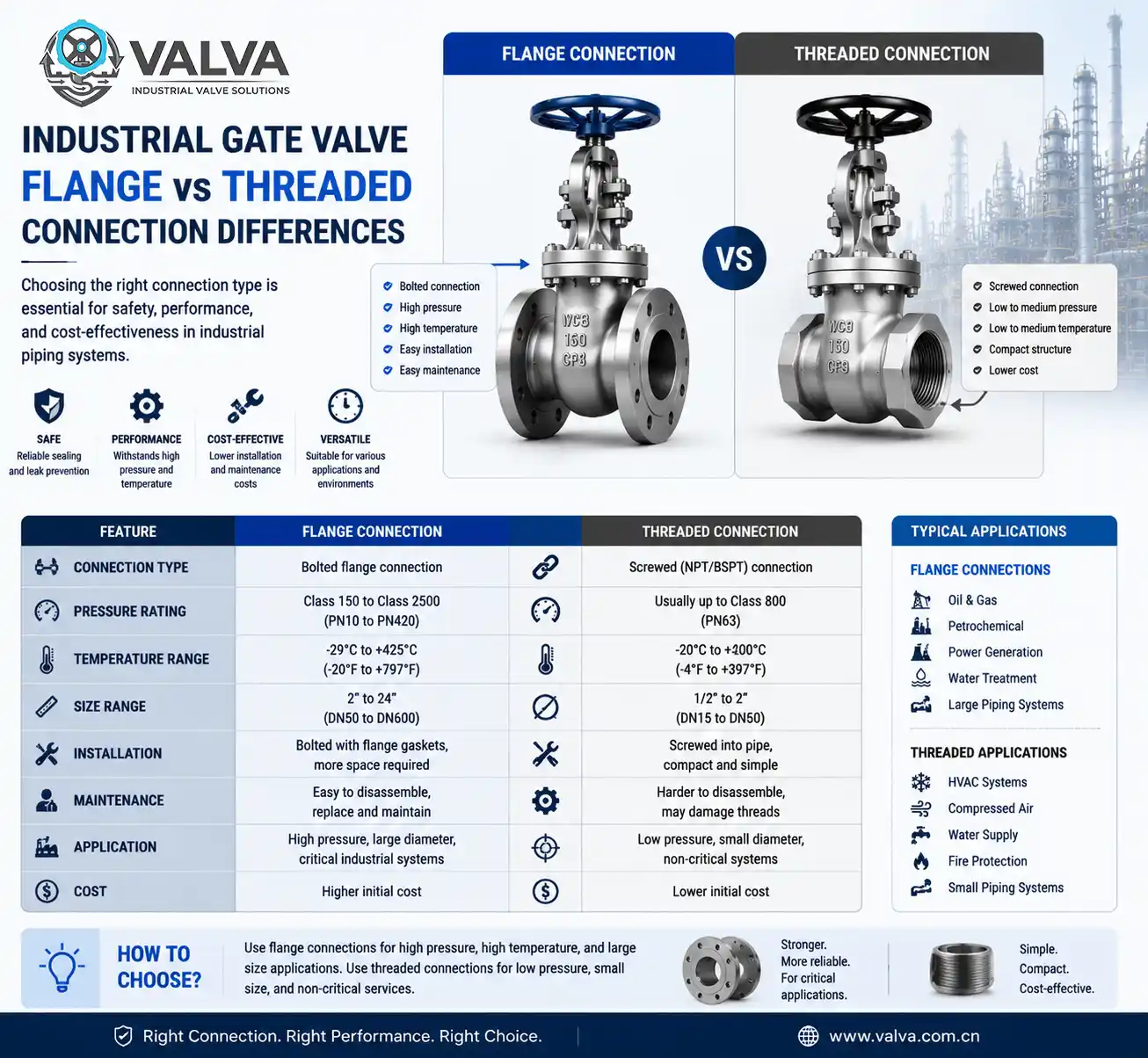
The main difference in a gate valve flange vs threaded connection lies in pressure capacity, pipe size suitability, and maintenance flexibility. Flanged connections are used in large-bore, high-pressure systems, while threaded connections are designed for small-bore, low-pressure utility pipelines. Therefore, engineers must select the connection type based on system stress, maintenance needs, and long-term leakage risk.
Introduction
Gate valve connection type directly affects pipeline safety and maintenance efficiency. Flanged and threaded designs serve different engineering scenarios. Therefore, selecting the correct connection method ensures stable sealing performance and reduces operational failure risks in industrial systems.
1. Flanged Connections: High-Strength Industrial Standard
Flanged gate valves use bolted joints with gasket sealing surfaces to connect directly to pipeline flanges.
Key characteristics include:
- High pressure resistance
- Large-bore suitability (typically >2 inches)
- Easy disassembly for maintenance
- Even load distribution across bolt circle
Therefore, flanged connections are the standard choice for refinery, oil, gas, and chemical pipeline systems.
2. Threaded Connections: Compact and Cost-Efficient Design
Threaded gate valves use internal or external pipe threads to connect directly to piping systems.
Key characteristics include:
- Compact installation size
- Low material cost
- Suitable for small-bore pipelines
- Fast installation in tight spaces
However, threaded connections are more sensitive to vibration, leakage risk, and thread wear. Therefore, they are mainly used in low-pressure utility systems.
3. Pressure and Mechanical Limitations
Flanged connections distribute mechanical stress across multiple bolts, making them suitable for high-pressure and high-temperature systems.
In contrast, threaded connections concentrate stress at the thread interface. Therefore, they are not recommended for heavy vibration, thermal cycling, or high-pressure applications.
4. Material Selection for Industrial Service
Severe industrial environments require advanced metallurgy for both connection types.
VALVA manufactures industrial gate valves using:
- 310S stainless steel (high-temperature resistance)
- 321 stainless steel (anti-sensitization welding stability)
- 2205 duplex steel (corrosion resistance)
Therefore, proper material selection improves sealing reliability for both flanged and threaded systems.
VALVA Structural Integrity Statement
All VALVA gate valves undergo strict hydrostatic pressure testing in accordance with API inspection standards. This ensures zero-leakage performance across both flanged and threaded connection types before shipment.
Related Articles
Technical & Design Insights
- How Industrial Gate Valve Works
- Industrial Gate Valve Uses
- Wedge Gate Valve Design Explained
- Wedge vs Slab Gate Valve
- Resilient vs Metal Seated Gate Valve
- High Pressure vs Standard Gate Valve
- Bolted Bonnet vs Welded Bonnet Gate Valve
- Cryogenic vs High Temperature Gate Valve
- Flange vs Threaded Connection Gate Valve
Selection & Sizing
Materials & Standards
Maintenance & Operation
Commercial & Purchasing Topics
- Where to Buy High Quality Industrial Gate Valves Wholesale
- Industrial Gate Valve Price List DN50 DN100
- Custom Industrial Gate Valve Manufacturer Oil Gas Pipeline
- Fast Delivery Industrial Gate Valve Supplier Bulk Order
- Electric Actuator Gate Valve Set Price
- Industrial Gate Valve Export Supplier CE ISO
- Low MOQ Industrial Gate Valve Supplier
- Industrial Gate Valve Bulk Warranty
- Industrial Gate Valve Shipping Lead Time