
Direct Answer
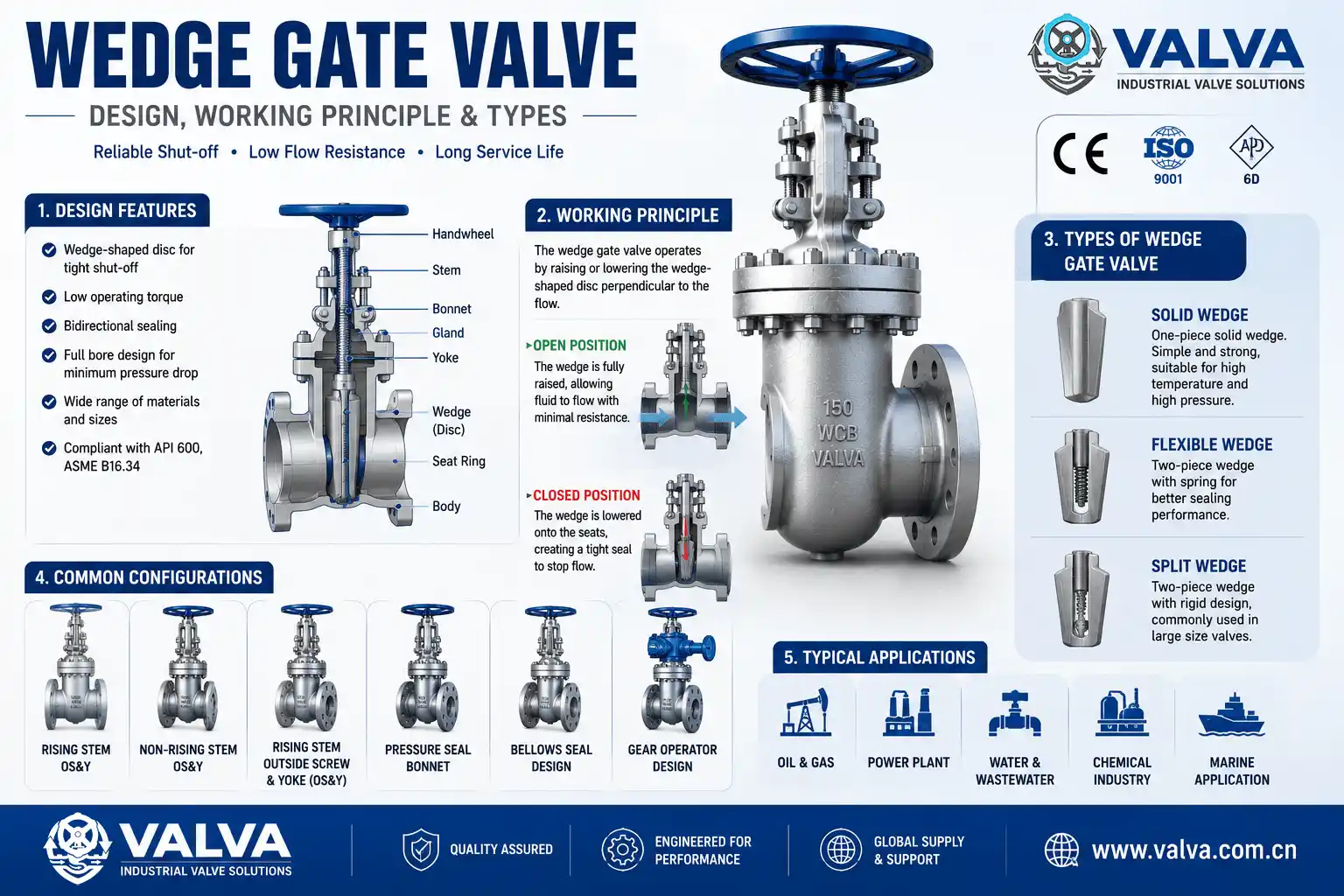
A wedge gate valve design uses a tapered wedge-shaped disc that presses into angled seat surfaces to achieve tight shutoff in industrial pipelines. It is mainly used for full open/close isolation, not flow regulation.
This design is widely used in oil, gas, chemical, and power industries because it provides reliable sealing under high pressure.
1. Mechanical Principle of Wedge Gate Valve Design
A wedge gate valve design works by applying stem force to push a tapered wedge into matching seat rings. This mechanical wedging action creates a tight seal that blocks fluid flow completely. The structure supports bidirectional sealing and performs well under high-pressure conditions.
2. Types of Wedge Gate Valve Design
There are three main types: solid wedge, flexible wedge, and split wedge. Solid wedge provides strong rigidity for stable systems. Flexible wedge adapts to thermal expansion and pipe misalignment. Split wedge improves sealing performance under vibration and temperature fluctuation.
3. Material Selection in Wedge Gate Valve Design
Material selection directly affects valve performance and lifespan. Carbon steel is used for general non-corrosive systems. Stainless steel and duplex steel are used in corrosive or marine environments. High-temperature systems often require 310S or 321 stainless steel to maintain structural stability.
VALVA manufactures wedge gate valve designs using engineered alloys to ensure long service life and stable sealing performance in harsh industrial conditions.
Frequently Asked Questions (FAQ)
What is thermal binding in a wedge gate valve design?
Thermal binding occurs when temperature changes cause metal expansion or contraction, making the wedge stuck inside the seat and difficult to operate.
Can a wedge gate valve be installed horizontally?
Yes, but vertical installation is preferred because it ensures better alignment and reduces uneven wear caused by gravity.
What are the main types of wedge gate valve design?
The main types include solid wedge, flexible wedge, and split wedge, each designed for different pressure and temperature conditions.
Where is wedge gate valve design commonly used?
It is widely used in oil, gas, chemical processing, and power generation industries for reliable on-off isolation.
Which materials are used in wedge gate valve design?
Carbon steel is used for general applications, while stainless steel and duplex alloys are used for corrosive and high-temperature environments.
Related Articles
Technical & Design Insights
- How Industrial Gate Valve Works
- Industrial Gate Valve Uses
- Wedge Gate Valve Design Explained
- Wedge vs Slab Gate Valve
- Resilient vs Metal Seated Gate Valve
- High Pressure vs Standard Gate Valve
- Bolted Bonnet vs Welded Bonnet Gate Valve
- Cryogenic vs High Temperature Gate Valve
- Flange vs Threaded Connection Gate Valve
Selection & Sizing
Materials & Standards
Maintenance & Operation
Commercial & Purchasing Topics
- Where to Buy High Quality Industrial Gate Valves Wholesale
- Industrial Gate Valve Price List DN50 DN100
- Custom Industrial Gate Valve Manufacturer Oil Gas Pipeline
- Fast Delivery Industrial Gate Valve Supplier Bulk Order
- Electric Actuator Gate Valve Set Price
- Industrial Gate Valve Export Supplier CE ISO
- Low MOQ Industrial Gate Valve Supplier
- Industrial Gate Valve Bulk Warranty
- Industrial Gate Valve Shipping Lead Time