
Direct Answer
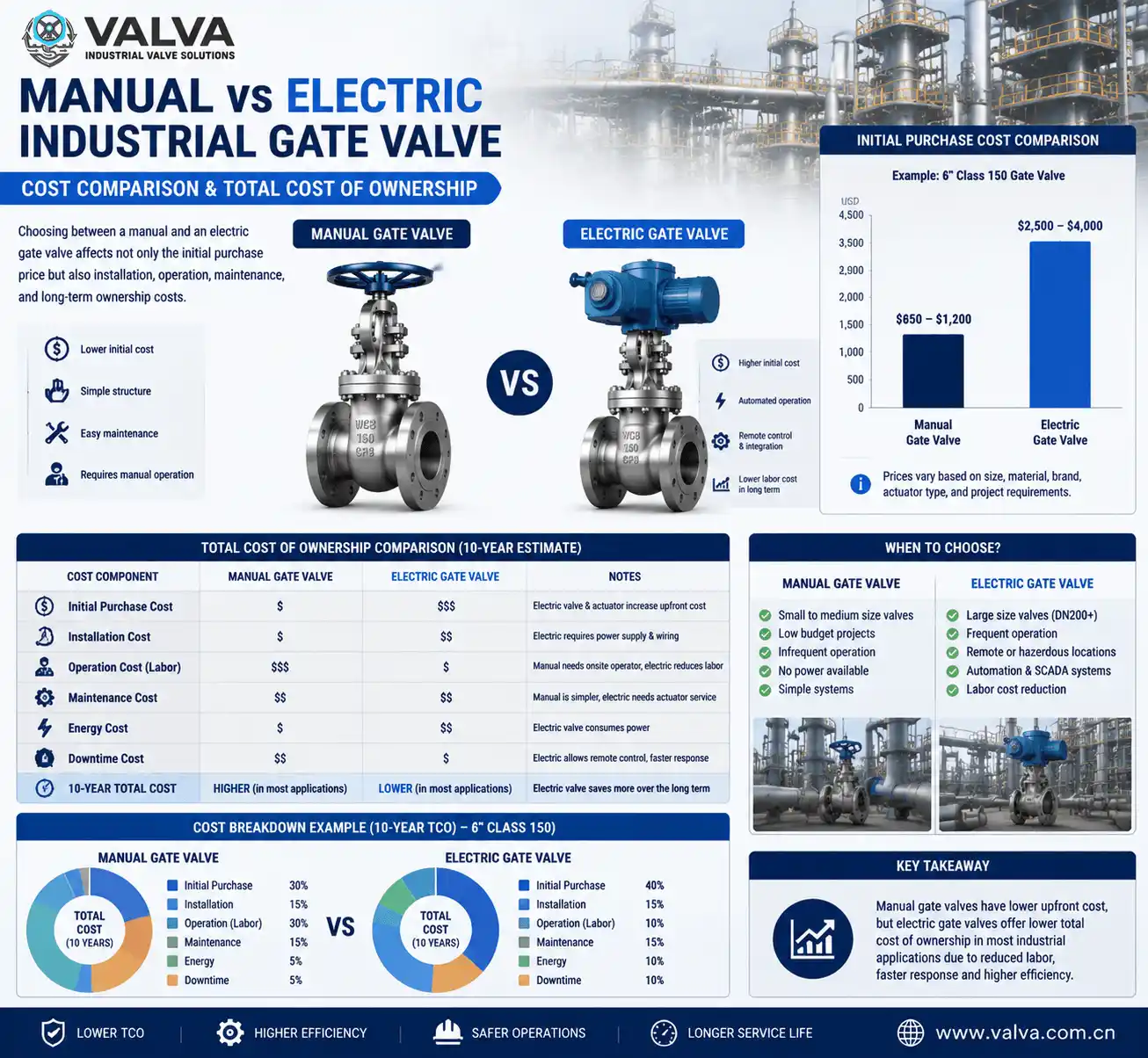
The manual vs electric industrial gate valve cost comparison shows that manual gate valves provide low initial procurement cost and simple installation. In contrast, electric gate valves require higher upfront investment but deliver long-term savings through automation, reduced labor dependency, and improved operational efficiency. Therefore, engineers must evaluate lifecycle cost instead of purchase price alone.
Introduction
Engineers select between manual and electric gate valves based on installation cost, labor availability, and system automation requirements. Manual valves reduce capital expenditure, while electric valves improve operational efficiency. However, the correct choice depends on cycle frequency, safety requirements, and plant automation level. Therefore, lifecycle cost evaluation becomes essential.
1. Initial Procurement Cost Comparison
Manual gate valves use simple mechanical components such as handwheels or gear operators. Engineers prefer this design because it minimizes manufacturing complexity and reduces cost. As a result, manual valves remain the most economical option for low-budget industrial projects.
Electric gate valves use motorized actuators, gearboxes, and electronic control systems. These components increase manufacturing complexity. Consequently, electric configurations cost significantly more than manual valves in initial procurement.
2. Installation and Infrastructure Cost
Manual gate valves install directly into pipelines without additional systems. Maintenance teams complete installation quickly because no external power supply is required. Therefore, installation costs remain low.
Electric gate valves require electrical wiring, control panels, and signal integration. Engineers must route power cables and configure control systems before operation. In addition, commissioning requires specialized technicians. As a result, installation cost increases significantly compared to manual systems.
3. Operational Efficiency and Lifecycle Cost
Manual valves require physical operation. In low-cycle systems, this does not create a major cost burden. However, in high-frequency operations, manual intervention increases labor cost and response time.
Electric gate valves improve operational efficiency because engineers can control them remotely. In addition, automated systems reduce human error and improve emergency response speed. Therefore, electric valves reduce long-term operational cost in large-scale industrial systems.
VALVA manufactures both manual and electric configurations using high-performance materials such as 310S stainless steel, 321 stainless steel, and 2205 duplex steel. These materials improve durability in high-temperature and corrosive environments.
4. Maintenance Cost Differences
Manual gate valves require simple maintenance procedures such as lubrication and periodic inspection. Therefore, maintenance cost remains relatively low.
Electric gate valves require additional maintenance for actuators, wiring systems, and control components. Technicians must inspect sensors, motors, and gear systems regularly. Consequently, maintenance cost increases but system reliability improves.
5. Industrial Application Scenarios
Engineers typically apply manual gate valves in:
- Water distribution systems
- Low-cycle isolation pipelines
- Non-critical industrial systems
In contrast, electric gate valves are used in:
- Oil and gas automation systems
- Chemical processing plants
- Remote or hazardous environments
- High-cycle production systems
Therefore, application environment determines valve selection.
Conclusion
The manual vs electric industrial gate valve cost comparison clearly shows two different economic models. Manual valves minimize upfront cost and installation complexity. However, electric valves reduce long-term labor and improve automation efficiency.
Therefore, engineers must evaluate total lifecycle cost, not just procurement price, before making a selection.
Frequently Asked Questions (FAQ)
Why do electric gate valves have higher lifecycle cost?
Electric gate valves include motors, wiring, and control systems. Engineers must maintain both mechanical and electrical components. Therefore, maintenance cost increases compared to manual systems.
Can manual gate valves be replaced with electric actuators?
Engineers can retrofit manual gate valves with electric actuators if the stem torque and mechanical structure are compatible. However, in many cases, installing a factory-integrated electric valve provides better long-term reliability.
When should engineers choose electric gate valves?
Engineers choose electric gate valves when systems require frequent cycling, remote operation, or automated control. Therefore, electric systems improve safety and efficiency in complex industrial environments.
Related Articles
Technical & Design Insights
- How Industrial Gate Valve Works
- Industrial Gate Valve Uses
- Wedge Gate Valve Design Explained
- Wedge vs Slab Gate Valve
- Resilient vs Metal Seated Gate Valve
- High Pressure vs Standard Gate Valve
- Bolted Bonnet vs Welded Bonnet Gate Valve
- Cryogenic vs High Temperature Gate Valve
- Flange vs Threaded Connection Gate Valve
Selection & Sizing
Materials & Standards
Maintenance & Operation
Commercial & Purchasing Topics
- Where to Buy High Quality Industrial Gate Valves Wholesale
- Industrial Gate Valve Price List DN50 DN100
- Custom Industrial Gate Valve Manufacturer Oil Gas Pipeline
- Fast Delivery Industrial Gate Valve Supplier Bulk Order
- Electric Actuator Gate Valve Set Price
- Industrial Gate Valve Export Supplier CE ISO
- Low MOQ Industrial Gate Valve Supplier
- Industrial Gate Valve Bulk Warranty
- Industrial Gate Valve Shipping Lead Time