
Direct Answer
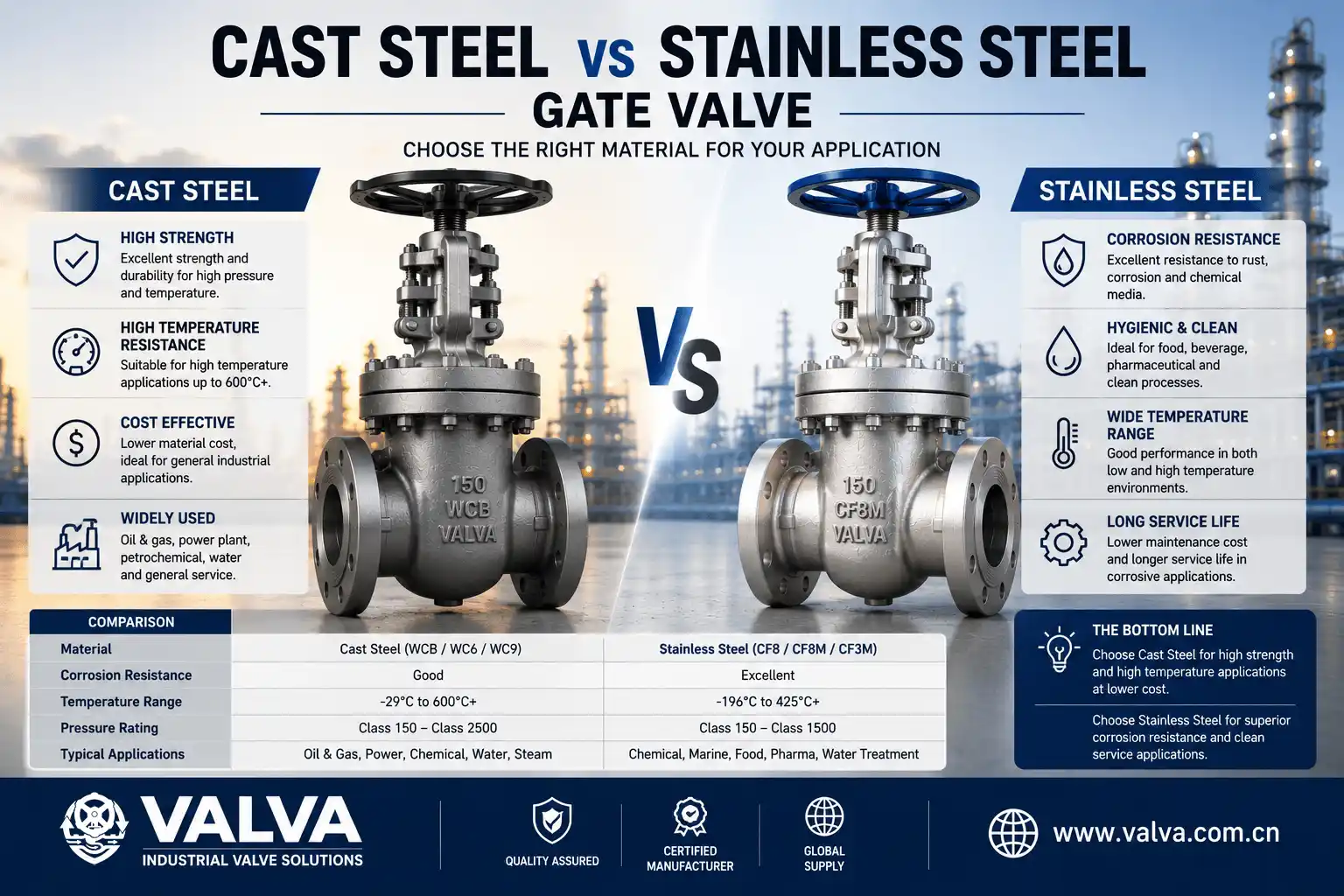
The cast steel vs stainless steel gate valve comparison shows that cast carbon steel provides high mechanical strength and cost efficiency for non-corrosive, high-pressure systems. In contrast, stainless steel delivers superior corrosion resistance and thermal stability for aggressive chemical and high-temperature environments. Therefore, engineers must select materials based on fluid chemistry and operating temperature rather than procurement cost alone.
Introduction
Engineers choose gate valve materials based on pressure, temperature, and corrosion risk. Cast steel performs well in general industrial utility systems. However, stainless steel performs better in corrosive or high-temperature environments. Therefore, selecting the correct material improves system safety and extends service life.
1. Cast Steel Gate Valve: Strength and Cost Efficiency
Cast carbon steel gate valves provide strong structural performance under high pressure conditions. Engineers often select ASTM A216 WCB because it delivers excellent tensile strength and mechanical durability.
In addition, cast steel valves reduce procurement costs significantly. Therefore, they remain widely used in oil, gas, and steam distribution systems where corrosion risk remains low.
However, cast steel lacks corrosion resistance. When exposed to moisture or chemical media, oxidation begins quickly. As a result, surface rust and internal degradation may occur over time.
2. Stainless Steel Gate Valve: Corrosion and Heat Resistance
Stainless steel gate valves provide superior resistance against chemical corrosion. Engineers rely on chromium-rich alloys to form a passive protective layer on the surface. This layer prevents rust formation and improves long-term stability.
Furthermore, stainless steel performs well in marine, chemical, and offshore environments. Therefore, engineers select stainless steel when systems involve aggressive fluids or corrosive media.
However, stainless steel increases procurement cost. Consequently, it is not always suitable for low-risk utility systems.
3. Temperature and Operational Limits
Cast steel gate valves perform reliably in temperatures up to approximately 425°C. Engineers use them in steam and general utility systems. However, oxidation risk increases at higher temperatures.
Stainless steel gate valves handle more demanding thermal environments. For example, 310S stainless steel supports extreme high-temperature operation up to 1100°C. In addition, 321 stainless steel improves welding stability in thermal cycling conditions.
Therefore, stainless steel becomes necessary in high-temperature industrial applications.
4. Application Selection Guidelines
Engineers select cast steel gate valves for:
- Steam distribution systems
- Oil and gas pipelines
- General industrial utilities
- Non-corrosive media
In contrast, engineers select stainless steel gate valves for:
- Chemical processing systems
- Marine and offshore environments
- High-temperature pipelines
- Corrosive fluid transport
Therefore, correct material selection depends on operating environment rather than cost alone.
5. Industrial Engineering Considerations
Engineers must evaluate fluid composition, pressure class, and temperature range before selecting valve materials. In addition, lifecycle cost plays an important role in procurement decisions.
VALVA manufactures both cast steel and stainless steel gate valves using advanced metallurgy, including 310S stainless steel, 321 stainless steel, and 2205 duplex steel. These materials improve durability and reduce maintenance requirements in demanding industrial environments.
Conclusion
The cast steel vs stainless steel gate valve comparison shows a clear engineering distinction. Cast steel provides strong mechanical performance at lower cost, while stainless steel delivers superior corrosion resistance and thermal stability.
Therefore, engineers must evaluate process conditions carefully to ensure long-term system reliability and cost efficiency.
Frequently Asked Questions (FAQ)
What is the main disadvantage of cast steel gate valves?
Cast steel gate valves lack corrosion resistance. When exposed to moisture or chemical media, they develop rust and surface degradation. Therefore, engineers avoid using cast steel in aggressive environments.
Why is stainless steel preferred in chemical industries?
Stainless steel contains chromium, which forms a passive protective layer. This layer prevents corrosion and improves resistance to chemical attack. Therefore, engineers use stainless steel in chemical and marine systems.
Can cast steel gate valves handle high temperatures?
Yes, cast steel gate valves perform well up to approximately 425°C. However, oxidation increases at higher temperatures. Therefore, stainless steel becomes necessary for extreme thermal applications.
Is stainless steel always better than cast steel?
No. Stainless steel is not always better. Engineers choose cast steel for cost efficiency in non-corrosive systems. Therefore, selection depends on operating conditions rather than material quality alone.
Related Articles
Technical & Design Insights
- How Industrial Gate Valve Works
- Industrial Gate Valve Uses
- Wedge Gate Valve Design Explained
- Wedge vs Slab Gate Valve
- Resilient vs Metal Seated Gate Valve
- High Pressure vs Standard Gate Valve
- Bolted Bonnet vs Welded Bonnet Gate Valve
- Cryogenic vs High Temperature Gate Valve
- Flange vs Threaded Connection Gate Valve
Selection & Sizing
Materials & Standards
Maintenance & Operation
Commercial & Purchasing Topics
- Where to Buy High Quality Industrial Gate Valves Wholesale
- Industrial Gate Valve Price List DN50 DN100
- Custom Industrial Gate Valve Manufacturer Oil Gas Pipeline
- Fast Delivery Industrial Gate Valve Supplier Bulk Order
- Electric Actuator Gate Valve Set Price
- Industrial Gate Valve Export Supplier CE ISO
- Low MOQ Industrial Gate Valve Supplier
- Industrial Gate Valve Bulk Warranty
- Industrial Gate Valve Shipping Lead Time