
Direct Answer
Industrial gate valve pressure rating standards define the maximum allowable working pressure a valve can safely handle at specific temperatures. The most widely used systems include ASME Class ratings, EN PN ratings, and API 598 testing standards. Therefore, engineers must evaluate both pressure and temperature together. Consequently, correct selection ensures safe long-term pipeline operation.
The industrial gate valve pressure rating standards determine how much pressure a valve can withstand under real operating conditions.
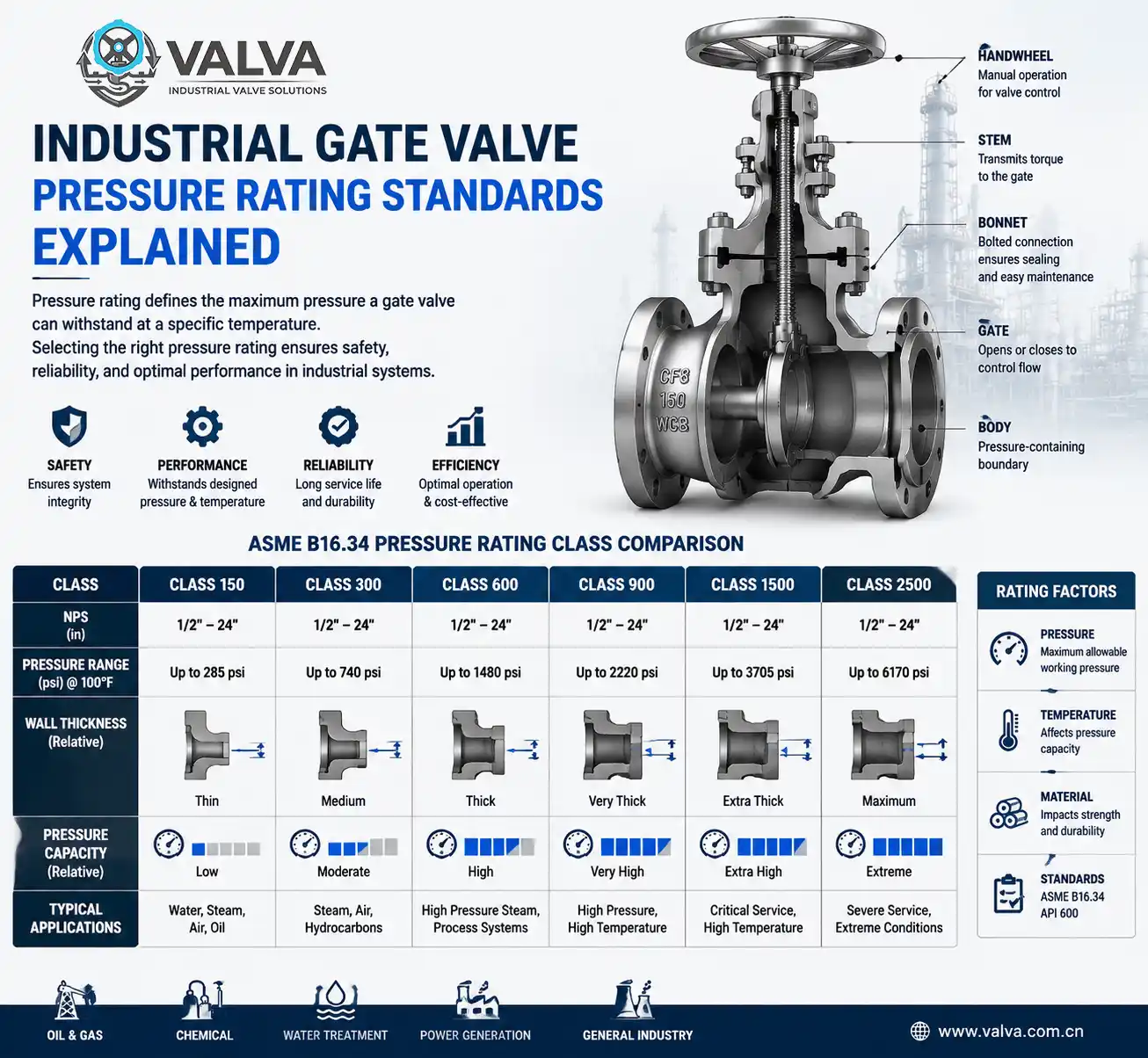
1. ASME B16.34 Industrial Gate Valve Pressure Rating Standards
The ASME B16.34 standard defines industrial gate valve pressure rating standards for Class 150, 300, 600, 900, 1500, and 2500 systems.
Each class represents a pressure–temperature curve instead of a fixed value. Therefore, engineers must always check material-specific charts. For example, Class 300 carbon steel performs differently from stainless steel under the same temperature.
2. EN PN Industrial Gate Valve Pressure Rating Standards
The EN 1092-1 system defines industrial gate valve pressure rating standards using PN values such as PN10, PN16, PN25, and PN40.
PN ratings are based on bar at 20°C. However, PN16 does not equal ASME Class 150. Therefore, engineers must avoid direct conversion without verification.
3. API 598 Testing and Validation Standards
API 598 does not define pressure classes. Instead, it validates industrial gate valve pressure rating standards through hydrostatic testing.
Valves are tested at:
- 1.5× shell pressure
- 1.1× closure pressure
Therefore, API 598 ensures real-world safety performance before shipment.
Frequently Asked Questions
What are industrial gate valve pressure rating standards?
They define the maximum allowable working pressure of a valve under different temperature conditions using ASME, PN, and API systems.
Why does pressure rating change with temperature?
Because metals lose strength at high temperatures, reducing allowable working pressure.
What is the difference between ASME and PN systems?
ASME uses pressure classes, while PN uses bar-based metric ratings. They are not directly interchangeable.
Does API 598 define pressure ratings?
No. It defines testing procedures, not pressure classes.
Related Articles
Technical & Design Insights
- How Industrial Gate Valve Works
- Industrial Gate Valve Uses
- Wedge Gate Valve Design Explained
- Wedge vs Slab Gate Valve
- Resilient vs Metal Seated Gate Valve
- High Pressure vs Standard Gate Valve
- Bolted Bonnet vs Welded Bonnet Gate Valve
- Cryogenic vs High Temperature Gate Valve
- Flange vs Threaded Connection Gate Valve
Selection & Sizing
Materials & Standards
Maintenance & Operation
Commercial & Purchasing Topics
- Where to Buy High Quality Industrial Gate Valves Wholesale
- Industrial Gate Valve Price List DN50 DN100
- Custom Industrial Gate Valve Manufacturer Oil Gas Pipeline
- Fast Delivery Industrial Gate Valve Supplier Bulk Order
- Electric Actuator Gate Valve Set Price
- Industrial Gate Valve Export Supplier CE ISO
- Low MOQ Industrial Gate Valve Supplier
- Industrial Gate Valve Bulk Warranty
- Industrial Gate Valve Shipping Lead Time