
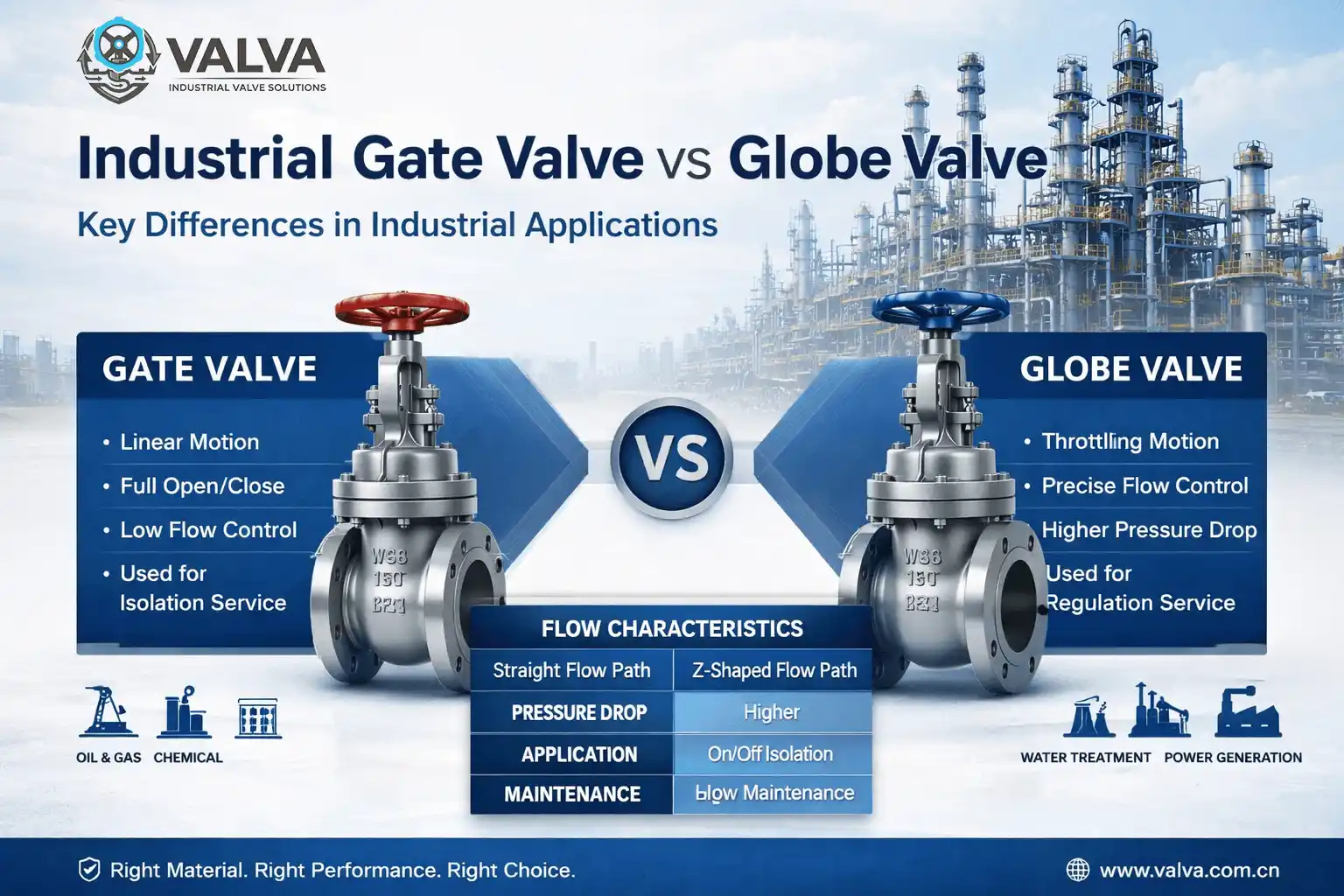
Direct Answer
The primary difference in an industrial gate valve vs globe valve comparison is that gate valves are designed for full shutoff isolation with minimal pressure drop, while globe valves are designed for precise flow regulation through controlled throttling. Therefore, gate valves are used for on/off service, and globe valves are used for flow control applications in industrial pipeline systems.
The industrial gate valve vs globe valve comparison is essential in pipeline engineering because these two valve types serve completely different functions. Gate valves are designed for full open and full close isolation, while globe valves are engineered for precise flow regulation. Therefore, engineers must not interchange them in system design. Gate valves minimize pressure loss through a straight flow path, whereas globe valves intentionally create resistance to control flow. As a result, selecting the correct valve type directly impacts system efficiency, pressure stability, and long-term operational safety.
1. Flow Function: Isolation vs Regulation in Industrial Gate Valve vs Globe Valve Design
The main difference in an industrial gate valve vs globe valve system lies in flow behavior. A gate valve operates strictly in two states: fully open or fully closed. Its wedge lifts completely out of the flow path, creating a straight-through channel with minimal resistance. However, using it for throttling leads to vibration, cavitation, and seat damage.
In contrast, a globe valve is designed for continuous throttling. Its plug moves against the flow direction, allowing controlled restriction of fluid volume. This makes it suitable for applications requiring frequent adjustment of flow rate.
2. Pressure Drop Characteristics in Industrial Gate Valve vs Globe Valve Systems
Another major distinction is pressure drop behavior.
A gate valve provides a straight-line flow path and therefore generates very low friction loss. This makes it ideal for isolation service and long-distance pipelines.
A globe valve forces fluid to change direction inside the valve body. This increases turbulence and pressure loss but enables precise flow control.
3. Structural Design Differences in Industrial Gate Valve vs Globe Valve Applications
A gate valve uses a vertical wedge movement for full isolation. A globe valve uses a plug moving perpendicular to flow for regulation. Because of this, gate valves prioritize low resistance, while globe valves prioritize controllability.
4. Material Selection for Industrial Gate Valve vs Globe Valve Performance
Gate valves and globe valves both require material selection based on pressure, temperature, and corrosion conditions. However, globe valves experience higher erosion due to throttling.
VALVA provides 310S heat-resistant steel, 321 stainless steel, and 2205 duplex steel solutions for high-demand industrial applications.
Frequently Asked Questions (FAQ)
What is the main difference between an industrial gate valve and a globe valve?
The main difference is that a gate valve is designed for full open or full close isolation, while a globe valve is designed for precise flow regulation through throttling. Gate valves minimize pressure loss, while globe valves intentionally create resistance for control purposes.
Can a gate valve be used for flow control?
No, a gate valve should not be used for flow control. Partial opening causes vibration, internal erosion, and seat damage. Gate valves are strictly designed for isolation service only.
Why does a globe valve create higher pressure drop than a gate valve?
A globe valve forces fluid to change direction inside the body, creating turbulence and higher resistance. A gate valve provides a straight-through flow path, resulting in minimal pressure drop.
Which valve is better for industrial isolation applications?
Gate valves are better for industrial isolation because they provide a full-bore straight flow path with minimal friction loss and stable shutoff performance.
Can gate valves and globe valves be used interchangeably?
No, they cannot be used interchangeably. Each valve is engineered for a different function—gate valves for isolation and globe valves for flow regulation. Substituting them can lead to system inefficiency and mechanical failure.
VALVA Engineering Assurance
All valves undergo hydrostatic and seat leakage testing to ensure compliance with international standards before shipment.
Related Articles
Technical & Design Insights
- How Industrial Gate Valve Works
- Industrial Gate Valve Uses
- Wedge Gate Valve Design Explained
- Wedge vs Slab Gate Valve
- Resilient vs Metal Seated Gate Valve
- High Pressure vs Standard Gate Valve
- Bolted Bonnet vs Welded Bonnet Gate Valve
- Cryogenic vs High Temperature Gate Valve
- Flange vs Threaded Connection Gate Valve
Selection & Sizing
Materials & Standards
Maintenance & Operation
Commercial & Purchasing Topics
- Where to Buy High Quality Industrial Gate Valves Wholesale
- Industrial Gate Valve Price List DN50 DN100
- Custom Industrial Gate Valve Manufacturer Oil Gas Pipeline
- Fast Delivery Industrial Gate Valve Supplier Bulk Order
- Electric Actuator Gate Valve Set Price
- Industrial Gate Valve Export Supplier CE ISO
- Low MOQ Industrial Gate Valve Supplier
- Industrial Gate Valve Bulk Warranty
- Industrial Gate Valve Shipping Lead Time