
Direct Answer
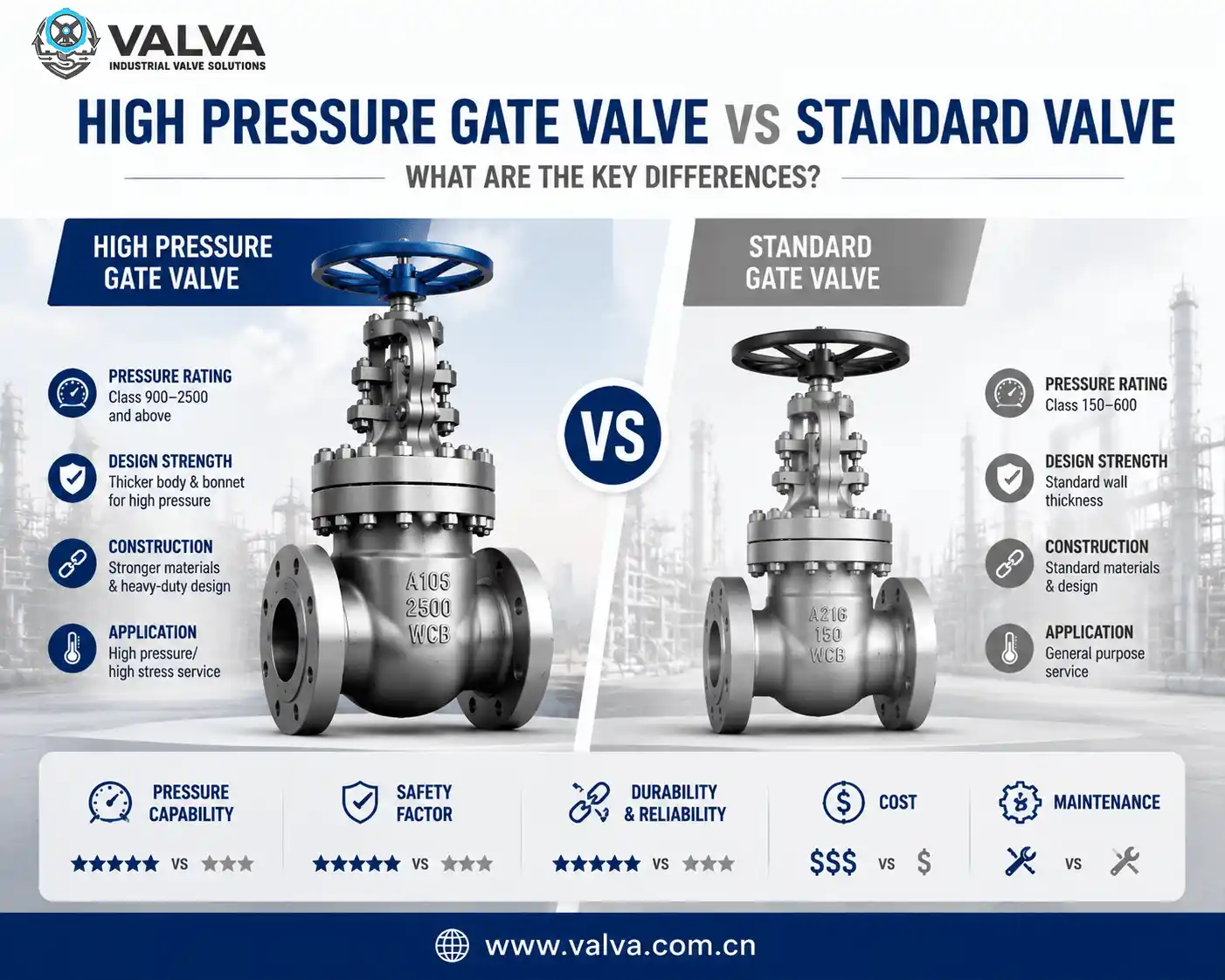
When comparing a high pressure gate valve with a standard industrial gate valve, engineers evaluate pressure ratings, wall thickness, body construction, sealing performance, material selection, and testing requirements.
Standard gate valves are commonly used in low- and medium-pressure services such as water distribution, utility systems, and general industrial pipelines. In contrast, high pressure gate valves are specifically engineered to withstand elevated operating pressures, severe thermal cycles, and demanding process conditions.
As operating pressure increases, valve bodies experience significantly higher mechanical stress. Therefore, manufacturers use thicker walls, stronger materials, reinforced sealing systems, and more rigorous testing procedures to ensure safe operation.
Ultimately, selecting the correct valve depends on operating pressure, process media, temperature conditions, and applicable industry standards.
Why High Pressure Gate Valves Require Different Designs
Although both valve types perform isolation functions, high-pressure applications create engineering challenges that standard valves are not designed to handle.
As pressure increases, fluid forces act directly on the valve body, seats, bonnet, and stem components. Consequently, valve manufacturers must strengthen these critical areas to prevent deformation, leakage, and premature failure.
Furthermore, pressure fluctuations, thermal cycling, and aggressive media can accelerate wear and increase maintenance requirements.
For these reasons, high pressure gate valves use different body designs, sealing technologies, and materials than standard gate valves.
Quick Selection Guide
Choose a Standard Gate Valve If:
- Operating pressures remain relatively low
- Water distribution systems are involved
- Utility applications require simple isolation
- Process conditions are not severe
- Cost efficiency is a primary concern
Choose a High Pressure Gate Valve If:
- Operating pressure exceeds 50 bar
- Severe pressure fluctuations occur
- High-temperature service is involved
- Process media are corrosive or abrasive
- Maximum reliability and safety are required
In many industrial facilities, both valve types operate within different sections of the same process system.
High Pressure Gate Valve vs Standard Valve Comparison
| Performance Factor | Standard Gate Valve | High Pressure Gate Valve |
|---|---|---|
| Typical Pressure Class | Class 150–300 | Class 600–2500 |
| Body Construction | Standard cast body | Reinforced cast or forged body |
| Wall Thickness | Moderate | Significantly thicker |
| Seat Design | Standard metal or soft seat | Hard-faced metal seat |
| Material Requirements | Carbon steel or standard stainless steel | High-strength alloys |
| Testing Requirements | Standard pressure testing | Enhanced pressure verification |
| Maintenance Requirements | Moderate | Critical inspection schedules |
| Typical Applications | Water, utilities, general industry | Refineries, petrochemicals, power plants |
Pressure Ratings and Structural Design
One of the most important differences between a high pressure gate valve and a standard valve is pressure classification.
Industry standards such as ASME B16.34 define pressure classes that establish allowable operating limits.
Standard industrial systems often use:
- Class 150
- Class 300
However, demanding process systems may require:
- Class 600
- Class 900
- Class 1500
- Class 2500
As pressure ratings increase, manufacturers strengthen valve bodies by increasing wall thickness and utilizing forged steel or specialized cast alloys.
Consequently, high pressure valves can withstand significantly greater mechanical loads while maintaining structural integrity.
Sealing Performance Under High Pressure
Sealing performance becomes increasingly important as operating pressure rises.
Standard gate valves typically perform well under moderate conditions. However, elevated pressure can increase seat loading and accelerate wear.
To address this challenge, high pressure gate valves frequently utilize:
- Metal-to-metal seating
- Stellite hard-facing
- Precision-machined sealing surfaces
- Enhanced stem sealing systems
Furthermore, manufacturers commonly perform hydrostatic testing according to API 598 requirements.
These tests verify shell integrity and seat tightness before valves enter service.
As a result, properly designed high pressure gate valves maintain reliable shutoff even under severe operating conditions.
Material Selection for High Pressure Applications
Material selection often determines long-term reliability.
For standard industrial services, carbon steel and conventional stainless steels frequently provide adequate performance.
However, high-pressure systems often expose valves to:
- Elevated temperatures
- Corrosive chemicals
- Thermal cycling
- Mechanical stress
Consequently, engineers may specify advanced materials such as:
2205 Duplex Stainless Steel
Offers excellent corrosion resistance and high mechanical strength.
321 Stainless Steel
Provides improved resistance to intergranular corrosion and elevated-temperature service.
310S Stainless Steel
Maintains oxidation resistance and structural stability at temperatures approaching 1100°C.
Therefore, selecting the proper material is essential for safe and reliable operation.
Industry Standards for High Pressure Gate Valves
Several international standards govern valve design and testing.
Common references include:
- API 600
- API 602
- API 598
- ASME B16.34
- ASME B16.10
- ISO 5208
These standards establish requirements for:
- Pressure ratings
- Materials
- Dimensions
- Testing procedures
- Performance verification
Compliance improves safety, reliability, and long-term operational performance.
Real-World Applications
Oil and Gas Facilities
High-pressure production systems require valves capable of handling elevated pressures and aggressive media.
Petrochemical Plants
Process units frequently utilize high pressure gate valves to isolate critical equipment safely.
Power Generation Systems
Steam systems often combine high pressure and elevated temperatures, requiring robust valve construction.
Chemical Processing Facilities
Corrosive media and severe operating conditions demand advanced materials and reinforced sealing systems.
Advantages and Limitations
High Pressure Gate Valve Advantages
- Suitable for elevated-pressure service
- Enhanced structural strength
- Improved sealing performance
- Compatible with severe operating conditions
- Longer service life in demanding applications
High Pressure Gate Valve Limitations
- Higher initial cost
- Increased weight
- More complex manufacturing requirements
- Stricter maintenance procedures
Standard Gate Valve Advantages
- Lower procurement cost
- Simpler maintenance
- Suitable for general industrial service
- Widely available
Standard Gate Valve Limitations
- Limited pressure capability
- Reduced suitability for severe service
- Lower resistance to extreme operating conditions
Key Takeaways
A high pressure gate valve differs significantly from a standard valve in terms of pressure rating, body construction, sealing technology, material selection, and testing requirements.
For general industrial services, standard gate valves often provide reliable and economical performance.
However, when operating pressures exceed conventional limits, engineers should specify high pressure gate valves designed to withstand elevated stress and demanding process conditions.
Ultimately, successful valve selection depends on pressure requirements, operating temperature, media characteristics, maintenance considerations, and applicable industry standards.
Frequently Asked Questions
Can a standard Class 150 gate valve be used in a high-pressure system?
No. Standard Class 150 valves are designed for lower-pressure applications and may not provide adequate structural strength for high-pressure service.
What is the difference between API 600 and API 602?
API 600 primarily covers larger cast steel gate valves, while API 602 focuses on compact forged steel valves commonly used in high-pressure applications.
How can thermal binding be prevented in high-pressure gate valves?
Engineers often specify flexible wedge designs that accommodate thermal expansion and reduce the risk of binding during temperature fluctuations.
Why do high-pressure valves use hard-faced seats?
Hard-faced seating surfaces improve wear resistance, sealing reliability, and service life under severe operating conditions.
Related Articles
Technical & Design Insights
- How Industrial Gate Valve Works
- Industrial Gate Valve Uses
- Wedge Gate Valve Design Explained
- Wedge vs Slab Gate Valve
- Resilient vs Metal Seated Gate Valve
- High Pressure vs Standard Gate Valve
- Bolted Bonnet vs Welded Bonnet Gate Valve
- Cryogenic vs High Temperature Gate Valve
- Flange vs Threaded Connection Gate Valve
Selection & Sizing
Materials & Standards
Maintenance & Operation
Commercial & Purchasing Topics
- Where to Buy High Quality Industrial Gate Valves Wholesale
- Industrial Gate Valve Price List DN50 DN100
- Custom Industrial Gate Valve Manufacturer Oil Gas Pipeline
- Fast Delivery Industrial Gate Valve Supplier Bulk Order
- Electric Actuator Gate Valve Set Price
- Industrial Gate Valve Export Supplier CE ISO
- Low MOQ Industrial Gate Valve Supplier
- Industrial Gate Valve Bulk Warranty
- Industrial Gate Valve Shipping Lead Time