Direct Answer
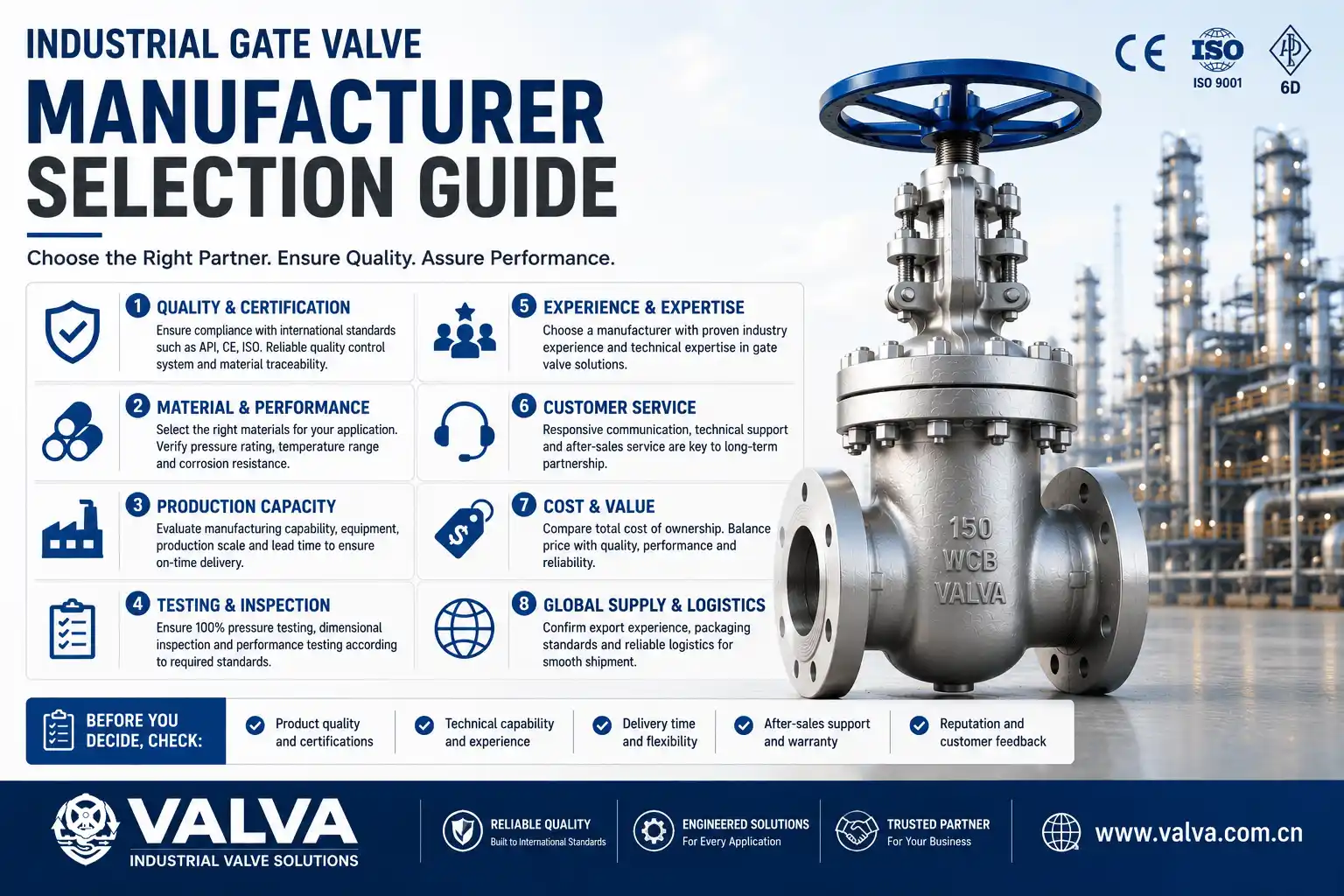
Selecting the right industrial gate valve manufacturer requires evaluating manufacturing capability, quality-control systems, testing procedures, material traceability, certifications, and industry experience.
While brand recognition may influence purchasing decisions, long-term valve reliability depends far more on engineering standards, production quality, and testing performance than on marketing visibility. Therefore, engineers and procurement teams should focus on objective technical criteria when comparing manufacturers.
Why Industrial Gate Valve Manufacturer Selection Matters
Choosing an industrial gate valve manufacturer directly affects system reliability, maintenance costs, operational safety, and service life.
Industrial gate valves often operate in demanding environments involving high pressure, corrosive media, temperature fluctuations, and continuous operation. Consequently, manufacturing quality plays a critical role in ensuring long-term performance.
A poorly manufactured valve may lead to:
- Leakage and sealing failures
- Unplanned shutdowns
- Increased maintenance costs
- Reduced operational efficiency
- Safety and environmental risks
As a result, selecting a qualified industrial gate valve manufacturer should be a key part of every procurement strategy.
Industrial Gate Valve Manufacturer Evaluation Checklist
When evaluating potential suppliers, engineers typically review several critical factors.
Consider a Manufacturer If It Provides:
- Material Test Reports (MTRs)
- Hydrostatic test documentation
- API-compliant manufacturing procedures
- Traceable quality-control systems
- International certifications
- Technical engineering support
Investigate Further If:
- Material traceability is unclear
- Testing records are unavailable
- Production is heavily outsourced
- Certification details are missing
- Engineering support is limited
Furthermore, manufacturers that maintain strong production control often deliver more consistent quality and shorter lead times.
How an Industrial Gate Valve Manufacturer Controls Quality
Quality control remains one of the most important indicators of manufacturer reliability.
A qualified industrial gate valve manufacturer typically implements inspection procedures throughout the entire production process, including:
- Raw material verification
- Casting inspection
- Dimensional measurement
- Machining inspection
- Assembly verification
- Final pressure testing
In addition, many industrial gate valves undergo hydrostatic shell testing and seat leakage testing before shipment.
These inspections help verify sealing integrity, dimensional accuracy, and pressure containment capability.
Industrial Gate Valve Manufacturer Material Capabilities
Material selection significantly influences valve performance and service life.
Different operating environments require different material solutions.
Carbon Steel
Carbon steel remains a common choice for general industrial applications involving water, steam, oil, and non-corrosive media.
321 Stainless Steel
321 stainless steel provides improved resistance to intergranular corrosion and elevated-temperature service.
2205 Duplex Stainless Steel
2205 Duplex stainless steel offers excellent corrosion resistance and high mechanical strength, making it suitable for aggressive process environments.
310S Stainless Steel
310S stainless steel is frequently specified for high-temperature applications because of its oxidation resistance and thermal stability.
Therefore, a reliable industrial gate valve manufacturer should offer a broad range of material options to support different operating conditions.
Industrial Gate Valve Manufacturer Certifications and Standards
International standards provide important guidance for valve design, manufacturing, and testing.
A qualified industrial gate valve manufacturer typically produces valves according to standards such as:
- API 600
- API 602
- API 598
- ASME B16.34
- ASME B16.10
- ISO 5208
Compliance with these standards helps ensure that products meet recognized industry requirements for performance and safety.
Furthermore, certification demonstrates a commitment to consistent manufacturing quality.
How to Compare Industrial Gate Valve Manufacturers
Comparing manufacturers requires more than reviewing product catalogs.
Engineers often evaluate:
- Production capacity
- Quality-control procedures
- Material traceability
- Pressure testing methods
- Industry certifications
- Engineering support capabilities
- Delivery performance
Moreover, reviewing actual testing documentation and Material Test Reports can provide valuable insight into manufacturing consistency.
For this reason, many procurement teams prioritize technical documentation over marketing materials during supplier evaluations.
Real-World Applications
An experienced industrial gate valve manufacturer should understand the requirements of different industries and operating environments.
Oil and Gas Facilities
Oil and gas systems require reliable isolation valves capable of handling pressure fluctuations and demanding operating conditions.
Petrochemical Plants
Petrochemical facilities often specify advanced materials and enhanced sealing systems to improve reliability.
Power Generation Systems
Power plants frequently require valves that can withstand elevated temperatures and long-term thermal cycling.
Water Treatment Facilities
Water treatment systems generally prioritize operational reliability, maintenance accessibility, and lifecycle cost efficiency.
Consequently, industry experience remains an important consideration when evaluating manufacturers.
Industry References
The following organizations provide internationally recognized engineering standards used throughout the valve industry:
- API (American Petroleum Institute)
- ASME (American Society of Mechanical Engineers)
- ISO (International Organization for Standardization)
These standards help establish requirements for design, manufacturing, inspection, and testing.
Advantages of Working with a Qualified Industrial Gate Valve Manufacturer
Working with an experienced manufacturer can provide several benefits:
- Consistent product quality
- Reliable material traceability
- Comprehensive testing procedures
- Technical engineering support
- Improved operational safety
- Reduced lifecycle costs
In addition, manufacturers with strong quality systems can help minimize operational risks and improve long-term reliability.
Key Takeaways
Selecting the right industrial gate valve manufacturer requires evaluating manufacturing capability, quality-control systems, testing standards, certifications, material options, and industry experience.
Rather than focusing solely on brand recognition, engineers should prioritize objective technical criteria that directly affect performance and reliability.
Ultimately, the most suitable industrial gate valve manufacturer is the one that consistently delivers products that meet the requirements of the intended application while maintaining strong quality assurance and technical support.
Frequently Asked Questions
What certifications should an industrial gate valve manufacturer have?
Many manufacturers produce valves according to standards such as API 600, API 602, API 598, ASME B16.34, and ISO 5208. Required certifications depend on the application and project specifications.
Why are Material Test Reports important?
Material Test Reports provide traceability and verification of material composition and mechanical properties, helping ensure compliance with project requirements.
How can valve quality be verified before installation?
Engineers typically review hydrostatic testing records, inspection reports, dimensional verification documents, and material certifications before accepting valves.
Does a larger manufacturer always provide better quality?
No. Product quality depends on manufacturing processes, quality-control systems, engineering standards, and testing procedures rather than company size alone.
Related Articles
Technical & Design Insights
- How Industrial Gate Valve Works
- Industrial Gate Valve Uses
- Wedge Gate Valve Design Explained
- Wedge vs Slab Gate Valve
- Resilient vs Metal Seated Gate Valve
- High Pressure vs Standard Gate Valve
- Bolted Bonnet vs Welded Bonnet Gate Valve
- Cryogenic vs High Temperature Gate Valve
- Flange vs Threaded Connection Gate Valve
Selection & Sizing
Materials & Standards
Maintenance & Operation
Commercial & Purchasing Topics
- Where to Buy High Quality Industrial Gate Valves Wholesale
- Industrial Gate Valve Price List DN50 DN100
- Custom Industrial Gate Valve Manufacturer Oil Gas Pipeline
- Fast Delivery Industrial Gate Valve Supplier Bulk Order
- Electric Actuator Gate Valve Set Price
- Industrial Gate Valve Export Supplier CE ISO
- Low MOQ Industrial Gate Valve Supplier
- Industrial Gate Valve Bulk Warranty
- Industrial Gate Valve Shipping Lead Time