Direct Answer
When comparing a bolted bonnet vs welded bonnet industrial gate valve, engineers evaluate maintenance requirements, leakage risk, operating pressure, thermal cycling conditions, and long-term serviceability.
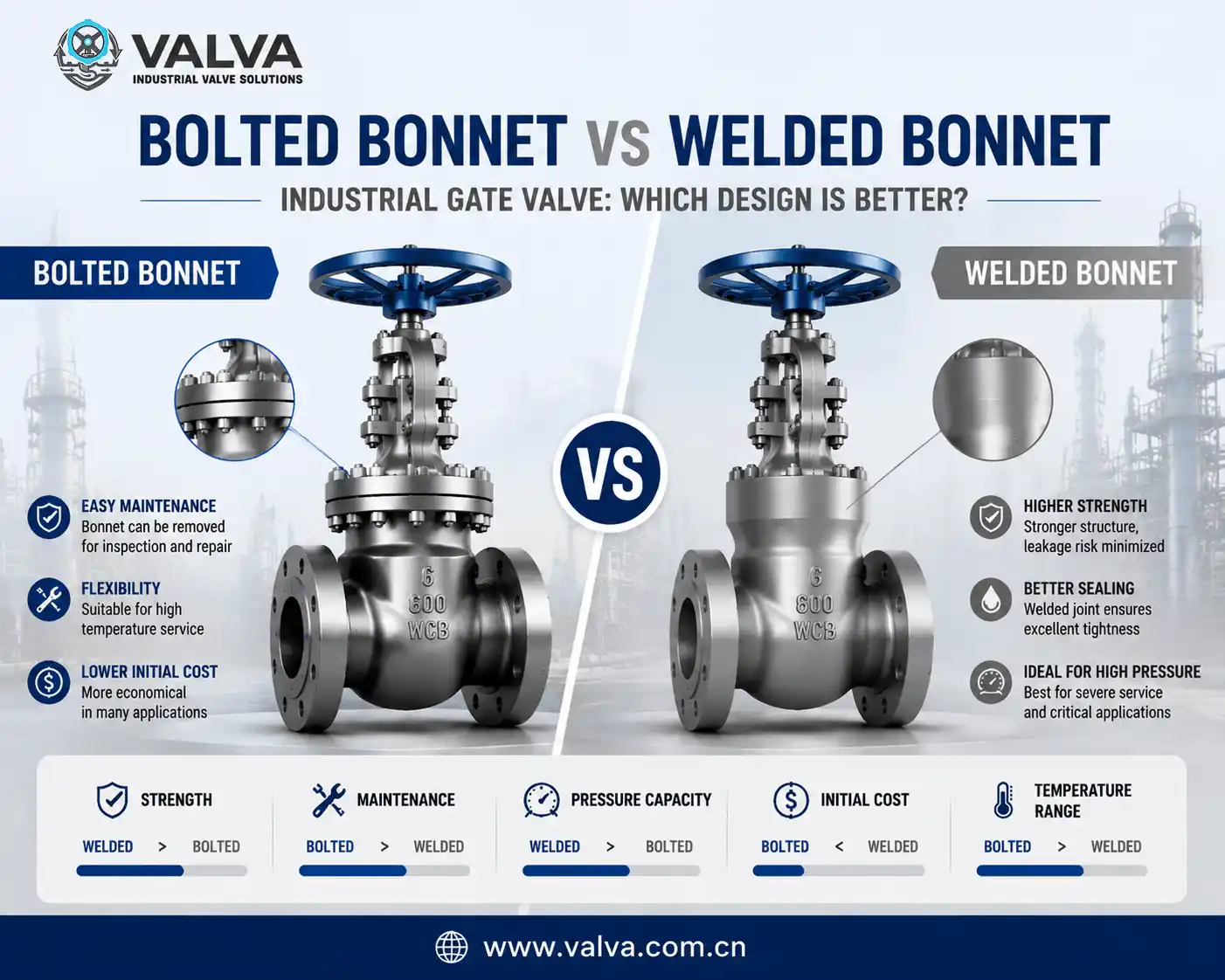
Bolted bonnet gate valves use a bolted body-to-bonnet connection sealed with a gasket. This design allows technicians to access internal components for inspection, maintenance, and repair without cutting the valve body.
Welded bonnet gate valves use a permanently welded body-to-bonnet joint that eliminates the gasketed connection. As a result, welded bonnet designs reduce the potential for external leakage and are commonly used in high-pressure, high-temperature, and hazardous fluid services.
Therefore, the best choice depends on whether maintenance accessibility or maximum pressure-boundary integrity is the primary design objective.
Why Bolted and Welded Bonnet Designs Exist
Although both valve types perform the same isolation function, they address different operational priorities.
Bolted bonnet gate valves prioritize maintainability. Engineers can remove the bonnet during scheduled shutdowns to inspect seats, wedges, stems, and sealing surfaces. Consequently, these valves remain common in power plants, water systems, chemical facilities, and large industrial piping networks.
By contrast, welded bonnet gate valves prioritize pressure containment. The welded joint removes the gasketed body-to-bonnet interface, reducing potential leakage paths. Therefore, these valves are frequently specified for hazardous fluids, high-pressure systems, and severe-service applications.
As a result, engineers select each design according to maintenance strategy, process risk, and operating conditions.
Quick Selection Guide
Choose a Bolted Bonnet Gate Valve If:
- Routine internal maintenance is expected
- Valve disassembly may be required during service life
- Large-diameter pipelines are involved
- Gasket replacement can be incorporated into maintenance schedules
- Long-term serviceability is a priority
Choose a Welded Bonnet Gate Valve If:
- Maximum pressure-boundary integrity is required
- Hazardous or toxic fluids are present
- High-temperature or high-pressure service is involved
- External leakage risk must be minimized
- Maintenance access is less important than containment reliability
In many facilities, engineers install both designs in different process areas because each configuration offers distinct operational advantages.
Bolted Bonnet vs Welded Bonnet Gate Valve Comparison
| Performance Factor | Bolted Bonnet Gate Valve | Welded Bonnet Gate Valve |
|---|---|---|
| Body-to-Bonnet Connection | Bolted joint with gasket | Permanent welded joint |
| Maintenance Accessibility | Excellent | Limited |
| Internal Inspection | Easy | Difficult |
| Gasket Replacement | Possible | Not required |
| Leakage Risk | Dependent on gasket condition | Lower external leakage potential |
| High Pressure Suitability | Good | Excellent |
| Thermal Cycling Resistance | Good with proper maintenance | Excellent |
| Large Diameter Applications | Common | Less common |
| Typical Industries | Water, chemical, power generation | Petrochemical, steam, hazardous service |
Bolted Bonnet Gate Valve Design Characteristics
The defining feature of a bolted bonnet valve is its removable bonnet assembly.
The body and bonnet connect through a bolted flange arrangement with a sealing gasket positioned between the mating surfaces. During maintenance, technicians can remove the bonnet and gain direct access to internal components.
This design simplifies:
- Seat inspection
- Wedge replacement
- Stem maintenance
- Internal cleaning
- Gasket replacement
Consequently, bolted bonnet designs often provide lower lifecycle maintenance costs in systems that require periodic inspection.
However, gasket performance remains critical. Over time, thermal cycling, vibration, and bolt relaxation can reduce gasket compression and increase leakage risk.
For this reason, maintenance programs typically include periodic bolt torque verification and gasket inspection.
Welded Bonnet Gate Valve Design Characteristics
Welded bonnet valves eliminate the gasketed body-to-bonnet connection.
Instead, manufacturers permanently weld the bonnet directly to the valve body. This construction creates a continuous pressure boundary and removes one of the most common external leakage paths.
As a result, welded bonnet valves are frequently used in:
- High-pressure steam systems
- Petrochemical facilities
- Hydrogen service
- Toxic fluid systems
- High-temperature process units
Because the bonnet cannot be removed easily, internal inspection generally requires cutting and rewelding operations.
Therefore, welded bonnet designs are usually selected when containment reliability outweighs maintenance accessibility.
Leakage Performance and Pressure Boundary Integrity
One of the primary differences between bolted and welded bonnet valves involves external leakage control.
Bolted bonnet valves depend on gasket performance and proper bolt loading. When correctly installed and maintained, these valves provide reliable sealing performance.
However, severe thermal cycling, vibration, or improper bolt torque may affect gasket compression over time.
Welded bonnet valves eliminate this concern by removing the gasketed joint entirely. Consequently, they provide an additional level of protection in applications where leakage control is critical.
For hazardous or environmentally sensitive services, engineers often favor welded bonnet configurations because they reduce potential fugitive emissions.
Thermal Cycling Considerations
Thermal cycling can significantly affect valve performance.
As temperatures fluctuate, valve bodies, bonnets, bolts, and sealing components expand and contract. In bolted bonnet valves, these dimensional changes may influence gasket loading.
Therefore, engineers often evaluate:
- Operating temperature range
- Thermal cycling frequency
- Bolt material selection
- Gasket design
- Maintenance intervals
Welded bonnet valves generally tolerate thermal cycling more effectively because the welded connection eliminates gasket compression concerns.
Nevertheless, engineers must still consider material expansion and overall valve design when specifying welded constructions.
Material Selection for Severe Service
Material selection plays an important role in both bonnet configurations.
For elevated-temperature applications, engineers frequently specify heat-resistant alloys that provide adequate oxidation resistance and creep strength.
Common materials include:
- ASTM A216 WCB
- ASTM A217 WC6
- ASTM A217 WC9
- ASTM A351 CF8M
- 321 Stainless Steel
- 310S Stainless Steel
When selecting materials, engineers typically evaluate:
- Operating temperature
- Working pressure
- Process media
- Corrosion potential
- Thermal cycling conditions
- Expected service life
Therefore, successful valve selection requires consideration of both bonnet design and material performance.
How Engineers Evaluate Bolted Bonnet vs Welded Bonnet Applications
Valve selection rarely depends on a single factor.
Instead, engineering teams evaluate:
- Operating pressure
- Process temperature
- Maintenance strategy
- Environmental requirements
- Leakage tolerance
- Safety objectives
- Lifecycle cost
Large industrial facilities often prioritize maintainability and therefore select bolted bonnet valves.
By contrast, facilities handling hazardous fluids frequently prioritize containment reliability and therefore select welded bonnet designs.
Ultimately, the most suitable configuration depends on the complete operating environment rather than any single design feature.
Industry Standards and Engineering References
Several international standards govern industrial gate valve design and testing.
Common references include:
- API 600
- API 598
- ASME B16.34
- ASME B16.10
- ISO 5208
- MSS SP-144
These standards establish requirements for design, pressure-temperature ratings, inspection, testing, and performance verification.
Compliance with recognized standards helps improve safety, reliability, and long-term operational performance.
Real-World Application Examples
Power Generation Facilities
Power plants often use bolted bonnet gate valves because maintenance teams require periodic access to internal components during scheduled outages.
Petrochemical Processing Units
Petrochemical systems frequently specify welded bonnet valves where leakage prevention and pressure-boundary integrity are critical.
Water Treatment Facilities
Municipal and industrial water systems commonly utilize bolted bonnet valves because maintenance accessibility remains a key operational requirement.
High-Pressure Steam Systems
High-pressure steam services often employ welded bonnet valves to reduce potential leakage paths and improve containment performance.
Advantages and Limitations
Bolted Bonnet Gate Valve Advantages
- Easy internal inspection
- Simplified maintenance
- Lower repair complexity
- Common for large-diameter valves
- Lower lifecycle maintenance costs
Bolted Bonnet Gate Valve Limitations
- Gasket maintenance required
- Potential external leakage path
- Bolt preload monitoring necessary
Welded Bonnet Gate Valve Advantages
- No body-to-bonnet gasket
- Reduced external leakage potential
- Excellent pressure-boundary integrity
- Suitable for hazardous service
Welded Bonnet Gate Valve Limitations
- Difficult internal access
- More complex repairs
- Higher maintenance intervention costs
Key Takeaways
Bolted bonnet and welded bonnet gate valves serve different engineering objectives.
Choose a bolted bonnet gate valve when maintenance accessibility, inspection capability, and long-term serviceability are priorities.
Choose a welded bonnet gate valve when containment reliability, leakage prevention, and pressure-boundary integrity are the primary concerns.
Ultimately, engineers should evaluate operating pressure, temperature, maintenance strategy, safety requirements, and lifecycle costs before selecting either design.
Frequently Asked Questions
Can a bolted bonnet gate valve be used in high-temperature steam service?
Yes. Bolted bonnet gate valves are commonly used in steam systems when proper materials, gasket designs, and maintenance procedures are applied.
Why are welded bonnet valves commonly used in hazardous fluid systems?
Welded bonnet valves eliminate the gasketed body-to-bonnet connection, reducing potential external leakage paths and improving containment reliability.
Are welded bonnet gate valves maintenance-free?
No. Internal components still require inspection and maintenance. However, access typically requires more extensive procedures than those used for bolted bonnet valves.
Which bonnet design is better for large-diameter pipelines?
Bolted bonnet designs are generally preferred for larger valves because they allow easier access to internal components during maintenance and inspection activities.
Related Articles
Technical & Design Insights
- How Industrial Gate Valve Works
- Industrial Gate Valve Uses
- Wedge Gate Valve Design Explained
- Wedge vs Slab Gate Valve
- Resilient vs Metal Seated Gate Valve
- High Pressure vs Standard Gate Valve
- Bolted Bonnet vs Welded Bonnet Gate Valve
- Cryogenic vs High Temperature Gate Valve
- Flange vs Threaded Connection Gate Valve
Selection & Sizing
Materials & Standards
Maintenance & Operation
Commercial & Purchasing Topics
- Where to Buy High Quality Industrial Gate Valves Wholesale
- Industrial Gate Valve Price List DN50 DN100
- Custom Industrial Gate Valve Manufacturer Oil Gas Pipeline
- Fast Delivery Industrial Gate Valve Supplier Bulk Order
- Electric Actuator Gate Valve Set Price
- Industrial Gate Valve Export Supplier CE ISO
- Low MOQ Industrial Gate Valve Supplier
- Industrial Gate Valve Bulk Warranty
- Industrial Gate Valve Shipping Lead Time