
Direct Answer
An industrial gate valve works by lifting or lowering a wedge or slab gate to fully open or fully block fluid flow, providing straight-through isolation with minimal pressure loss in industrial piping systems.
Industrial gate valve working is based on a linear motion mechanism where the gate moves vertically to control flow isolation. Unlike regulating valves, it is designed strictly for on/off service, making it ideal for oil, gas, water, and chemical pipelines where reliable shutoff is critical.
1. Core Working Principle of Industrial Gate Valve
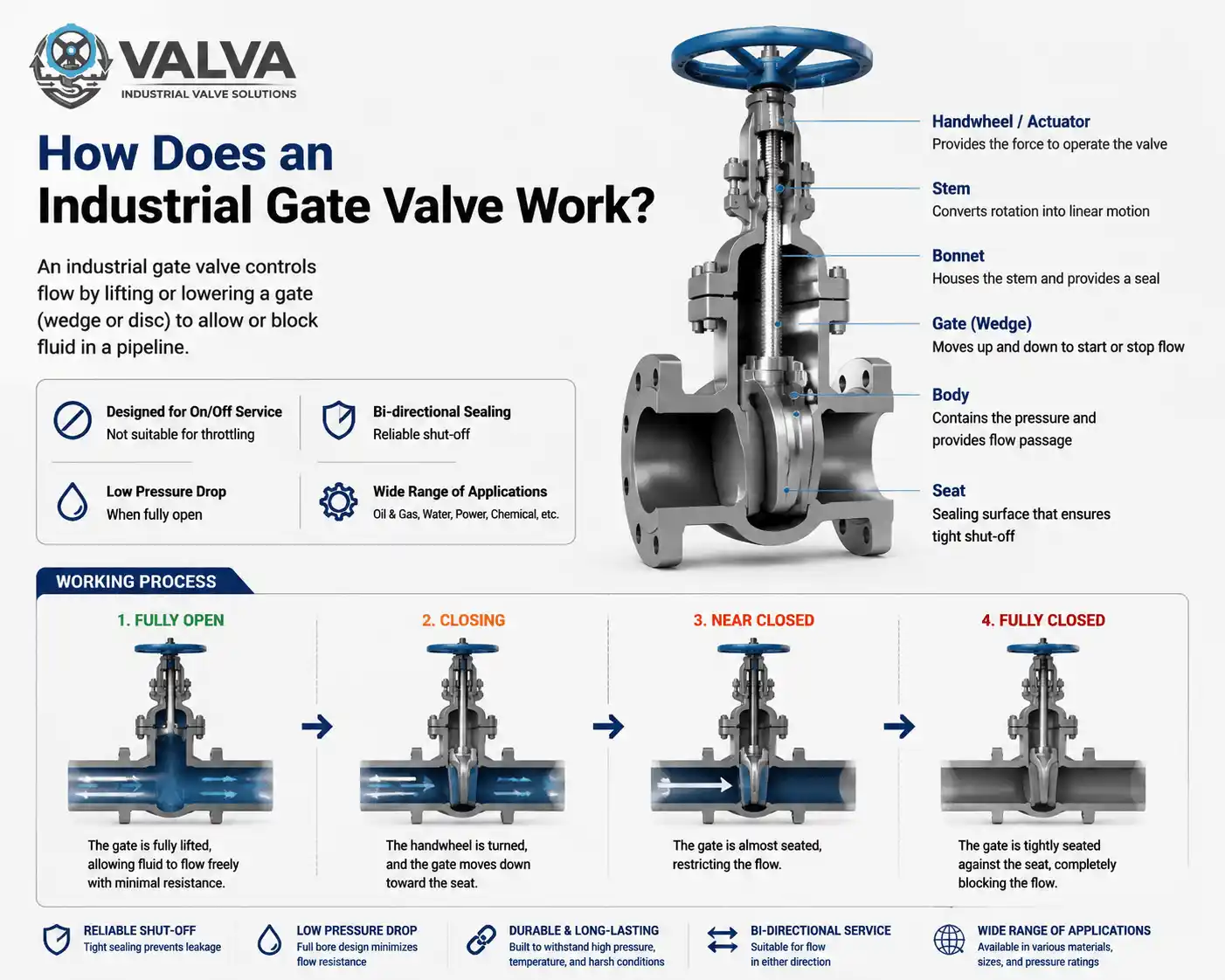
An industrial gate valve is a linear isolation valve used only for full opening or full closing. The gate disc moves vertically inside the valve body, driven by a handwheel, gearbox, or actuator. When fully open, the gate retracts completely, creating an unobstructed flow path. When closed, it seals tightly against the seat, stopping fluid flow completely and ensuring safe pipeline isolation.
2. Key Structural Components of Industrial Gate Valve
Three main components define industrial gate valve working performance. The gate disc provides sealing (wedge type for high pressure, slab type for general service). The stem converts rotational motion into vertical movement. The seat ensures sealing integrity, using either metal or resilient materials depending on application conditions.
3. Working Characteristics of Industrial Gate Valve
Industrial gate valves are designed only for fully open or fully closed operation. Partial opening causes vibration, erosion, and seat damage. However, when fully open, the straight-through design minimizes turbulence and pressure drop, making it ideal for long-distance pipeline transport in industrial systems.
Frequently Asked Questions (FAQ)
Q1: Can an industrial gate valve regulate flow?
No. An industrial gate valve is designed only for isolation. Partial opening causes vibration, erosion, and seat damage.
Q2: Why does a gate valve have low pressure loss?
Because the gate fully retracts from the flow path, the internal passage becomes straight and unobstructed, minimizing resistance.
Q3: What is the difference between wedge and slab gate valves?
Wedge gate valves provide stronger sealing for high-pressure systems, while slab gate valves offer simpler structure and better performance in general industrial pipelines.
Related Articles
Technical & Design Insights
- How Industrial Gate Valve Works
- Industrial Gate Valve Uses
- Wedge Gate Valve Design Explained
- Wedge vs Slab Gate Valve
- Resilient vs Metal Seated Gate Valve
- High Pressure vs Standard Gate Valve
- Bolted Bonnet vs Welded Bonnet Gate Valve
- Cryogenic vs High Temperature Gate Valve
- Flange vs Threaded Connection Gate Valve
Selection & Sizing
Materials & Standards
Maintenance & Operation
Commercial & Purchasing Topics
- Where to Buy High Quality Industrial Gate Valves Wholesale
- Industrial Gate Valve Price List DN50 DN100
- Custom Industrial Gate Valve Manufacturer Oil Gas Pipeline
- Fast Delivery Industrial Gate Valve Supplier Bulk Order
- Electric Actuator Gate Valve Set Price
- Industrial Gate Valve Export Supplier CE ISO
- Low MOQ Industrial Gate Valve Supplier
- Industrial Gate Valve Bulk Warranty
- Industrial Gate Valve Shipping Lead Time