
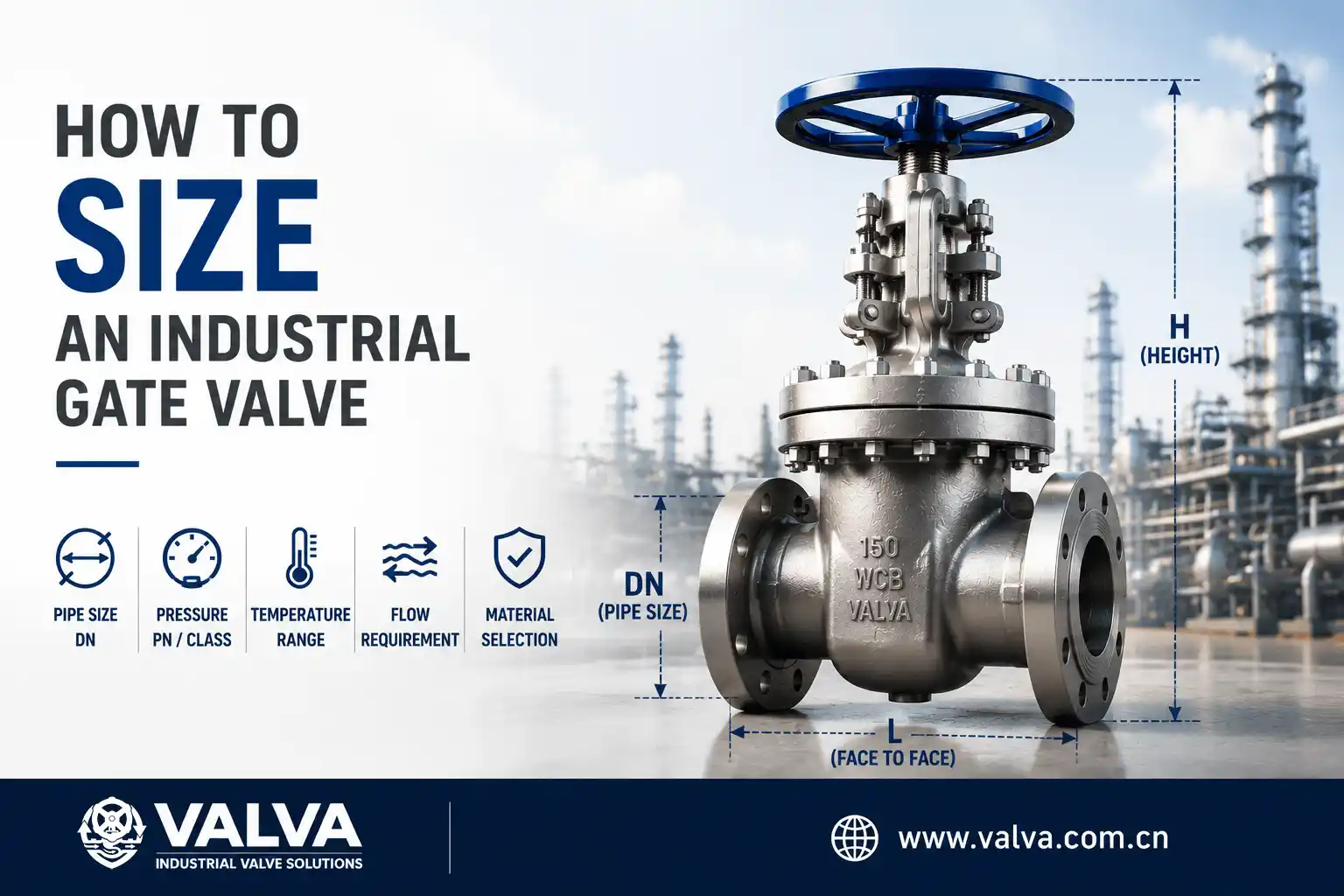
Direct Answer
Sizing an industrial gate valve requires engineers to match the valve full-port bore directly with the pipeline inner diameter while also evaluating flow rate, fluid velocity, and pressure drop conditions. Therefore, proper sizing ensures unobstructed flow, stable isolation performance, and long-term system reliability.
Introduction
Engineers size gate valves based on hydraulic performance and pipeline geometry. A gate valve functions as a full-open or full-close isolation device, not a throttling control element. Therefore, correct sizing directly affects flow efficiency, erosion resistance, and system safety.
1. Bore Matching and Pipeline Alignment
First, engineers must align the valve bore with the pipeline inner diameter. A full-port industrial gate valve allows a straight-through flow path when fully open. Therefore, the internal bore must match the pipe to avoid flow restriction.
If engineers install a smaller bore valve, the system experiences increased pressure drop and flow turbulence. In addition, maintenance tools such as pipeline pigs may fail to pass through the system. Therefore, full-port alignment ensures stable long-distance pipeline operation.
2. Flow Velocity and Erosion Control
Second, engineers must evaluate fluid velocity inside the pipeline. High flow velocity increases internal friction and accelerates wear on seating surfaces.
For liquid systems, maintaining velocity within a controlled range reduces erosion risk and extends valve life. However, when velocity exceeds recommended thresholds, turbulence damages internal components. Therefore, engineers often increase valve size in high-flow systems to reduce velocity stress.
3. Pressure Drop and Cv Considerations
Third, flow coefficient (Cv) plays a key role in sizing decisions. A fully open gate valve provides a very high Cv value due to its straight-through structure.
Therefore, gate valves generate minimal pressure loss when fully open. However, engineers must still ensure that reduced-port designs do not restrict system capacity in critical applications such as slurry or piggable pipelines.
4. Thermal Expansion and Material Stability
High-temperature systems require additional clearance considerations. Metal expansion can affect internal alignment and operational smoothness.
VALVA manufactures industrial gate valves using advanced alloys such as 310S stainless steel, 321 stainless steel, and 2205 duplex steel. These materials maintain structural stability under thermal cycling conditions. Therefore, they reduce deformation risk in high-temperature service environments.
5. Oversizing and Undersizing Risks
Engineers must avoid improper sizing decisions. An oversized gate valve increases cost, weight, and installation load without improving flow performance. However, it does not improve hydraulic efficiency.
Conversely, an undersized valve increases pressure drop and restricts system capacity. Therefore, correct sizing ensures balanced performance between cost efficiency and operational reliability.
VALVA Sizing Integrity Statement
VALVA verifies all gate valve internal geometries through strict dimensional control and hydrostatic pressure testing. We follow API 598 testing protocols to ensure full sealing integrity and structural compliance before shipment.
Frequently Asked Questions (FAQ)
What happens if I install an oversized gate valve in a pipeline?
An oversized gate valve increases procurement cost and structural load without improving flow performance. Since gate valves function as isolation devices, oversizing does not improve hydraulic efficiency. Therefore, matching the valve size to the pipeline remains the most cost-effective engineering approach.
How does the flow coefficient (Cv) affect gate valve sizing?
The flow coefficient (Cv) measures the flow capacity through a fully open valve. Gate valves typically provide very high Cv values due to their straight-through design. Therefore, they create minimal pressure loss when fully open, making them suitable for long-distance pipeline systems.
Can a reduced-port gate valve be used in industrial pipelines?
Yes, reduced-port gate valves can be used in clean fluid systems where pressure drop is not critical. However, engineers must avoid reduced-port designs in slurry systems, piggable pipelines, or high-solid-content media. Therefore, full-port designs remain the standard for industrial pipeline applications.
Related Articles
Technical & Design Insights
- How Industrial Gate Valve Works
- Industrial Gate Valve Uses
- Wedge Gate Valve Design Explained
- Wedge vs Slab Gate Valve
- Resilient vs Metal Seated Gate Valve
- High Pressure vs Standard Gate Valve
- Bolted Bonnet vs Welded Bonnet Gate Valve
- Cryogenic vs High Temperature Gate Valve
- Flange vs Threaded Connection Gate Valve
Selection & Sizing
Materials & Standards
Maintenance & Operation
Commercial & Purchasing Topics
- Where to Buy High Quality Industrial Gate Valves Wholesale
- Industrial Gate Valve Price List DN50 DN100
- Custom Industrial Gate Valve Manufacturer Oil Gas Pipeline
- Fast Delivery Industrial Gate Valve Supplier Bulk Order
- Electric Actuator Gate Valve Set Price
- Industrial Gate Valve Export Supplier CE ISO
- Low MOQ Industrial Gate Valve Supplier
- Industrial Gate Valve Bulk Warranty
- Industrial Gate Valve Shipping Lead Time