
Direct Answer
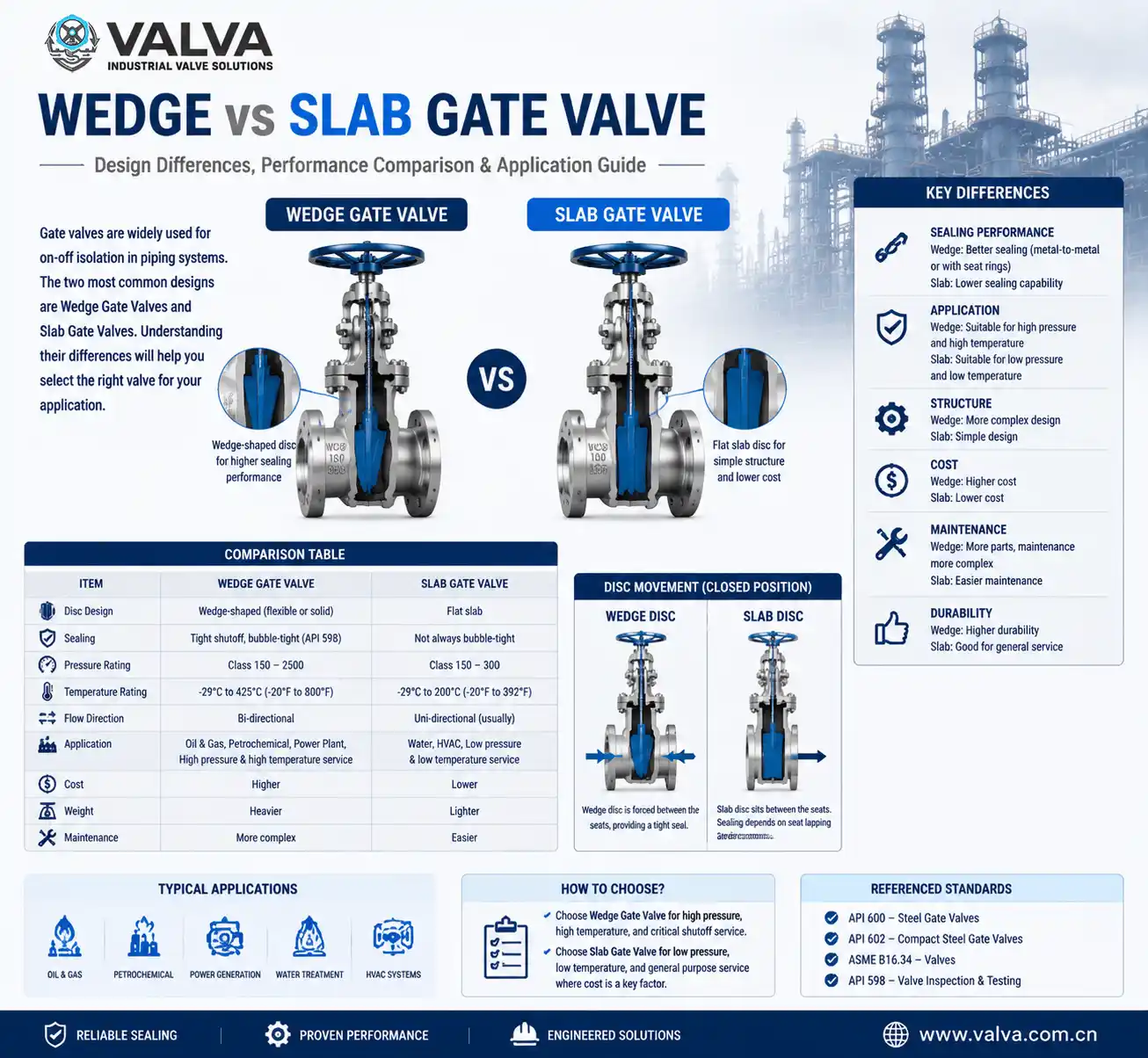
The wedge vs slab gate valve comparison shows that wedge gate valves use a tapered disc that mechanically wedges into angled seats for high-pressure and clean fluid systems. In contrast, slab gate valves use a flat sliding gate that relies on line pressure and floating seats to achieve sealing in slurry and pipeline transmission systems. Therefore, engineers must select valve geometry based on media type, pressure conditions, and operational torque requirements.
Introduction
Engineers select gate valve types based on sealing mechanism and pipeline conditions. Wedge gate valves provide strong mechanical sealing for clean and high-pressure systems. However, slab gate valves perform better in dirty, abrasive, or long-distance pipelines. Therefore, understanding their structural differences improves system reliability and reduces failure risk.
1. Sealing Mechanism Difference
Wedge gate valves use a tapered disc design. When the valve closes, the stem forces the wedge into angled seats. This action creates a tight mechanical seal under high torque. Therefore, engineers use wedge valves in systems that require strong shutoff performance.
In contrast, slab gate valves use a flat gate with a through-conduit opening. Pipeline pressure pushes the gate against the seat to create sealing force. Consequently, slab valves require lower operating torque and adapt better to pressure fluctuations.
2. Media Suitability and Flow Conditions
Wedge gate valves perform best in clean media systems. However, solid particles can accumulate in the bottom cavity. As a result, debris may prevent full closure in dirty pipelines.
Slab gate valves handle contaminated media more effectively. The flat gate design pushes debris away during operation. Therefore, engineers use slab valves in crude oil, slurry, and pipeline transport systems where sediment exists.
3. Pressure and Torque Behavior
Wedge gate valves require higher torque because the sealing force depends on mechanical wedging. Therefore, they perform well in stable high-pressure systems.
Slab gate valves rely on line pressure to assist sealing. As a result, they operate with lower torque and adapt more efficiently to large-diameter pipelines.
4. Materials for Industrial Applications
Engineers select valve materials based on temperature, corrosion, and pressure conditions. VALVA manufactures wedge and slab gate valves using advanced materials such as 310S stainless steel, 321 stainless steel, and 2205 duplex steel.
These materials improve resistance to corrosion, abrasion, and thermal stress. Therefore, they extend valve service life in demanding industrial environments.
5. Operational Reliability
Wedge gate valves may experience thermal binding when exposed to high-temperature cycling. However, engineers can reduce this risk by selecting flexible wedge designs or heat-resistant alloys.
Slab gate valves maintain stable operation in fluctuating pressure systems. In addition, their self-cleaning flow path reduces maintenance frequency in contaminated pipelines.
Conclusion
The wedge vs slab gate valve comparison shows two fundamentally different isolation mechanisms. Wedge gate valves provide strong sealing for clean and high-pressure systems. However, slab gate valves offer superior performance in abrasive, dirty, and long-distance pipeline applications.
Therefore, engineers must evaluate media type, pressure behavior, and operational environment before selecting a valve design.
Frequently Asked Questions (FAQ)
What is the main advantage of a slab gate valve?
The main advantage of a slab gate valve is its full-bore flow path. When fully open, the internal passage aligns with the pipeline. Therefore, it reduces turbulence and allows pigging operations in transmission systems.
Why do wedge gate valves experience thermal binding?
Wedge gate valves may experience thermal binding when temperature changes cause expansion or contraction of metal components. As a result, the wedge may become tightly locked inside the seat. Engineers reduce this risk by using flexible wedge designs or heat-resistant materials.
Which valve is better for slurry pipelines?
Slab gate valves perform better in slurry pipelines. Their flat gate design prevents sediment buildup and removes debris during operation. Therefore, they maintain more stable long-term performance in abrasive media systems.
Can slab gate valves handle high pressure?
Yes, slab gate valves can handle high pressure because line pressure assists sealing. However, engineers must ensure proper seat design and material selection for extreme conditions.
Related Articles
Technical & Design Insights
- How Industrial Gate Valve Works
- Industrial Gate Valve Uses
- Wedge Gate Valve Design Explained
- Wedge vs Slab Gate Valve
- Resilient vs Metal Seated Gate Valve
- High Pressure vs Standard Gate Valve
- Bolted Bonnet vs Welded Bonnet Gate Valve
- Cryogenic vs High Temperature Gate Valve
- Flange vs Threaded Connection Gate Valve
Selection & Sizing
Materials & Standards
Maintenance & Operation
Commercial & Purchasing Topics
- Where to Buy High Quality Industrial Gate Valves Wholesale
- Industrial Gate Valve Price List DN50 DN100
- Custom Industrial Gate Valve Manufacturer Oil Gas Pipeline
- Fast Delivery Industrial Gate Valve Supplier Bulk Order
- Electric Actuator Gate Valve Set Price
- Industrial Gate Valve Export Supplier CE ISO
- Low MOQ Industrial Gate Valve Supplier
- Industrial Gate Valve Bulk Warranty
- Industrial Gate Valve Shipping Lead Time