
Direct Answer
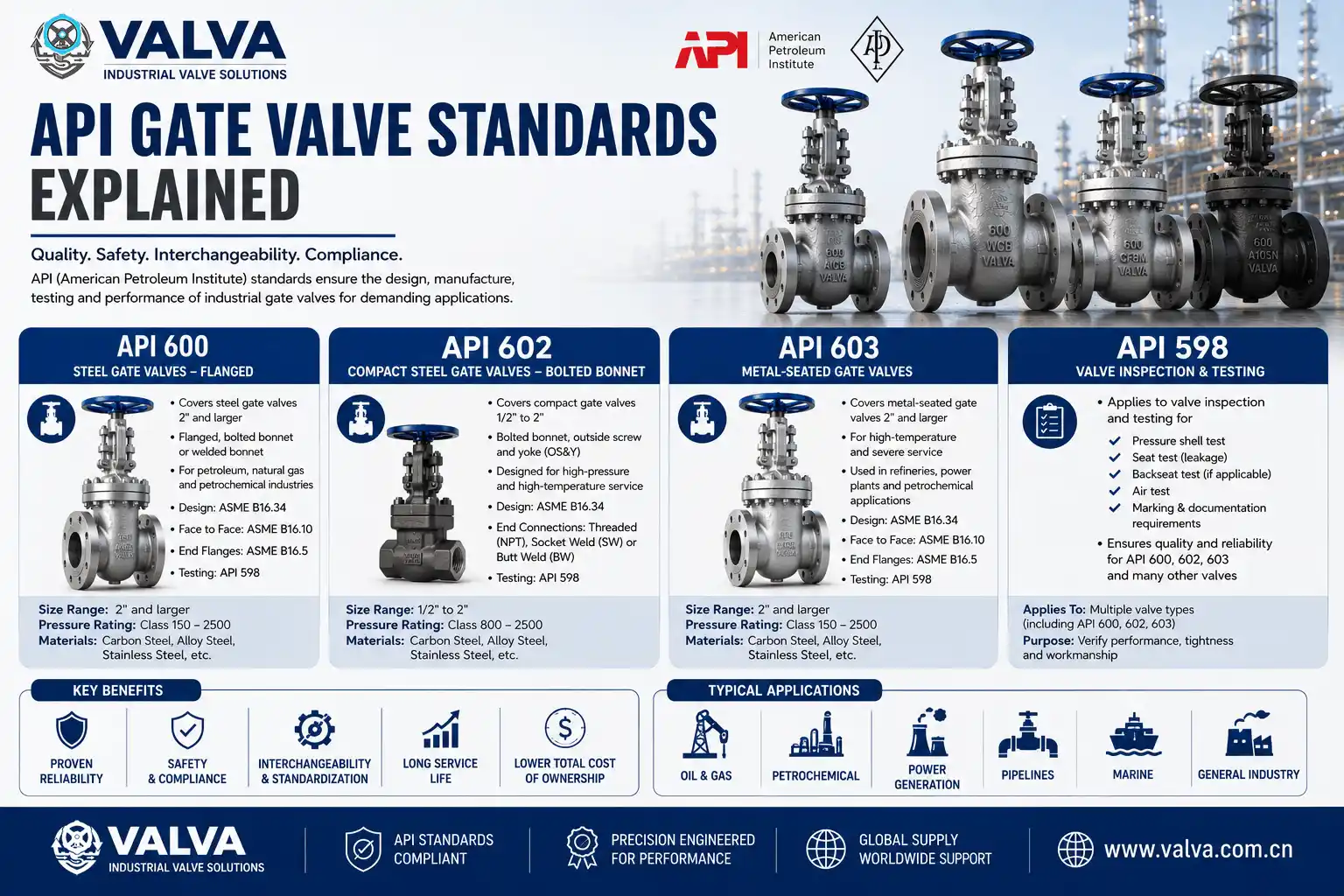
API gate valve standards define engineering requirements for design, materials, pressure ratings, and testing of industrial gate valves. The main standards include API 600, API 602, API 603, and API 598. Therefore, engineers must follow these standards to ensure safe operation in oil, gas, and chemical pipeline systems.
Introduction
API gate valve standards establish unified rules for industrial valve design and testing. These standards ensure consistent performance under high-pressure and high-temperature conditions. Therefore, engineers rely on API specifications to reduce failure risks and improve system reliability in critical pipeline applications.
1. API 600: Heavy-Duty Steel Gate Valves
API 600 applies to large-bore cast steel gate valves used in refinery and oil and gas systems.
It defines requirements for:
- Wall thickness
- Wedge design
- Stem strength
- Pressure-temperature ratings
Therefore, API 600 valves provide strong mechanical performance in high-pressure environments.
2. API 602: Forged Steel Compact Gate Valves
API 602 covers small-bore forged steel gate valves.
These valves feature:
- Compact forged body design
- High-pressure capability
- Screwed or socket-welded ends
Therefore, API 602 valves are widely used in instrumentation and compact refinery piping systems.
3. API 603: Stainless Steel Gate Valves
API 603 applies to stainless steel gate valves designed for corrosion resistance and lightweight construction.
Key features include:
- Thin wall structure
- Stainless steel or alloy materials
- Chemical resistance
However, API 603 is not suitable for extreme mechanical stress applications.
4. API 598: Valve Testing and Inspection
API 598 defines pressure testing and inspection requirements for gate valves.
It includes:
- Hydrostatic shell test (typically 1.5× design pressure)
- Seat leakage test (typically 1.1× rating)
- Zero-leakage acceptance criteria
Therefore, API 598 ensures every valve meets strict safety standards before shipment.
VALVA Engineering Compliance
VALVA manufactures industrial gate valves according to API standards using materials such as 310S stainless steel, 321 stainless steel, and 2205 duplex steel. These materials ensure durability in high-pressure and corrosive environments.
Related Articles
Technical & Design Insights
- How Industrial Gate Valve Works
- Industrial Gate Valve Uses
- Wedge Gate Valve Design Explained
- Wedge vs Slab Gate Valve
- Resilient vs Metal Seated Gate Valve
- High Pressure vs Standard Gate Valve
- Bolted Bonnet vs Welded Bonnet Gate Valve
- Cryogenic vs High Temperature Gate Valve
- Flange vs Threaded Connection Gate Valve
Selection & Sizing
Materials & Standards
Maintenance & Operation
Commercial & Purchasing Topics
- Where to Buy High Quality Industrial Gate Valves Wholesale
- Industrial Gate Valve Price List DN50 DN100
- Custom Industrial Gate Valve Manufacturer Oil Gas Pipeline
- Fast Delivery Industrial Gate Valve Supplier Bulk Order
- Electric Actuator Gate Valve Set Price
- Industrial Gate Valve Export Supplier CE ISO
- Low MOQ Industrial Gate Valve Supplier
- Industrial Gate Valve Bulk Warranty
- Industrial Gate Valve Shipping Lead Time