
Direct Answer:
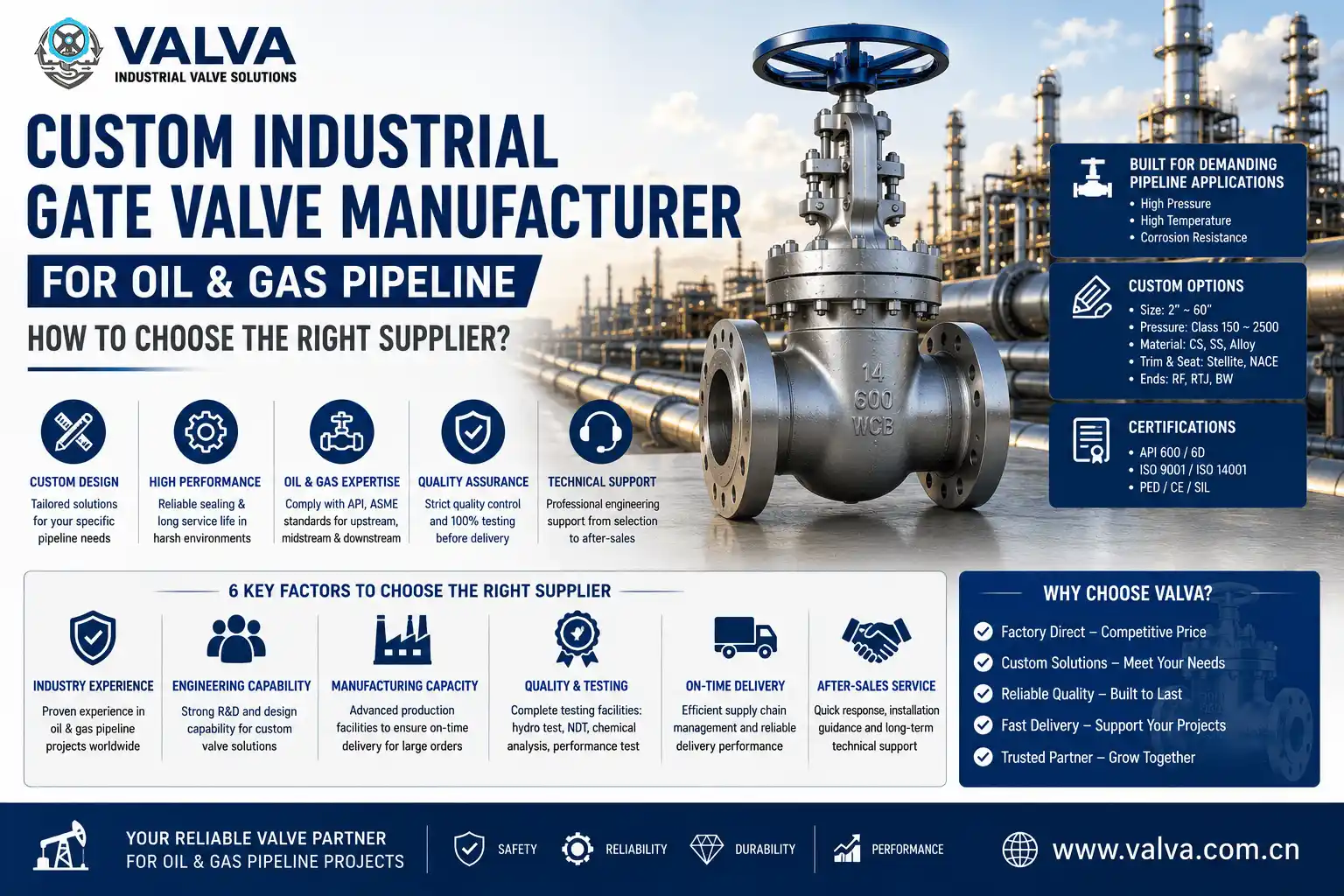
A custom industrial gate valve manufacturer for oil & gas pipelines is selected based on API compliance, pressure class capability, material engineering, and proven hydrostatic testing performance, because oil & gas systems require zero-leakage, high-pressure durability, and long-term corrosion resistance under extreme operating conditions.
Custom Industrial Gate Valve Manufacturer for Oil & Gas Pipeline Requirements Overview
In oil & gas pipeline systems, valve performance directly impacts safety, uptime, and environmental risk control. Therefore, custom manufacturing is not optional—it is a core engineering requirement.
A qualified manufacturer must design gate valves according to ASME B16.34 and API 600 / API 598 standards. In addition, customization ensures compatibility with specific pressure classes, temperature ranges, and corrosive media conditions found in upstream, midstream, and downstream operations.
Unlike standard catalog valves, custom solutions allow optimization of body thickness, wedge design, sealing structure, and actuator integration.
API Standards Compliance in Oil & Gas Gate Valve Manufacturing
First, API compliance defines whether a manufacturer is suitable for oil & gas applications.
Key standards include:
- API 600: Heavy-duty steel gate valves for refinery and pipeline systems
- API 602: Compact forged gate valves for high-pressure small bore lines
- API 598: Pressure testing and inspection standard ensuring zero-leakage performance
A reliable custom manufacturer must fully implement these standards across design, casting, machining, and final inspection stages.
Material Selection for Oil & Gas Gate Valve Applications
Second, material engineering determines long-term reliability in corrosive and high-pressure environments.
Common materials include:
- ASTM A216 WCB Carbon Steel: High strength for general oil & gas transport
- Stainless Steel (316 / 321 / 310S): Corrosion and heat resistance in chemical environments
- Duplex 2205 / Super Duplex: High resistance to chloride stress corrosion cracking in offshore systems
Therefore, material selection must match crude oil composition, gas impurities, temperature cycles, and seawater exposure.
Pressure Class and Design Customization Capabilities
Third, oil & gas pipelines operate under extreme pressure variations, requiring precise engineering customization.
A qualified manufacturer provides:
- Class 150 to Class 2500 pressure design options
- Flexible wedge or solid wedge configurations
- Rising stem / non-rising stem customization
- Flanged, welded, or threaded end connections
In addition, high-end manufacturers perform hydrostatic testing at 1.5× design pressure to ensure structural integrity before shipment.
Why Custom Manufacturing Is Critical for Oil & Gas Safety
Finally, standard off-the-shelf valves cannot fully meet oil & gas operational risks.
Custom manufacturing ensures:
- Reduced leakage risk in high-pressure pipelines
- Optimized flow isolation performance
- Longer service life in corrosive environments
- Lower maintenance downtime in critical operations
Therefore, oil & gas companies rely heavily on direct factory customization to maintain operational safety and cost efficiency.
Frequently Asked Questions (FAQ)
Q1: Why do oil & gas pipelines require custom industrial gate valves?
Oil & gas systems operate under extreme pressure, temperature, and corrosion conditions. Custom valves ensure correct material selection, pressure class design, and API compliance for safe long-term operation.
Q2: What API standards should a gate valve manufacturer follow for oil & gas use?
The key standards are API 600 for design, API 602 for forged valves, and API 598 for pressure testing and leakage verification.
Q3: Which materials are best for oil & gas gate valve applications?
Carbon steel is used for general pipelines, stainless steel for corrosive media, and duplex stainless steel for offshore and high-chloride environments.
Related Articles
Technical & Design Insights
- How Industrial Gate Valve Works
- Industrial Gate Valve Uses
- Wedge Gate Valve Design Explained
- Wedge vs Slab Gate Valve
- Resilient vs Metal Seated Gate Valve
- High Pressure vs Standard Gate Valve
- Bolted Bonnet vs Welded Bonnet Gate Valve
- Cryogenic vs High Temperature Gate Valve
- Flange vs Threaded Connection Gate Valve
Selection & Sizing
Materials & Standards
Maintenance & Operation
Commercial & Purchasing Topics
- Where to Buy High Quality Industrial Gate Valves Wholesale
- Industrial Gate Valve Price List DN50 DN100
- Custom Industrial Gate Valve Manufacturer Oil Gas Pipeline
- Fast Delivery Industrial Gate Valve Supplier Bulk Order
- Electric Actuator Gate Valve Set Price
- Industrial Gate Valve Export Supplier CE ISO
- Low MOQ Industrial Gate Valve Supplier
- Industrial Gate Valve Bulk Warranty
- Industrial Gate Valve Shipping Lead Time