
Direct Answer
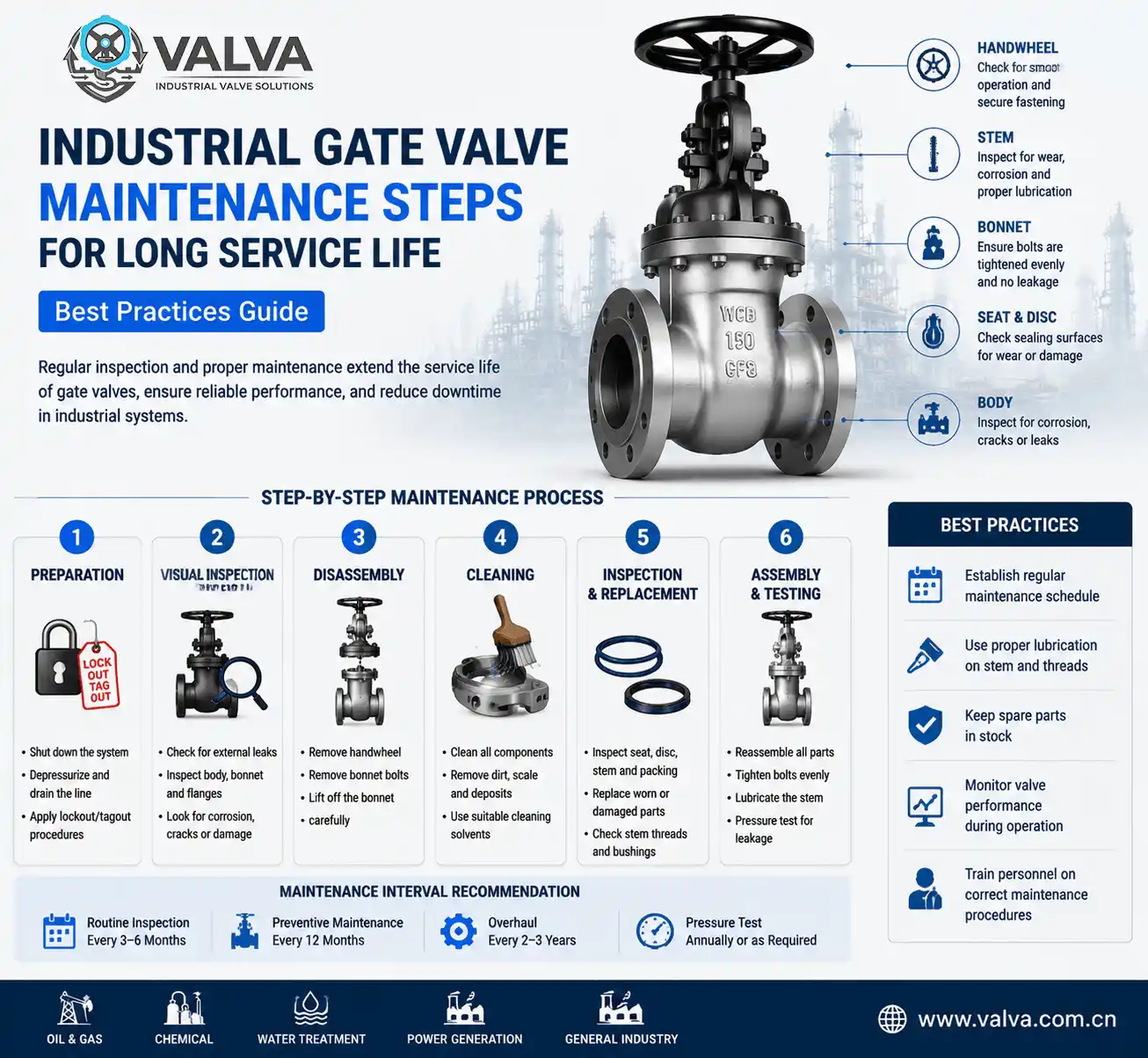
Industrial gate valve maintenance steps focus on routine inspection, lubrication, and packing adjustment to ensure sealing reliability, prevent leakage, and extend valve service life in high-pressure pipeline systems.
Proper maintenance reduces unplanned downtime, protects pipeline safety, and significantly lowers long-term operational costs in industrial applications.
Because gate valves operate under isolation duty rather than throttling, small mechanical issues can quickly escalate into full system failures if ignored.
1. Routine Inspection in Industrial Gate Valve Maintenance Steps
First, technicians should perform systematic inspections to detect early-stage mechanical or sealing issues.
They must check the valve body, bonnet joint, and packing area for visible leakage, corrosion, or deformation. In addition, operators should fully cycle the valve (open and close) on a scheduled basis to prevent internal sticking caused by sediment or scaling.
Furthermore, cleaning external components helps remove dust, chemical residue, and industrial contaminants that accelerate wear.
👉 Recommended internal link: /knowledge/gate-valve/what-is-gate-valve/
2. Lubrication of Stem and Mechanical Components
Second, proper lubrication plays a critical role in reducing operational friction and preventing mechanical failure.
Technicians should apply industrial-grade grease to the stem threads and yoke sleeve. This step ensures smooth torque transmission during opening and closing operations.
However, in high-temperature or chemically aggressive environments, only corrosion-resistant lubricants should be used to avoid degradation.
As a result, lubrication directly improves operational stability and reduces emergency actuation force.
3. Packing Adjustment for Leak Prevention
Third, stem packing maintenance ensures long-term sealing performance.
If minor leakage appears around the gland area, operators should evenly tighten the gland nuts to restore compression on the packing rings.
At the same time, excessive tightening must be avoided because it increases stem friction and accelerates wear.
Therefore, balanced adjustment ensures both sealing integrity and operational smoothness.
4. Preventive Maintenance Strategy for Industrial Gate Valves
Finally, preventive maintenance is more effective than reactive repair.
Facilities should establish maintenance schedules based on operating conditions, including pressure level, temperature, and media type. For example, high-temperature or slurry systems require more frequent inspection cycles than clean water systems.
In addition, consistent monitoring helps detect early warning signs such as vibration, torque increase, or abnormal noise.
Internal Link Strategy (Recommended)
To strengthen your Knowledge Center SEO cluster, this article should internally link to:
- /knowledge/gate-valve/
- /knowledge/gate-valve/cryogenic-vs-high-temperature-gate-valve/
- /knowledge/gate-valve/resilient-vs-metal-seated/
- /knowledge/gate-valve/high-pressure-vs-standard/
Industrial Gate Valve Maintenance Key Takeaways
Industrial gate valve maintenance steps are essential for ensuring long-term reliability in pipeline systems. Regular inspection, proper lubrication, and precise packing adjustment work together to maintain sealing performance and prevent costly failures.
Ultimately, a structured preventive maintenance program significantly extends valve lifespan and improves overall system safety.
Related Articles
Technical & Design Insights
- How Industrial Gate Valve Works
- Industrial Gate Valve Uses
- Wedge Gate Valve Design Explained
- Wedge vs Slab Gate Valve
- Resilient vs Metal Seated Gate Valve
- High Pressure vs Standard Gate Valve
- Bolted Bonnet vs Welded Bonnet Gate Valve
- Cryogenic vs High Temperature Gate Valve
- Flange vs Threaded Connection Gate Valve
Selection & Sizing
Materials & Standards
Maintenance & Operation
Commercial & Purchasing Topics
- Where to Buy High Quality Industrial Gate Valves Wholesale
- Industrial Gate Valve Price List DN50 DN100
- Custom Industrial Gate Valve Manufacturer Oil Gas Pipeline
- Fast Delivery Industrial Gate Valve Supplier Bulk Order
- Electric Actuator Gate Valve Set Price
- Industrial Gate Valve Export Supplier CE ISO
- Low MOQ Industrial Gate Valve Supplier
- Industrial Gate Valve Bulk Warranty
- Industrial Gate Valve Shipping Lead Time