Direct Answer
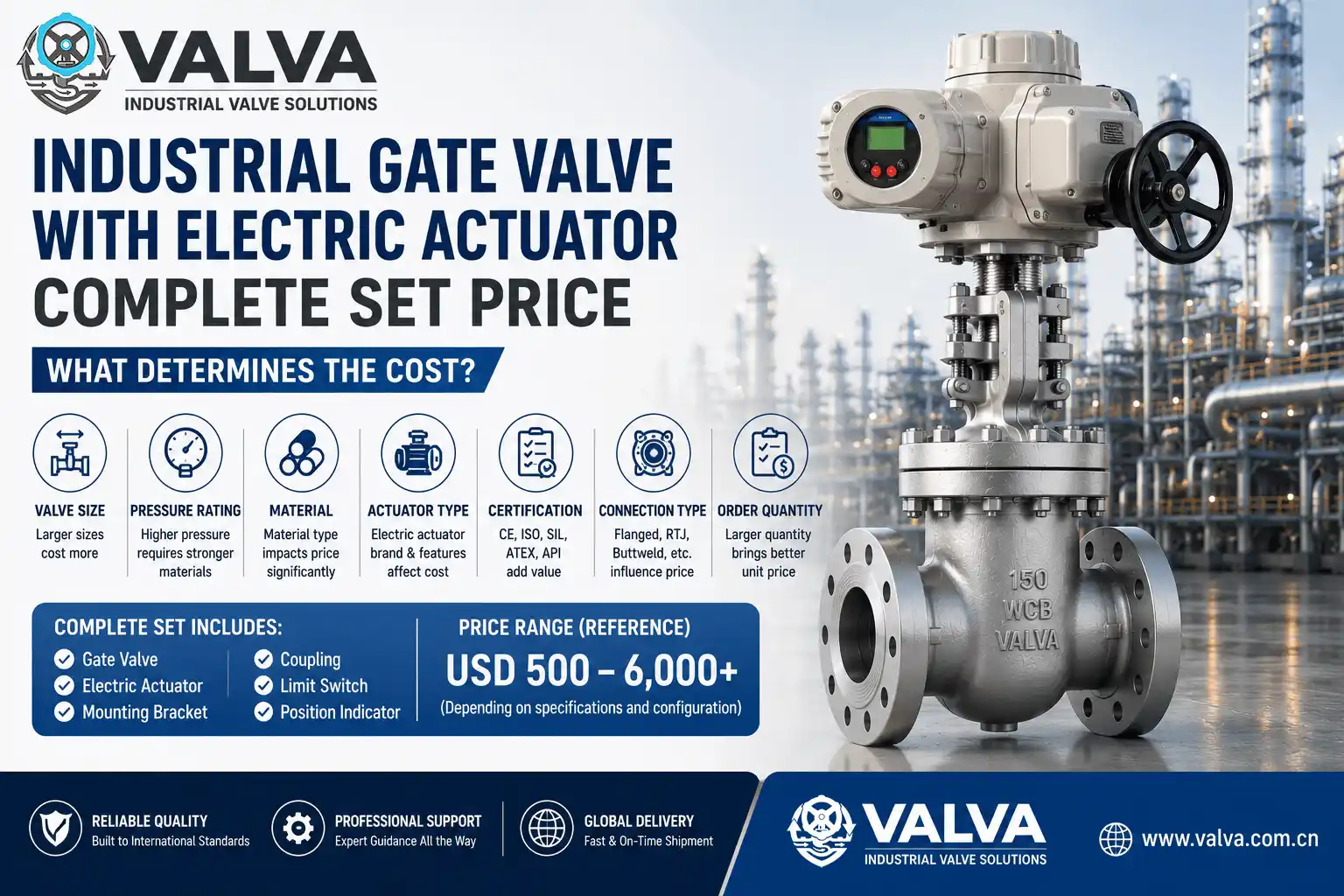
The price of an industrial gate valve with electric actuator complete set depends mainly on valve size, pressure class, actuator torque rating, and material selection, and a DN50–DN200 configuration typically costs significantly less than heavy-duty DN300+ systems because actuator power and valve body strength requirements increase sharply with pipeline scale.
Industrial Gate Valve with Electric Actuator Complete Set Price Overview
Industrial gate valve electric actuator assemblies combine a mechanical isolation valve with an automated electric actuator system. Therefore, the final cost is not just the valve itself but a full integrated control solution used in modern automation pipelines.
These complete sets are widely used in oil & gas, chemical plants, water treatment systems, and remote pipeline automation projects.
Key Cost Drivers of Electric Actuated Gate Valve Systems
First, multiple engineering factors directly influence total system pricing.
Main cost factors include:
- Valve diameter (DN50 to DN600+)
- Pressure class (Class 150 / 300 / 600 / 1500)
- Electric actuator torque output requirement
- Voltage configuration (AC/DC, explosion-proof options)
- Control system type (on/off vs modulating)
Therefore, actuator specification often accounts for 40–60% of total system cost.
Electric Actuator Types and Their Price Impact
Second, actuator selection significantly changes system cost structure.
Common actuator types include:
- Standard on/off electric actuators (lowest cost, basic automation)
- Intelligent modulating actuators (mid-range cost, position control feedback)
- Explosion-proof actuators (high-cost, oil & gas environments)
In addition, higher torque ratings required for large gate valves increase gearbox complexity and motor size, further raising cost.
Material Selection Impact on Complete Set Pricing
Third, valve body material strongly affects total system pricing.
Typical materials include:
- Carbon steel (ASTM A216 WCB): cost-effective for utility pipelines
- Stainless steel (304/316/321): corrosion-resistant chemical applications
- Duplex 2205: high-strength offshore and seawater systems
Therefore, corrosive environments always require higher-cost actuator-valve combinations.
Industrial Application Scenarios for Electric Gate Valve Sets
Finally, these complete systems are selected based on automation requirements rather than manual operation feasibility.
Typical applications include:
- Remote pipeline shutoff systems
- Chemical plant automated control networks
- Offshore oil and gas platforms
- High-frequency cycle industrial lines
Consequently, automation reduces labor costs and improves operational safety in hazardous environments.
Frequently Asked Questions (FAQ)
Q1: What is included in an industrial gate valve electric actuator complete set?
It typically includes the gate valve body, electric actuator, mounting bracket, coupling accessories, and sometimes a control unit for automation integration.
Q2: Why are electric actuator gate valve systems more expensive than manual valves?
Because they include motors, gearboxes, control electronics, and higher engineering requirements for torque and automation compatibility.
Q3: Can I retrofit an electric actuator onto an existing gate valve?
Yes, in many cases retrofitting is possible if the valve stem and torque rating match the actuator specification, but factory-integrated sets ensure better reliability.
Related Articles
Technical & Design Insights
- How Industrial Gate Valve Works
- Industrial Gate Valve Uses
- Wedge Gate Valve Design Explained
- Wedge vs Slab Gate Valve
- Resilient vs Metal Seated Gate Valve
- High Pressure vs Standard Gate Valve
- Bolted Bonnet vs Welded Bonnet Gate Valve
- Cryogenic vs High Temperature Gate Valve
- Flange vs Threaded Connection Gate Valve
Selection & Sizing
Materials & Standards
Maintenance & Operation
Commercial & Purchasing Topics
- Where to Buy High Quality Industrial Gate Valves Wholesale
- Industrial Gate Valve Price List DN50 DN100
- Custom Industrial Gate Valve Manufacturer Oil Gas Pipeline
- Fast Delivery Industrial Gate Valve Supplier Bulk Order
- Electric Actuator Gate Valve Set Price
- Industrial Gate Valve Export Supplier CE ISO
- Low MOQ Industrial Gate Valve Supplier
- Industrial Gate Valve Bulk Warranty
- Industrial Gate Valve Shipping Lead Time