
Direct Answer:
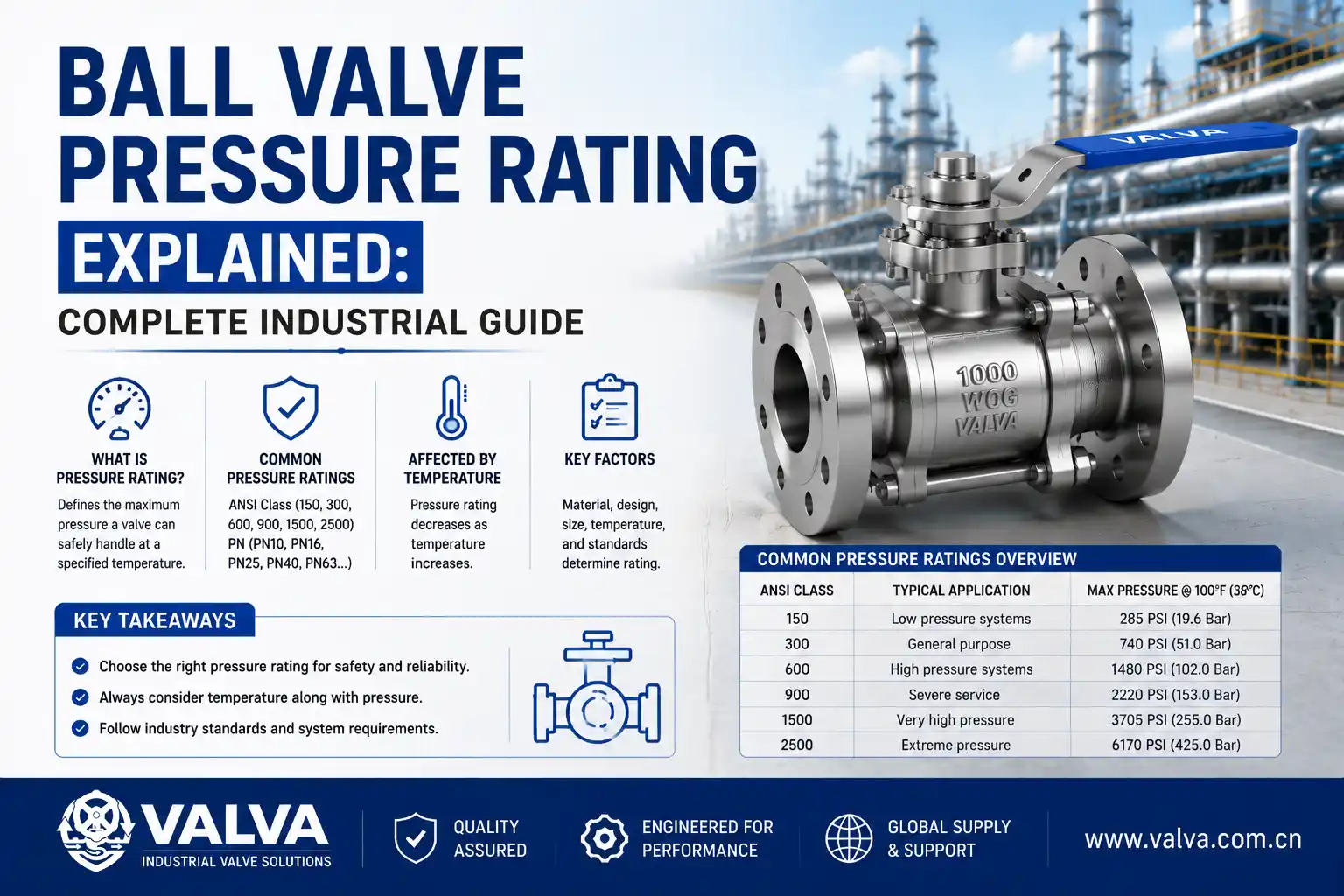
Ball valve pressure rating refers to the maximum allowable working pressure a ball valve can safely withstand at a specific temperature. It is not a fixed value because pressure capacity decreases as temperature increases. Therefore, engineers must always evaluate both pressure class and temperature conditions when selecting a ball valve.
Understanding ball valve pressure rating is critical for ensuring pipeline safety, preventing leakage, and avoiding catastrophic valve failure in industrial systems.
What Is a Ball Valve Pressure Rating?
A ball valve pressure rating defines:
- Maximum working pressure (PSI or bar)
- Temperature-dependent strength limits
- Material-based performance boundaries
In industrial standards, pressure ratings are expressed using systems such as:
- ASME Class ratings (Class 150, 300, 600, 900, 1500, 2500)
- PN ratings (PN10, PN16, PN25, PN40)
Because these systems are standardized, engineers can match valves to pipeline requirements safely.
ASME Pressure Class System
The ASME B16.34 standard defines pressure classes for ball valves used in oil, gas, and petrochemical industries.
Common classes include:
- Class 150 → low to medium pressure systems
- Class 300 → general industrial applications
- Class 600 → high-pressure pipelines
- Class 900–2500 → extreme pressure environments
However, pressure rating depends on:
- Material type (carbon steel, stainless steel, duplex)
- Operating temperature
- Valve design and wall thickness
Therefore, a Class 300 valve does not always mean the same pressure capacity under all conditions.
Temperature vs Pressure Relationship
Pressure rating decreases as temperature increases because materials lose strength under heat.
For example:
- At ambient temperature → maximum pressure capacity
- At high temperature → reduced allowable pressure
This relationship is critical in steam, refinery, and chemical systems.
As a result:
- Engineers must always check pressure-temperature charts
- Valve selection cannot rely on pressure class alone
PN (Metric) Pressure Rating System
The PN system is widely used in European and international pipelines.
Common values include:
- PN10 → low-pressure systems
- PN16 → standard industrial use
- PN25 → medium-high pressure systems
- PN40 → high-pressure applications
However:
- PN rating is based on 20°C reference temperature
- Real operating conditions may reduce actual capacity
Therefore, PN and ASME ratings are not directly interchangeable.
Material Impact on Pressure Rating
Material selection strongly affects valve pressure capability.
Common materials include:
- Carbon steel (ASTM A216 WCB) → strong and cost-effective
- Stainless steel (304/316/321) → corrosion resistance + moderate pressure
- Duplex steel (2205) → high strength + chemical resistance
- Alloy steels → extreme pressure and temperature service
Stronger materials allow:
- Higher pressure classes
- Better thermal stability
- Longer service life
Testing Standards for Pressure Ratings
Ball valve pressure ratings are verified using standards such as:
- API 598 → pressure testing and leakage verification
- API 6D → pipeline valve requirements
- ASME B16.34 → design and pressure-temperature limits
Typical testing includes:
- Shell test (1.5× rated pressure)
- Seat test (1.1× rated pressure)
These tests ensure valve safety before shipment.
How to Choose the Right Pressure Rating
When selecting a ball valve, engineers should evaluate:
- System operating pressure
- Maximum temperature conditions
- Fluid type and corrosiveness
- Required safety margin
- Applicable design standard (ASME or PN)
A higher pressure class does not always mean better selection—it must match system requirements.
Common Mistakes in Pressure Rating Selection
Avoid these errors:
- Ignoring temperature derating
- Mixing PN and ASME systems incorrectly
- Selecting based only on pipeline pressure
- Overlooking material limitations
- Ignoring safety factors in design
Proper engineering evaluation is essential.
Conclusion
In summary, ball valve pressure rating is a temperature-dependent safety classification that defines how much pressure a valve can handle under real operating conditions. Correct interpretation of ASME and PN ratings ensures safe, efficient, and reliable industrial valve performance.
Frequently Asked Questions
What does ball valve pressure rating mean?
It defines maximum safe working pressure.
It indicates how much pressure a ball valve can withstand at a specific temperature without failure.
Does temperature affect ball valve pressure rating?
Yes, significantly.
As temperature increases, material strength decreases, reducing the allowable pressure capacity of the valve.
Are ASME and PN pressure ratings the same?
No.
ASME uses Class ratings, while PN uses bar-based metric ratings. They are not directly equivalent.
Related Articles
Technical & Design Insights
- What Is a Ball Valve
- How Does a Ball Valve Work
- Different Types of Ball Valves
- Floating vs Trunnion Ball Valve
- Full Port vs Reduced Port Ball Valve
- Top Entry vs Side Entry Ball Valve
- V Port vs Standard Ball Valve
- What Are Ball Valves Used For
- One Piece vs Two Piece Ball Valve
- Two Piece vs Three Piece Ball Valve
- What Are the Different Types of Ball Valves