
Direct Answer:
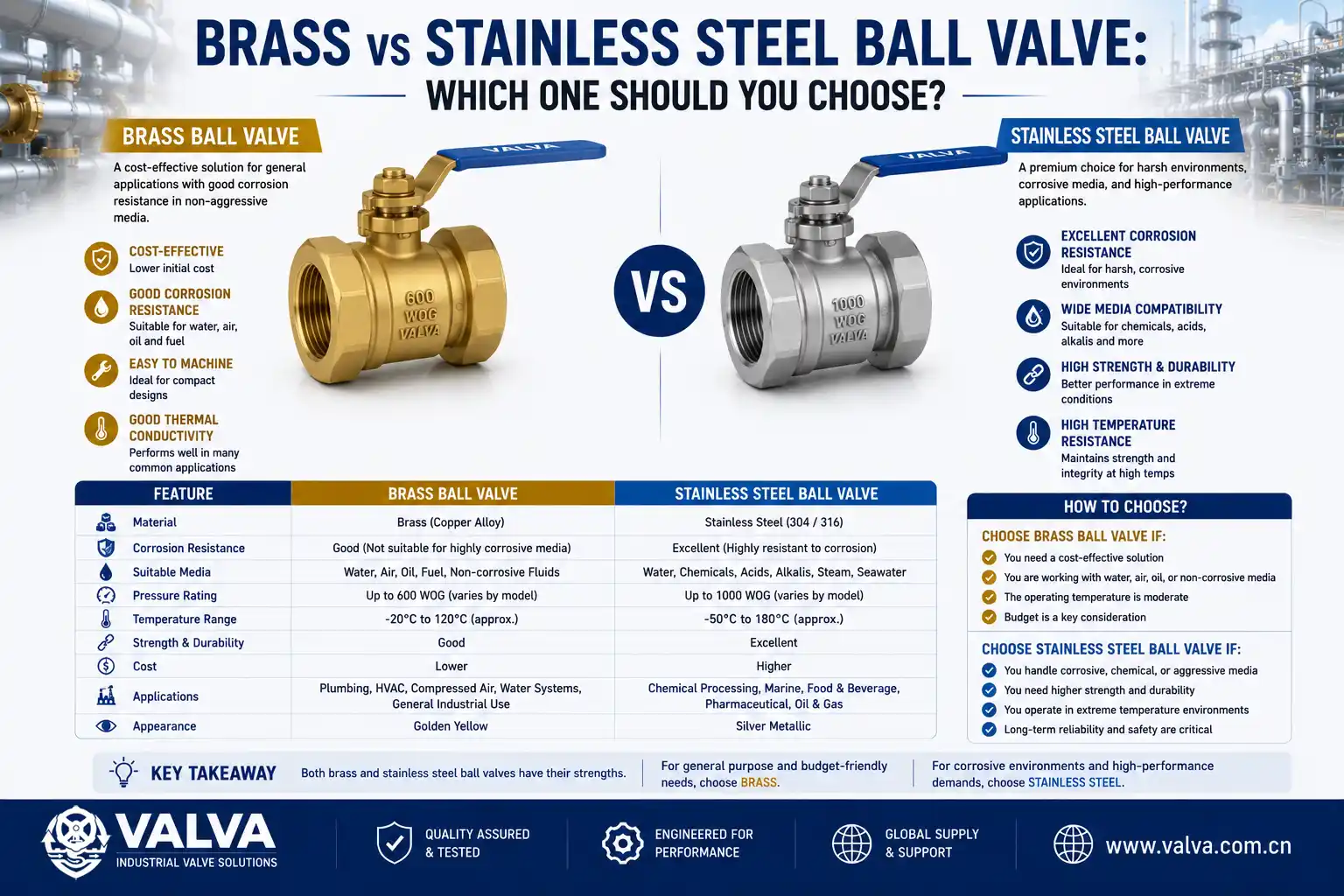
Brass vs stainless steel ball valve—the main difference is material performance and application range. Brass ball valves are cost-effective and suitable for water, air, and low-to-medium pressure systems, while stainless steel ball valves offer superior corrosion resistance, higher strength, and better performance in aggressive or high-pressure industrial environments.
Understanding brass vs stainless steel ball valve helps engineers and buyers select the right valve material based on fluid type, pressure conditions, temperature, and long-term durability requirements.
What Is a Brass Ball Valve?
A brass ball valve is made from copper-zinc alloy (brass), typically used in general-purpose fluid control systems.
When operating:
- The internal brass ball rotates 90° to open or close flow.
- Sealing is achieved using PTFE or similar soft seats.
Because of its material properties, brass ball valves offer:
- Low cost
- Good machinability
- Reliable performance in clean water systems
- Easy installation
- Suitable for residential and light industrial use
However, brass has limitations in highly corrosive or high-temperature environments.
What Is a Stainless Steel Ball Valve?
A stainless steel ball valve is manufactured from alloys such as 304 or 316 stainless steel.
During operation:
- The ball rotates inside a corrosion-resistant body.
- Metal strength ensures stability under high pressure and temperature.
Therefore, stainless steel ball valves provide:
- Excellent corrosion resistance
- High-pressure capability
- Long service life
- Strong mechanical durability
- Suitable for harsh industrial conditions
As a result, they are widely used in petrochemical, marine, and chemical industries.
Brass vs Stainless Steel Ball Valve: Key Differences
| Feature | Brass Ball Valve | Stainless Steel Ball Valve |
|---|---|---|
| Material | Copper-zinc alloy | 304 / 316 stainless steel |
| Corrosion resistance | Moderate | High |
| Pressure rating | Low to medium | Medium to high |
| Temperature resistance | Limited | Excellent |
| Cost | Lower | Higher |
| Strength | Moderate | High |
| Service life | Medium | Long |
| Best use | Water, air, HVAC | Chemical, marine, oil & gas |
| Durability in harsh media | Limited | Excellent |
Performance Comparison
Brass ball valves perform well in stable, non-corrosive environments.
However, when exposed to:
- Chlorides
- Acids
- Seawater
- High-temperature fluids
brass gradually loses structural integrity.
In contrast, stainless steel maintains:
- Stable mechanical strength
- Resistance to oxidation
- Long-term sealing reliability
Therefore, stainless steel valves are preferred in demanding industrial systems.
Pressure and Temperature Capability
Brass ball valves typically operate in:
- Low to medium pressure systems
- Temperatures up to moderate ranges depending on seat material
Stainless steel ball valves handle:
- High-pressure pipelines
- High-temperature environments
- Continuous industrial operation
As pressure increases, stainless steel provides significantly better safety margins.
Cost Comparison
Brass ball valves are more affordable due to:
- Lower raw material cost
- Easier machining
- Simpler manufacturing process
Stainless steel ball valves cost more because:
- Alloy materials are more expensive
- Machining requires higher precision
- Corrosion resistance adds long-term value
However, stainless steel often reduces lifecycle cost in industrial applications due to longer service life.
Applications
Brass Ball Valve Applications
Brass valves are commonly used in:
- Residential plumbing systems
- HVAC systems
- Water supply networks
- Compressed air systems
- Light industrial utilities
Stainless Steel Ball Valve Applications
Stainless steel valves are widely used in:
- Chemical processing plants
- Oil and gas pipelines
- Marine environments
- Food and beverage production
- Pharmaceutical systems
- High-pressure industrial lines
How to Choose Between Brass and Stainless Steel Ball Valves
Before selecting a valve, evaluate:
- Fluid type (water, gas, chemical, seawater)
- Corrosiveness of media
- Operating pressure
- Temperature conditions
- Required service life
- Budget constraints
- Industry standards
If your system is clean water or air at low pressure, brass is often sufficient.
If your system involves corrosion, high pressure, or industrial chemicals, stainless steel is the safer choice.
Conclusion
In the comparison of brass vs stainless steel ball valve, brass offers a low-cost solution for general utility systems, while stainless steel provides superior strength, corrosion resistance, and durability for demanding industrial applications. The correct choice depends on operating conditions, not just initial cost.
Frequently Asked Questions
Is stainless steel better than brass for ball valves?
Yes, in harsh environments.
Stainless steel performs better in corrosive, high-pressure, and high-temperature applications due to its superior mechanical and chemical resistance.
Are brass ball valves suitable for industrial use?
Limited use only.
Brass ball valves are suitable for light-duty industrial systems, but they are not recommended for aggressive chemicals or high-pressure pipelines.
Why are stainless steel ball valves more expensive?
Because of material and performance advantages.
Stainless steel costs more to produce and machine, but it provides longer service life and better resistance to corrosion and pressure.
Related Articles
Technical & Design Insights
- What Is a Ball Valve
- How Does a Ball Valve Work
- Different Types of Ball Valves
- Floating vs Trunnion Ball Valve
- Full Port vs Reduced Port Ball Valve
- Top Entry vs Side Entry Ball Valve
- V Port vs Standard Ball Valve
- What Are Ball Valves Used For
- One Piece vs Two Piece Ball Valve
- Two Piece vs Three Piece Ball Valve
- What Are the Different Types of Ball Valves