Direct Answer:
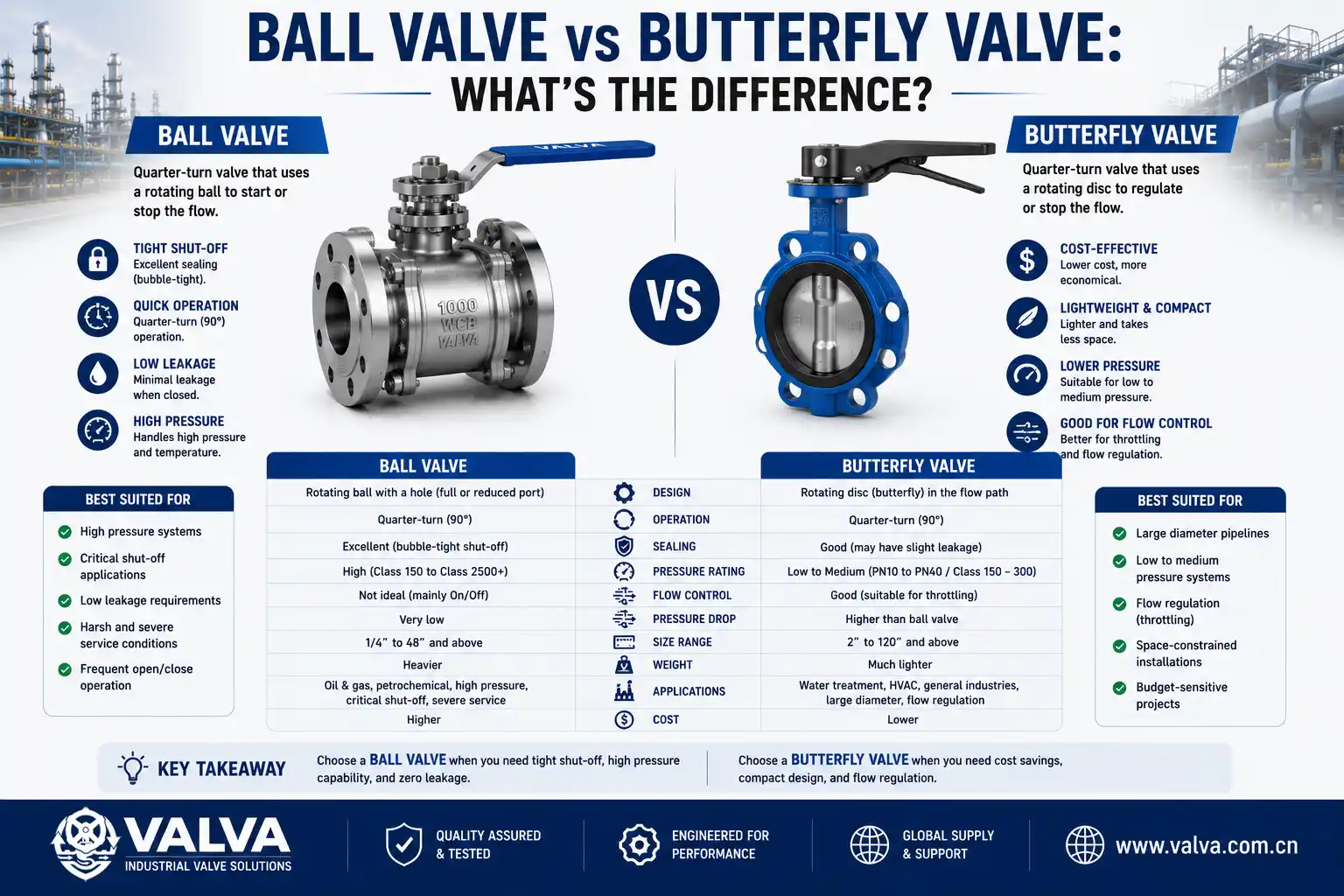
Ball valve vs butterfly valve—the main difference is the internal closing mechanism. A ball valve uses a rotating spherical ball to achieve tight shut-off with excellent sealing performance, while a butterfly valve uses a rotating disc that sits in the flow path, offering compact design and lower cost for large-diameter pipelines.
Choosing between a ball valve and a butterfly valve depends on pressure level, pipe size, sealing requirements, space constraints, and budget. Understanding ball valve vs butterfly valve helps engineers select the most efficient solution for industrial flow control and isolation systems.
How a Ball Valve Works
A ball valve uses a hollow spherical ball with a central bore.
When the handle rotates 90 degrees:
- The bore aligns with the pipeline and allows flow.
- The ball rotates to block the flow completely when closed.
Because of this design, ball valves provide:
- Bubble-tight sealing
- Low leakage risk
- Fast quarter-turn operation
- Strong performance under pressure
Ball valves are widely used in applications that require reliable shut-off and high sealing integrity.
How a Butterfly Valve Works
A butterfly valve uses a flat circular disc mounted on a rotating shaft.
When the valve operates:
- The disc rotates parallel to the flow to open.
- The disc turns perpendicular to block the flow.
Because the disc always stays inside the flow path, butterfly valves provide:
- Compact structure
- Lightweight design
- Fast operation
- Lower cost for large sizes
However, the presence of the disc causes a slight pressure drop even when fully open.
Ball Valve vs Butterfly Valve: Key Differences
| Feature | Ball Valve | Butterfly Valve |
|---|---|---|
| Closing element | Rotating ball | Rotating disc |
| Sealing performance | Excellent (bubble-tight) | Good (depends on seat type) |
| Pressure rating | High pressure capability | Medium pressure range |
| Size suitability | Small to medium pipelines | Large-diameter pipelines |
| Pressure drop | Very low | Slightly higher |
| Cost | Higher | Lower |
| Weight | Heavier | Lighter |
| Space requirement | Larger | Compact |
| Flow control | On/off service | On/off + limited throttling |
| Maintenance | Moderate | Easier for large sizes |
Pressure and Performance Comparison
Ball valves perform better in high-pressure systems because the spherical sealing mechanism creates strong, uniform contact with the seats.
Therefore, engineers prefer ball valves in:
- Oil and gas pipelines
- High-pressure chemical systems
- Critical isolation applications
In contrast, butterfly valves perform well in low to medium pressure systems, especially where pipe diameter is large.
Because of their simple structure, butterfly valves reduce:
- Installation cost
- Structural load
- Space requirements
Cost Comparison
Butterfly valves are generally more cost-effective, especially in large diameters.
This is because they use:
- Less material
- Simpler construction
- Lightweight components
Ball valves, however, cost more due to:
- Precision-machined spherical ball
- Higher sealing requirements
- Stronger body design
As a result, ball valves are selected for performance-critical systems, while butterfly valves dominate large utility pipelines.
When to Use a Ball Valve
Choose a ball valve when your system requires:
- Tight shut-off
- High-pressure resistance
- Low leakage risk
- Frequent on/off operation
- Critical process isolation
Common applications include:
- Oil and gas pipelines
- Petrochemical systems
- High-pressure water systems
- Chemical processing plants
When to Use a Butterfly Valve
Choose a butterfly valve when you need:
- Large-diameter pipeline control
- Compact installation
- Lower cost solution
- Lightweight piping design
- Basic flow isolation or throttling
Common applications include:
- HVAC systems
- Water distribution networks
- Cooling water systems
- Fire protection systems
- Large industrial utilities
Advantages and Limitations
Ball Valve Advantages
- Excellent sealing performance
- High-pressure capability
- Fast operation
- Long service life
Ball Valve Limitations
- Higher cost
- Heavier design
- Not ideal for very large diameters
Butterfly Valve Advantages
- Lightweight
- Cost-effective
- Easy installation
- Suitable for large pipelines
Butterfly Valve Limitations
- Lower sealing performance
- Disc remains in flow path
- Not ideal for very high pressure
Conclusion
In the comparison of ball valve vs butterfly valve, neither is universally better. Ball valves provide superior sealing and high-pressure performance, making them ideal for critical industrial systems. Butterfly valves offer a compact, cost-effective solution for large-diameter and low-pressure applications. Selecting the right valve depends on pressure requirements, pipeline size, and system design priorities.
Frequently Asked Questions
Which is better, a ball valve or a butterfly valve?
It depends on the application.
Ball valves offer better sealing and high-pressure performance, while butterfly valves are more suitable for large-diameter, low-pressure systems due to their compact and cost-effective design.
Can a butterfly valve replace a ball valve?
Not always.
A butterfly valve can replace a ball valve in low-pressure systems, but it cannot match the sealing performance or pressure capacity of a ball valve in critical applications.
Why are butterfly valves cheaper than ball valves?
Because of simpler construction.
Butterfly valves use a disc and shaft mechanism with fewer materials and simpler machining, making them more economical, especially in large sizes.
Related Articles
Technical & Design Insights
- What Is a Ball Valve
- How Does a Ball Valve Work
- Different Types of Ball Valves
- Floating vs Trunnion Ball Valve
- Full Port vs Reduced Port Ball Valve
- Top Entry vs Side Entry Ball Valve
- V Port vs Standard Ball Valve
- What Are Ball Valves Used For
- One Piece vs Two Piece Ball Valve
- Two Piece vs Three Piece Ball Valve
- What Are the Different Types of Ball Valves