
Direct Answer:
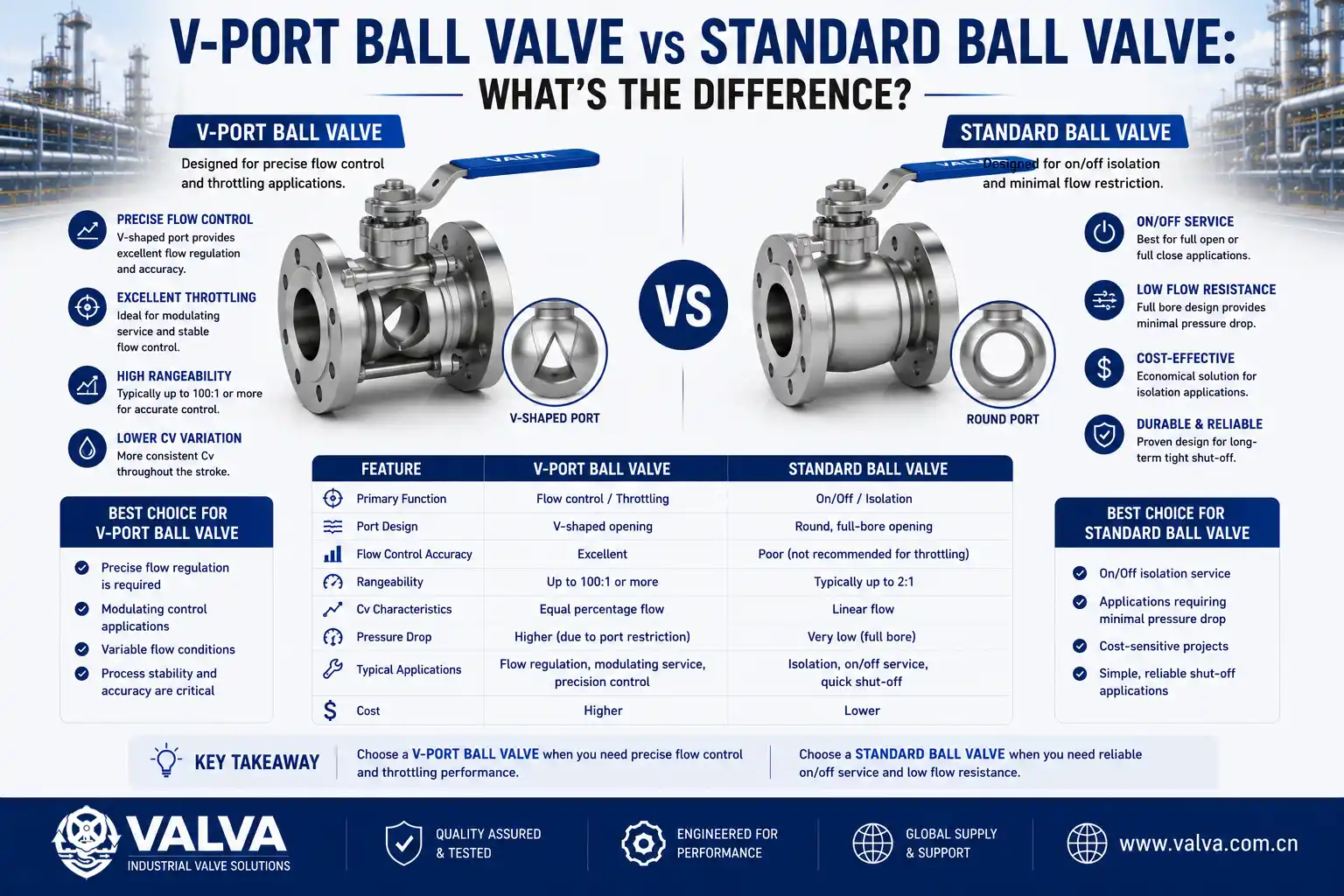
V-port ball valve vs standard ball valve—the key difference is flow control capability. A standard ball valve is designed for full open/close isolation with a straight-through bore, while a V-port ball valve uses a V-shaped opening in the ball to provide precise throttling and flow regulation.
Understanding V-port ball valve vs standard ball valve is essential for selecting between simple shut-off service and accurate industrial flow control.
What Is a Standard Ball Valve?
A standard ball valve uses a spherical ball with a round bore through the center.
During operation:
- The valve rotates 90° to open or close flow.
- When open, the bore aligns fully with the pipeline.
- When closed, the solid part blocks flow completely.
Because of this design, standard ball valves provide:
- Fast quarter-turn operation
- Tight shut-off performance
- Low pressure drop
- High reliability for isolation service
However, they are not suitable for precise flow control.
What Is a V-Port Ball Valve?
A V-port ball valve uses a ball with a V-shaped cut in the opening.
During rotation:
- The V-shaped port gradually exposes flow area.
- Flow increases in a controlled and predictable way.
- The valve provides linear or equal-percentage flow characteristics.
Therefore, V-port ball valves provide:
- Precise throttling control
- Stable flow modulation
- Better control over process variables
- Improved performance in automation systems
Because of this design, they are widely used in control applications.
V-Port Ball Valve vs Standard Ball Valve: Key Differences
| Feature | Standard Ball Valve | V-Port Ball Valve |
|---|---|---|
| Flow function | On/off isolation | Flow regulation |
| Ball design | Full round bore | V-shaped opening |
| Control ability | Poor | Excellent |
| Pressure drop control | Not adjustable | Adjustable and stable |
| Flow characteristics | Non-linear during partial opening | Predictable (linear/equal %) |
| Best use | Shut-off service | Process control |
| Wear during throttling | High | Lower |
| Cost | Lower | Higher |
Flow Control Performance
Standard ball valves are designed for binary operation:
- Fully open → full flow
- Fully closed → zero flow
When partially opened:
- Flow becomes turbulent
- Seat wear increases
- Control accuracy is poor
In contrast, V-port ball valves are engineered for modulation:
- The V-shaped port gradually changes flow area.
- The valve maintains stable control across rotation angles.
- Flow behavior becomes predictable and adjustable.
Therefore, V-port designs are preferred in automated process systems.
Pressure Drop and Flow Behavior
Standard ball valves:
- Offer extremely low pressure drop when fully open
- Become unstable under partial opening conditions
V-port ball valves:
- Allow controlled pressure drop
- Maintain stability in throttling conditions
- Improve process efficiency in regulated systems
Because of this, engineers use V-port valves where flow consistency matters.
Wear and Service Life
Standard ball valves experience:
- High wear when used for throttling
- Seat damage under partial opening conditions
V-port ball valves reduce this issue because:
- Flow is distributed gradually
- Turbulence is more controlled
- Contact stress is reduced
However, both types require correct selection to avoid misuse.
Applications
Standard Ball Valve Applications
- Pipeline isolation
- Water systems
- Gas shut-off lines
- HVAC systems
- General industrial on/off service
V-Port Ball Valve Applications
- Chemical dosing systems
- Process control loops
- Mixing and blending systems
- Automation-controlled pipelines
- Flow regulation in industrial plants
How to Choose Between V-Port and Standard Ball Valves
Before selecting a valve, evaluate:
- Required function (isolation vs control)
- Flow accuracy requirements
- System automation level
- Fluid type and pressure
- Maintenance expectations
If the system requires only on/off control, a standard ball valve is sufficient.
If the system requires precise flow modulation, a V-port ball valve is the correct choice.
Conclusion
In the comparison of V-port ball valve vs standard ball valve, standard designs are ideal for fast isolation with low pressure drop, while V-port designs deliver precise and stable flow control. Choosing the right type ensures better system efficiency, improved control accuracy, and longer equipment life.
Frequently Asked Questions
Can a standard ball valve be used for flow control?
Not recommended.
Standard ball valves are designed for full open or closed operation. Partial opening causes turbulence and reduces control accuracy.
Why is a V-port ball valve better for throttling?
Because of its geometry.
The V-shaped opening provides a controlled flow path, allowing gradual and predictable flow adjustment.
Are V-port ball valves more expensive?
Yes.
They require precision machining and are designed for control applications, which increases manufacturing cost compared to standard ball valves.
Related Articles
Technical & Design Insights
- What Is a Ball Valve
- How Does a Ball Valve Work
- Different Types of Ball Valves
- Floating vs Trunnion Ball Valve
- Full Port vs Reduced Port Ball Valve
- Top Entry vs Side Entry Ball Valve
- V Port vs Standard Ball Valve
- What Are Ball Valves Used For
- One Piece vs Two Piece Ball Valve
- Two Piece vs Three Piece Ball Valve
- What Are the Different Types of Ball Valves