
Direct Answer:
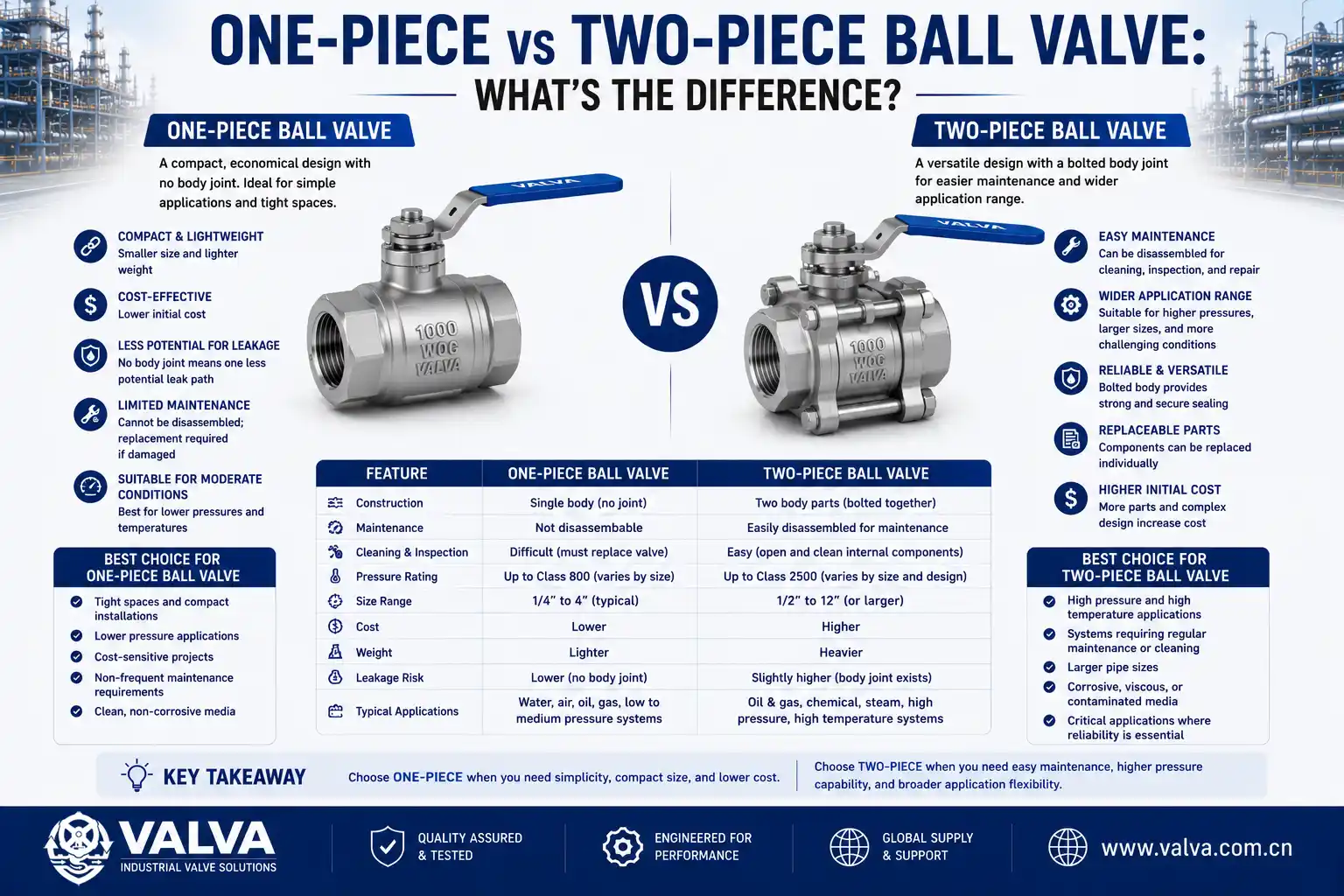
One-piece vs two-piece ball valve—the main difference is body construction and maintenance capability. A one-piece ball valve has a single solid body offering maximum leak resistance and compact design, while a two-piece ball valve has a split body that improves assembly flexibility and allows easier internal access for maintenance.
Understanding one-piece vs two-piece ball valve helps engineers balance cost, maintenance needs, and system reliability in industrial piping design.
What Is a One-Piece Ball Valve?
A one-piece ball valve features a single solid cast or forged body.
In this design:
- The body fully encloses the ball and stem
- The internal components are permanently retained
- No body joints exist except end connections
Because of this structure, one-piece ball valves provide:
- Excellent leak prevention (fewer sealing joints)
- Compact and lightweight design
- Low manufacturing cost
- High structural integrity
- Minimal external leakage risk
However, the internal components cannot be fully removed for repair.
What Is a Two-Piece Ball Valve?
A two-piece ball valve consists of:
- One main body section
- One end cap section
- Internal ball, stem, and seats assembled inside
During assembly:
- The valve is bolted or threaded together
- Internal parts can be accessed after removing one section
Because of this structure, two-piece ball valves provide:
- Easier maintenance than one-piece valves
- Strong and reliable body design
- Moderate cost level
- Better service flexibility
- Suitable for industrial applications
However, full disassembly still requires removing the valve from the pipeline.
One-Piece vs Two-Piece Ball Valve: Key Differences
| Feature | One-Piece Ball Valve | Two-Piece Ball Valve |
|---|---|---|
| Body structure | Single solid body | Two connected sections |
| Maintenance | Not serviceable internally | Partially serviceable |
| Leak risk | Very low | Low |
| Cost | Lowest | Moderate |
| Installation | Very simple | Simple |
| Structural strength | High | High |
| Repairability | Limited | Better |
| Application range | Light-duty systems | Industrial general service |
Maintenance and Serviceability
One-piece ball valves are designed for:
- Long-term use without internal servicing
- Replacement instead of repair
As a result:
- Maintenance is minimal
- Downtime is reduced
- But internal repairs are not practical
Two-piece ball valves improve service flexibility because:
- One body section can be removed
- Internal seals and seats can be replaced
- Maintenance is more practical in industrial environments
Therefore, two-piece designs are more suitable for systems requiring periodic maintenance.
Pressure and Performance
Both valve types can handle industrial pressures depending on material and design class.
However:
- One-piece valves are more common in low-pressure and compact systems.
- Two-piece valves are widely used in medium to high-pressure industrial pipelines.
Performance depends more on material grade (carbon steel, stainless steel, duplex) than body configuration alone.
Cost Comparison
One-piece ball valves are generally cheaper because:
- They use less machining and assembly
- They have fewer components
- Production is faster
Two-piece ball valves cost more due to:
- Additional machining and assembly steps
- Split body design
- Increased manufacturing complexity
However, two-piece valves offer better lifecycle flexibility in industrial systems.
Applications
One-Piece Ball Valve Applications
- Residential plumbing systems
- HVAC systems
- Low-pressure water lines
- Compressed air systems
- Light-duty utility piping
Two-Piece Ball Valve Applications
- Industrial process systems
- Chemical pipelines
- Water treatment plants
- Oil and gas auxiliary lines
- General industrial fluid control
How to Choose Between One-Piece and Two-Piece Ball Valves
Before selecting a valve, consider:
- Maintenance requirements
- System pressure level
- Budget constraints
- Installation space
- Expected service life
- Downtime tolerance
If your system is simple and cost-sensitive, a one-piece valve is sufficient.
If your system requires moderate maintenance flexibility, a two-piece valve is the better choice.
Conclusion
In the comparison of one-piece vs two-piece ball valve, one-piece valves offer simplicity, compact design, and low cost, while two-piece valves provide better maintenance access and industrial usability. The right selection depends on whether your priority is cost efficiency or service flexibility.
Frequently Asked Questions
Which is better, one-piece or two-piece ball valve?
It depends on usage.
One-piece valves are better for low-cost, low-maintenance systems, while two-piece valves are better for industrial applications requiring serviceability.
Can a one-piece ball valve be repaired?
No.
One-piece valves are not designed for internal repair. If internal components fail, the valve is typically replaced.
Why choose a two-piece ball valve over a one-piece design?
For maintenance flexibility.
Two-piece valves allow partial disassembly for cleaning or replacement of internal parts, making them more suitable for industrial systems.
Related Articles
Technical & Design Insights
- What Is a Ball Valve
- How Does a Ball Valve Work
- Different Types of Ball Valves
- Floating vs Trunnion Ball Valve
- Full Port vs Reduced Port Ball Valve
- Top Entry vs Side Entry Ball Valve
- V Port vs Standard Ball Valve
- What Are Ball Valves Used For
- One Piece vs Two Piece Ball Valve
- Two Piece vs Three Piece Ball Valve
- What Are the Different Types of Ball Valves