Direct Answer:
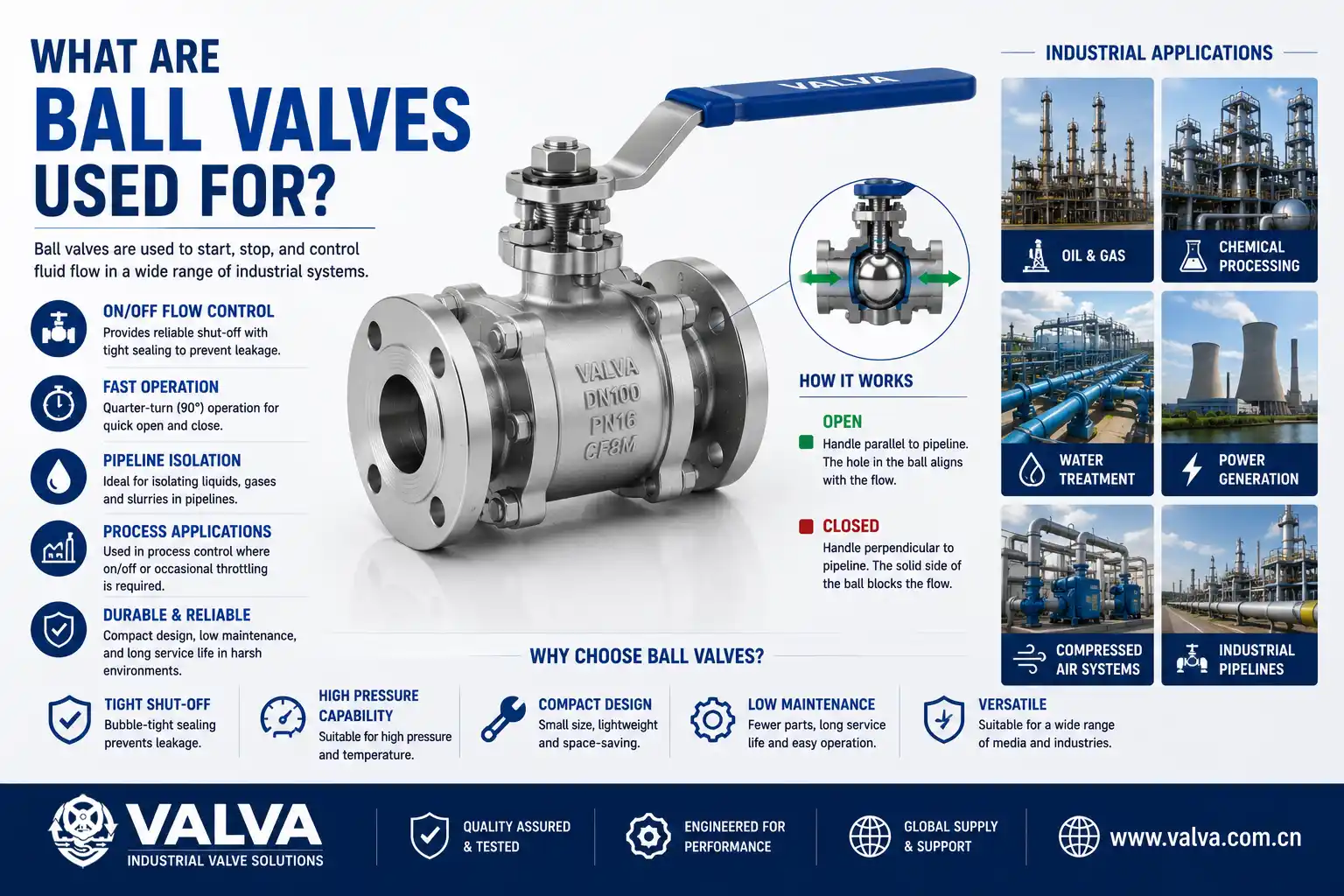
What are ball valves used for? Ball valves are primarily used to start, stop, or isolate the flow of liquids and gases in piping systems. Thanks to their quarter-turn operation, reliable sealing, and long service life, industries widely use ball valves in oil and gas, chemical processing, water treatment, power generation, HVAC, food processing, and many other industrial applications.
Because they offer fast operation and excellent leak-tight performance, ball valves have become one of the most common valve types in modern industrial systems. Understanding what ball valves are used for helps engineers and buyers select the right valve for specific operating conditions.
Where Are Ball Valves Commonly Used?
Ball valves serve a wide range of industries because they provide dependable shut-off and require minimal maintenance.
Common applications include:
- Oil and gas pipelines
- Chemical processing plants
- Water treatment facilities
- Power generation stations
- HVAC systems
- Food and beverage production
- Pharmaceutical manufacturing
- Marine engineering
- Mining operations
- Industrial automation systems
Furthermore, many facilities install automated ball valves to improve process efficiency and reduce manual operation.
Why Are Ball Valves So Popular?
Several advantages explain why industries choose ball valves over many other valve types.
First, ball valves open and close with only a 90-degree turn.
Next, their simple internal design reduces wear and minimizes maintenance requirements.
In addition, the polished ball and resilient seats create an excellent seal that prevents leakage.
As a result, ball valves offer:
- Fast operation
- Bubble-tight shut-off
- Low pressure drop
- Long service life
- Low operating torque
- Easy automation
- High reliability
Because of these benefits, engineers specify ball valves for both general-purpose and critical industrial applications.
What Fluids Can Ball Valves Control?
Ball valves can handle a wide variety of media.
Depending on the valve material and seat design, they are suitable for:
- Water
- Steam
- Air
- Natural gas
- Crude oil
- Refined petroleum products
- Chemicals
- Acids
- Alkalis
- Compressed gases
- Food-grade liquids
- Pharmaceutical fluids
However, selecting the correct body material, ball material, and seat material remains essential for achieving reliable long-term performance.
Which Industries Use Ball Valves?
Oil and Gas Industry
Oil and gas facilities rely heavily on ball valves for pipeline isolation, storage terminals, offshore platforms, and refineries.
Because they provide tight shut-off and withstand high pressures, they help improve operational safety.
Chemical Processing
Chemical plants often use stainless steel or alloy ball valves to handle corrosive media.
Moreover, PTFE seats provide excellent chemical resistance for many applications.
Water Treatment
Water treatment plants install ball valves throughout pumping stations, filtration systems, and distribution networks.
Their simple operation reduces maintenance costs while ensuring reliable flow control.
Power Generation
Power plants use industrial ball valves for cooling water, compressed air, fuel systems, and auxiliary piping.
Consequently, operators benefit from dependable isolation during maintenance.
Food and Beverage
Food-grade stainless steel ball valves help maintain hygienic production conditions.
Their smooth internal surfaces also simplify cleaning and reduce contamination risks.
Are Ball Valves Used for Flow Control?
Although ball valves can partially regulate flow, manufacturers mainly design them for on-off service.
Keeping a standard ball valve partially open for extended periods may damage the valve seats and reduce sealing performance.
If precise flow regulation is necessary, engineers usually recommend:
- V-port ball valves
- Globe valves
- Control valves
Therefore, standard ball valves perform best when fully open or fully closed.
Manual vs. Automated Ball Valves
Depending on system requirements, operators can choose manual or automated operation.
Manual Ball Valves
Manual ball valves are ideal for:
- Small piping systems
- Utility services
- Equipment isolation
- Maintenance shut-off
They offer a simple, economical solution for many industrial applications.
Automated Ball Valves
Automated ball valves use pneumatic, electric, or hydraulic actuators.
They are commonly installed in:
- SCADA systems
- Automated production lines
- Remote pipeline stations
- Process control systems
As a result, operators can monitor and control valves without manual intervention.
How to Choose the Right Ball Valve
Before purchasing a ball valve, buyers should evaluate several important factors.
These include:
- Working pressure
- Operating temperature
- Media compatibility
- Valve size
- Pressure class
- Body material
- Seat material
- End connection
- Manual or actuated operation
- Applicable standards
Selecting the correct valve improves safety, reduces maintenance costs, and extends service life.
Conclusion
Now you know what ball valves are used for. Ball valves provide reliable shut-off for liquids and gases across numerous industries. Their fast quarter-turn operation, excellent sealing performance, and long service life make them one of the most trusted valve types for industrial piping systems worldwide.
Frequently Asked Questions
Can ball valves control flow continuously?
Not typically.
Standard ball valves are designed for full-open or full-closed operation. For continuous flow regulation, engineers generally recommend V-port ball valves or dedicated control valves.
Are ball valves suitable for high-pressure applications?
Yes.
Industrial ball valves are available in pressure classes such as ANSI Class 150, 300, 600, and higher. Selecting the correct pressure rating ensures safe and reliable operation.
Why do industries prefer ball valves?
Because they combine reliability and simplicity.
Ball valves operate quickly, seal tightly, require minimal maintenance, and integrate easily with automated control systems. These advantages make them a preferred choice in many industrial applications.
Related Articles
Technical & Design Insights
- What Is a Ball Valve
- How Does a Ball Valve Work
- Different Types of Ball Valves
- Floating vs Trunnion Ball Valve
- Full Port vs Reduced Port Ball Valve
- Top Entry vs Side Entry Ball Valve
- V Port vs Standard Ball Valve
- What Are Ball Valves Used For
- One Piece vs Two Piece Ball Valve
- Two Piece vs Three Piece Ball Valve
- What Are the Different Types of Ball Valves