
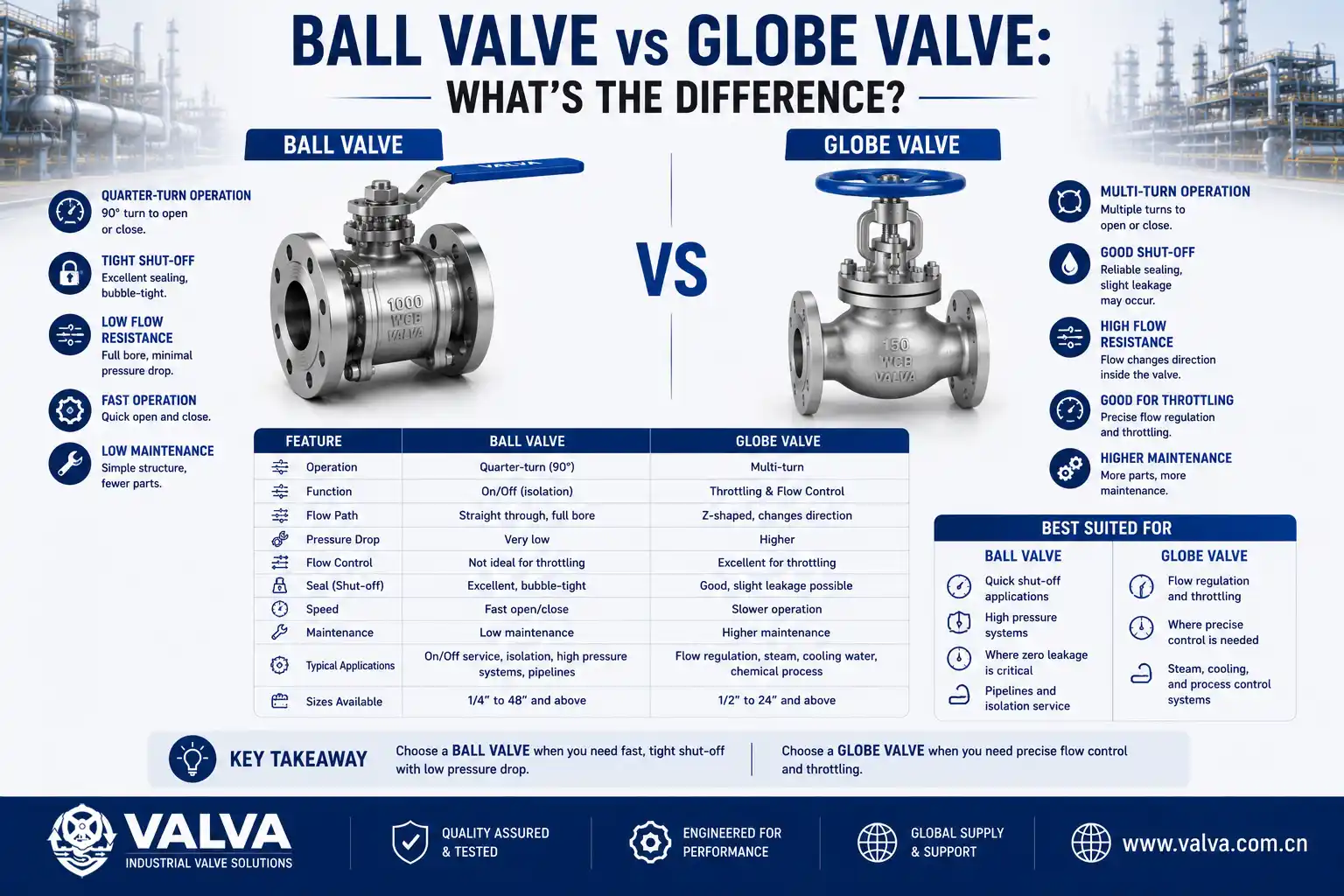
Direct Answer:
Ball valve vs globe valve—the key difference is their function and internal flow design. A ball valve is designed for fast on/off isolation with minimal pressure drop, using a rotating spherical ball. A globe valve is designed for precise flow regulation, using a movable disc that throttles flow through a tortuous internal path.
Understanding ball valve vs globe valve helps engineers choose the correct valve type for either tight shut-off or accurate flow control in industrial piping systems.
How a Ball Valve Works
A ball valve uses a rotating spherical ball with a central bore.
When the valve handle turns 90 degrees:
- The bore aligns with the pipeline to allow full flow.
- The ball rotates to block flow completely when closed.
Because of this design, ball valves provide:
- Fast operation (quarter-turn)
- Tight shut-off performance
- Low pressure drop
- High reliability in isolation service
Ball valves are best suited for applications where flow is either fully open or fully closed.
How a Globe Valve Works
A globe valve uses a movable disc (plug) that travels vertically onto a seat.
As the stem turns:
- The disc moves up or down to adjust flow.
- The internal flow path changes direction, creating resistance.
Because of this structure, globe valves provide:
- Precise flow regulation
- Stable throttling performance
- Better control accuracy
- Smooth adjustment over a wide range
Globe valves are widely used when flow control is more important than pressure loss.
Ball Valve vs Globe Valve: Key Differences
| Feature | Ball Valve | Globe Valve |
|---|---|---|
| Primary function | On/off isolation | Flow regulation |
| Flow control | Limited | Excellent |
| Internal design | Straight-through bore | S-shaped flow path |
| Pressure drop | Very low | Higher |
| Operation | Quarter-turn | Multi-turn |
| Sealing performance | Excellent | Good |
| Wear under throttling | High (not recommended) | Low (designed for it) |
| Speed | Fast | Slower |
| Typical use | Isolation service | Control service |
Flow Control Capability
Ball valves are not designed for throttling. When partially opened, high-velocity flow creates turbulence, which can damage the seat and ball surface over time.
In contrast, globe valves are specifically engineered for throttling service. Their internal geometry allows controlled pressure drop across the valve, enabling precise adjustment of flow rates.
Therefore:
- Ball valves = On/off control only
- Globe valves = Continuous flow regulation
Pressure Drop Comparison
Ball valves have a straight flow path.
As a result:
- They produce minimal pressure loss.
- They improve system efficiency.
- They reduce pumping energy requirements.
Globe valves force fluid to change direction inside the body.
Therefore:
- Pressure drop is significantly higher.
- Energy consumption increases.
- Flow resistance is intentionally used for control.
Maintenance and Service Life
Ball valves generally require less maintenance because:
- Fewer moving parts contact the flow
- Sealing surfaces are protected when fully open or closed
- Operation is simple and quick
However, globe valves may require more maintenance in throttling service due to:
- Continuous erosion at the seat
- Higher friction during operation
- More complex internal flow dynamics
Even so, globe valves remain essential for control applications where precision is critical.
Applications
Ball Valve Applications
Ball valves are commonly used in:
- Oil and gas pipelines
- Water distribution systems
- Chemical isolation lines
- HVAC systems
- General industrial shut-off service
Globe Valve Applications
Globe valves are widely used in:
- Steam control systems
- Process industries
- Cooling systems
- Flow regulation pipelines
- Boiler feedwater systems
Which Valve Should You Choose?
Choose a ball valve if you need:
- Fast shut-off
- Low pressure drop
- Simple operation
- High sealing reliability
Choose a globe valve if you need:
- Precise flow control
- Stable throttling
- Adjustable flow rates
- Process regulation
Therefore, engineers often use both valve types in the same system for different functions.
Conclusion
In the comparison of ball valve vs globe valve, the difference comes down to function. Ball valves excel in fast isolation with minimal pressure loss, while globe valves provide accurate and stable flow control. Selecting the correct valve type ensures efficient system performance, lower maintenance costs, and safer industrial operation.
Frequently Asked Questions
Can a ball valve be used for flow control?
Not recommended.
Ball valves are designed for on/off service. Partial opening causes turbulence and can damage sealing surfaces over time.
Why does a globe valve have higher pressure drop?
Because of its internal flow path.
The fluid changes direction inside the valve body, creating resistance that enables precise flow control but increases pressure loss.
Which valve is better for steam systems?
Globe valves.
Steam systems require accurate throttling and pressure control, making globe valves the preferred choice in most industrial applications.
Related Articles
Technical & Design Insights
- What Is a Ball Valve
- How Does a Ball Valve Work
- Different Types of Ball Valves
- Floating vs Trunnion Ball Valve
- Full Port vs Reduced Port Ball Valve
- Top Entry vs Side Entry Ball Valve
- V Port vs Standard Ball Valve
- What Are Ball Valves Used For
- One Piece vs Two Piece Ball Valve
- Two Piece vs Three Piece Ball Valve
- What Are the Different Types of Ball Valves