Direct Answer:
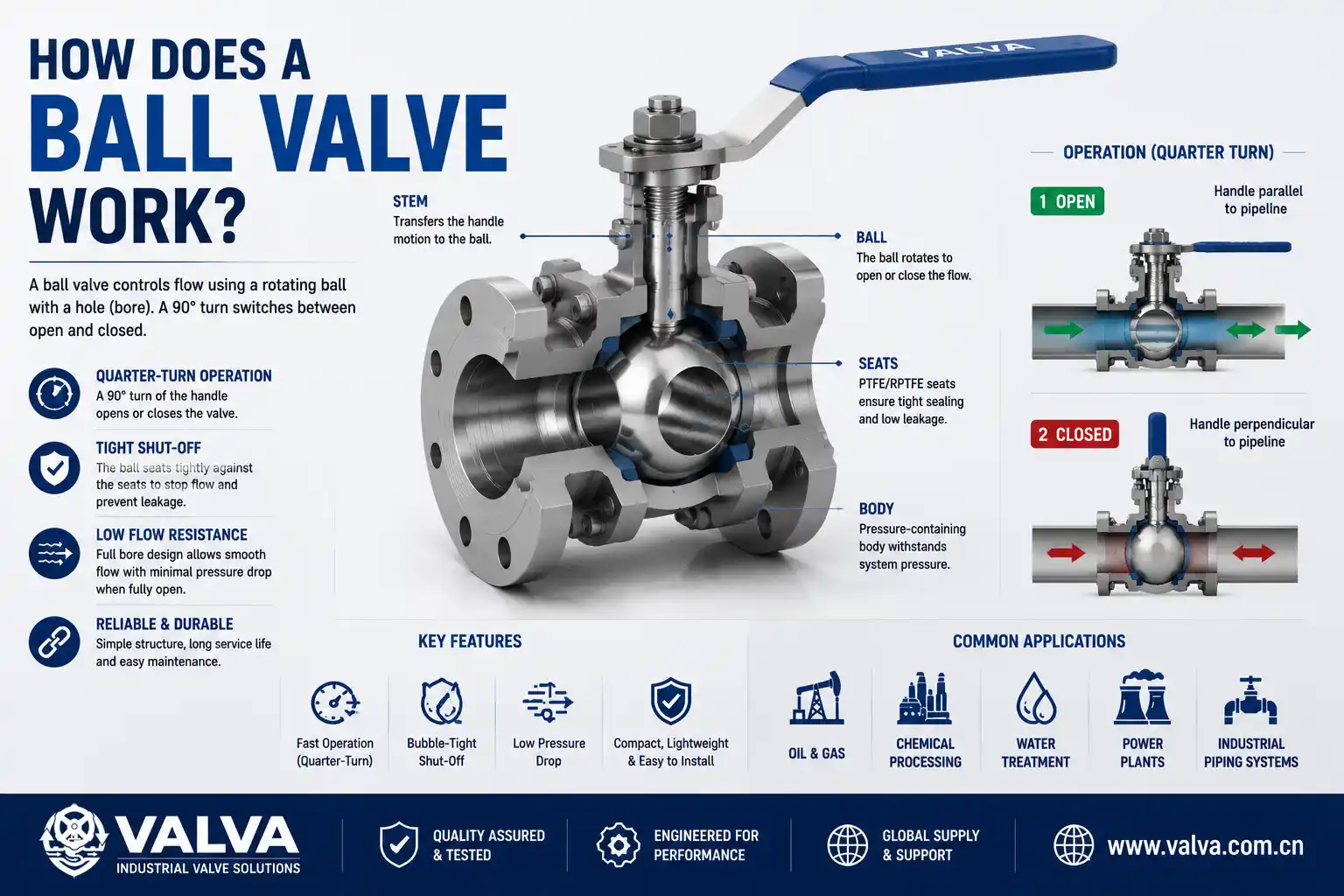
How does a ball valve work? A ball valve works by rotating a hollow ball with a drilled bore 90 degrees inside the valve body. When the bore aligns with the pipeline, fluid flows freely. Conversely, when the ball turns perpendicular to the flow path, the valve blocks the passage completely and creates a tight seal.
Ball valves are among the most popular industrial isolation valves because they combine simple operation, reliable sealing, and a long service life. Understanding how a ball valve works helps engineers, buyers, and maintenance teams select the right valve for different pressure, temperature, and media conditions.
How Does a Ball Valve Work?
The working principle of a ball valve is simple yet highly effective. At the center of the valve sits a precision-machined metal ball with a hole through its middle. This opening is called the bore.
When an operator turns the handle or an actuator rotates the stem, the ball rotates exactly 90 degrees.
- First, when the bore lines up with the pipeline, fluid passes directly through the valve.
- Next, when the ball rotates one-quarter turn, the solid side of the ball faces the pipeline.
- As a result, the valve completely stops the flow.
- Therefore, operators can quickly switch between fully open and fully closed positions.
Because of this quarter-turn operation, ball valves provide fast shut-off while requiring very little operating force.
Main Components That Make a Ball Valve Work
Several precision components work together to ensure smooth operation and reliable sealing.
The main parts include:
- Valve body
- Ball
- Stem
- Valve seats
- Stem packing
- Handle or actuator
- End connections
First, the handle or actuator rotates the stem.
Next, the stem transfers the rotational force directly to the ball.
Meanwhile, the valve seats maintain continuous contact with the polished ball surface.
Consequently, the valve creates a tight seal whenever it reaches the closed position.
Each component plays an essential role in maintaining long-term performance, especially in demanding industrial environments.
Open Position vs. Closed Position
Understanding the two operating positions makes it easier to see how a ball valve works.
Fully Open
When the valve is fully open:
- The bore aligns with the pipeline.
- Fluid flows in a straight path.
- Pressure loss remains very low.
- The system reaches maximum flow capacity.
Because the flow path is almost unrestricted, ball valves deliver excellent flow efficiency.
Fully Closed
When the valve closes:
- The solid portion of the ball blocks the pipeline.
- The seats press tightly against the ball.
- The valve stops the flow completely.
- Leakage remains extremely low.
As a result, industries often choose ball valves for applications that require dependable shut-off.
Manual and Automated Ball Valve Operation
Depending on the application, operators can control a ball valve manually or automatically.
Manual Ball Valves
For smaller systems, operators simply rotate the handle 90 degrees to open or close the valve.
Manual operation offers:
- Simple construction
- Low maintenance
- Fast operation
- Lower installation cost
Pneumatic Ball Valves
For automated systems, compressed air powers a pneumatic actuator.
As a result, pneumatic ball valves provide:
- Rapid operation
- Remote control
- High cycle life
- Reliable automation
Electric Ball Valves
Similarly, electric actuators rotate the valve automatically.
Engineers often install electric ball valves in:
- Water treatment plants
- HVAC systems
- Chemical processing facilities
- Automated manufacturing lines
Therefore, electric ball valves simplify remote monitoring and process control.
Why Ball Valves Provide Excellent Sealing
Another major advantage of ball valves is their outstanding sealing performance.
The valve seats press firmly against the polished ball surface whenever the valve closes.
Consequently, the valve offers several important benefits:
- Bubble-tight shut-off
- Low operating torque
- Minimal leakage
- Long service life
- Reduced maintenance costs
Soft seats usually provide excellent sealing for general industrial services.
However, metal-seated ball valves perform better in high-temperature or abrasive applications.
Choosing the correct seat material significantly improves valve reliability and operating life.
Common Applications of Ball Valves
Because of their simple design and dependable performance, industries around the world rely on ball valves.
Typical applications include:
- Oil and gas pipelines
- Petrochemical plants
- Water treatment facilities
- Power generation stations
- Food and beverage production
- Pharmaceutical manufacturing
- Marine engineering
- HVAC systems
Furthermore, many automated production lines use actuated ball valves to improve efficiency and reduce manual operation.
Whether the application involves clean water, steam, chemicals, or natural gas, understanding how a ball valve works helps engineers choose the right valve configuration.
How to Choose the Right Ball Valve
Selecting the correct ball valve requires more than matching the pipe size.
Before purchasing, buyers should evaluate:
- Working pressure
- Operating temperature
- Fluid type
- Valve material
- End connection
- Seat material
- Actuation method
- Industry standards
For example, stainless steel ball valves resist corrosion better than carbon steel models, while metal-seated designs perform well under extreme temperatures.
Therefore, selecting the right specification reduces maintenance costs and improves long-term reliability.
Conclusion
Now that you understand how a ball valve works, selecting the right valve becomes much easier. Ball valves use a simple quarter-turn mechanism to deliver fast operation, reliable sealing, and long service life. As a result, they remain one of the most widely used isolation valves across industrial piping systems worldwide.
Frequently Asked Questions(FAQ)
Can a ball valve regulate flow?
Although a standard ball valve can partially control flow, manufacturers primarily design it for on-off service. If your application requires accurate flow regulation, a V-port ball valve or a dedicated control valve is usually a better choice.
Is a ball valve better than a gate valve?
It depends on the application. Ball valves provide faster operation, tighter shut-off, and lower maintenance. However, gate valves are often preferred for large-diameter pipelines and applications requiring minimal pressure drop during continuous operation.
How long does a ball valve typically last?
A high-quality industrial ball valve can operate reliably for many years when users install it correctly and follow proper maintenance practices. Its actual service life depends on factors such as pressure, temperature, operating frequency, media type, and seat material.
Related Articles
Technical & Design Insights
- What Is a Ball Valve
- How Does a Ball Valve Work
- Different Types of Ball Valves
- Floating vs Trunnion Ball Valve
- Full Port vs Reduced Port Ball Valve
- Top Entry vs Side Entry Ball Valve
- V Port vs Standard Ball Valve
- What Are Ball Valves Used For
- One Piece vs Two Piece Ball Valve
- Two Piece vs Three Piece Ball Valve
- What Are the Different Types of Ball Valves