
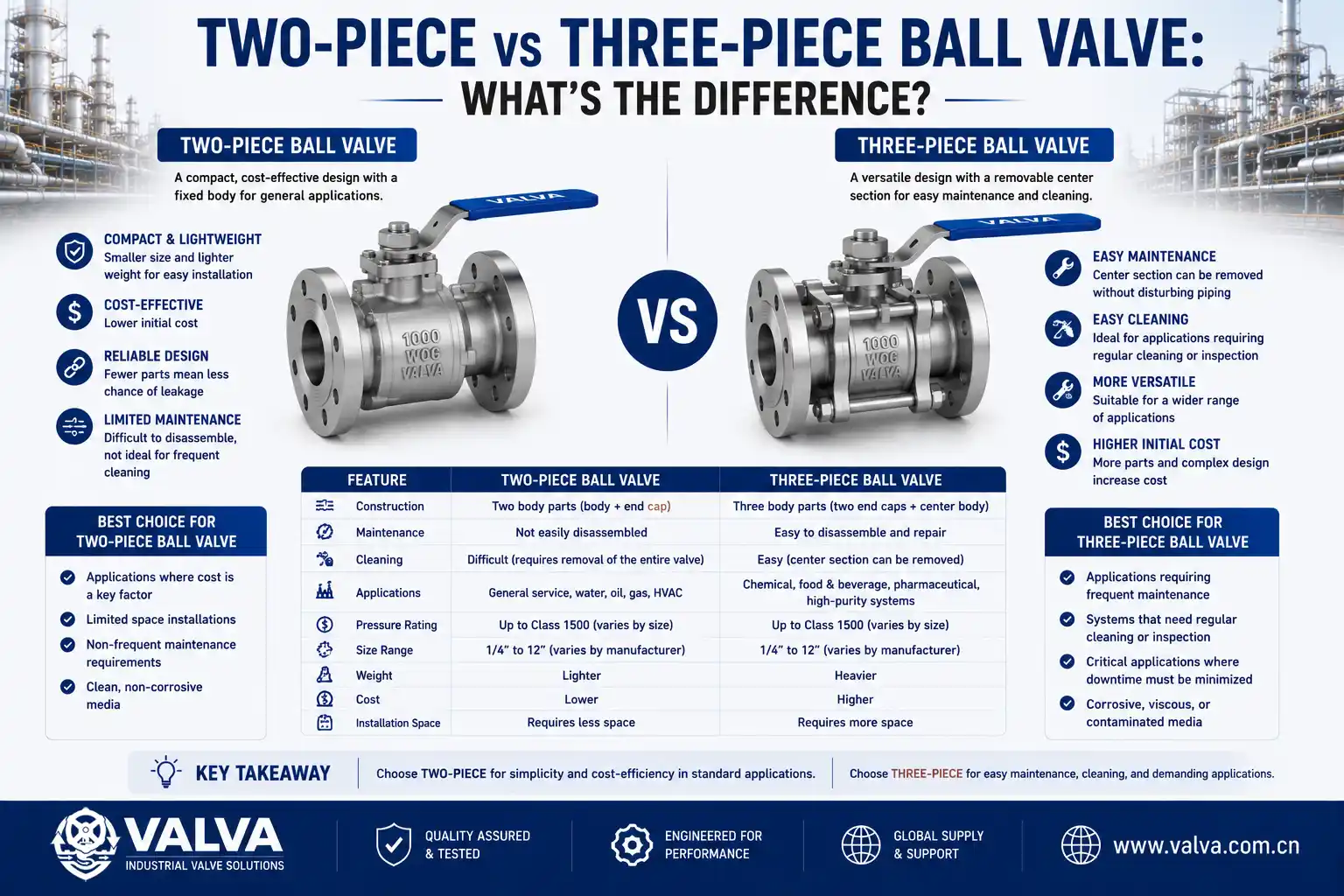
Direct Answer:
Two-piece vs three-piece ball valve—the key difference is body construction and maintainability. A two-piece ball valve has a body split into two sections, offering a balance of strength and cost efficiency. A three-piece ball valve has a modular body with a central section that can be removed for maintenance without disconnecting the pipeline, making it ideal for industrial systems requiring frequent servicing.
Understanding two-piece vs three-piece ball valve helps engineers choose between lower cost installation and easier long-term maintenance.
What Is a Two-Piece Ball Valve?
A two-piece ball valve consists of:
- One main body section
- One end cap section
- Internal ball and stem assembly
During assembly:
- The valve is bolted or threaded together.
- The body encloses the ball permanently during service.
Because of this structure, two-piece ball valves offer:
- Compact design
- Lower manufacturing cost
- Good mechanical strength
- Reliable shut-off performance
- Moderate maintenance complexity
However, full internal servicing requires removing the entire valve from the pipeline.
What Is a Three-Piece Ball Valve?
A three-piece ball valve consists of:
- Two end caps connected to the pipeline
- A removable central body section
- Internal ball, stem, and seats housed in the middle section
During maintenance:
- The central section can be removed without disturbing pipeline connections.
- Internal parts can be replaced or serviced easily.
Therefore, three-piece ball valves provide:
- Easy in-line maintenance
- Reduced downtime
- High flexibility in industrial systems
- Better long-term serviceability
- Suitable for frequent cleaning or replacement
Because of this design, they are widely used in process industries.
Two-Piece vs Three-Piece Ball Valve: Key Differences
| Feature | Two-Piece Ball Valve | Three-Piece Ball Valve |
|---|---|---|
| Body structure | 2 sections | 3 modular sections |
| Maintenance | Requires pipeline removal | In-line maintenance possible |
| Cost | Lower | Higher |
| Installation | Simple | Slightly more complex |
| Downtime during repair | Higher | Lower |
| Strength | High | High (modular design) |
| Cleaning access | Limited | Excellent |
| Industrial usage | General service | Process & sanitary systems |
Maintenance and Serviceability
Two-piece ball valves require full removal from the pipeline for internal inspection or repair.
As a result:
- Maintenance takes more time.
- System downtime increases.
- Labor cost is higher during servicing.
In contrast, three-piece ball valves allow:
- Quick disassembly of the central section
- Seat and seal replacement without pipe removal
- Faster cleaning in hygienic applications
Therefore, industries with strict uptime requirements often prefer three-piece designs.
Cost Comparison
Two-piece ball valves are more economical because:
- Fewer components
- Simpler machining
- Faster production process
Three-piece ball valves cost more due to:
- Modular construction
- Additional flanges and bolts
- Higher precision assembly requirements
However, the higher upfront cost can be offset by reduced maintenance downtime in industrial environments.
Pressure and Performance
Both valve types provide strong performance under industrial conditions.
However:
- Two-piece valves are ideal for stable systems with minimal maintenance needs.
- Three-piece valves are preferred in systems requiring frequent inspection or cleaning.
Pressure ratings depend more on material and design class than body type, but both can meet high-pressure industrial standards.
Applications
Two-Piece Ball Valve Applications
- Water supply systems
- HVAC systems
- General industrial pipelines
- Compressed air systems
- Utility service lines
Three-Piece Ball Valve Applications
- Chemical processing plants
- Food and beverage systems
- Pharmaceutical pipelines
- High-purity fluid systems
- Systems requiring frequent maintenance
How to Choose Between Two-Piece and Three-Piece Ball Valves
Before selecting a valve, evaluate:
- Maintenance frequency
- System downtime cost
- Fluid cleanliness requirements
- Installation space
- Budget constraints
- Process criticality
If your system is stable and rarely maintained, a two-piece valve is sufficient.
If your system requires frequent cleaning or servicing, a three-piece valve is the better long-term solution.
Conclusion
In the comparison of two-piece vs three-piece ball valve, the difference is primarily maintenance flexibility versus cost efficiency. Two-piece valves offer a simple, cost-effective solution for general use, while three-piece valves provide superior serviceability for demanding industrial and sanitary applications. The best choice depends on maintenance needs and operational priorities.
Frequently Asked Questions
Which is better, two-piece or three-piece ball valve?
It depends on the application.
Two-piece valves are better for low-maintenance systems, while three-piece valves are better for systems requiring frequent cleaning or repair.
Why are three-piece ball valves more expensive?
Because of their design.
They use additional components and a modular structure that allows in-line maintenance, increasing manufacturing complexity and cost.
Can a three-piece ball valve be repaired without removing it from the pipeline?
Yes.
The central body section can be removed while the end connections remain installed, making maintenance faster and reducing downtime.
Related Articles
Technical & Design Insights
- What Is a Ball Valve
- How Does a Ball Valve Work
- Different Types of Ball Valves
- Floating vs Trunnion Ball Valve
- Full Port vs Reduced Port Ball Valve
- Top Entry vs Side Entry Ball Valve
- V Port vs Standard Ball Valve
- What Are Ball Valves Used For
- One Piece vs Two Piece Ball Valve
- Two Piece vs Three Piece Ball Valve
- What Are the Different Types of Ball Valves