
Direct Answer:
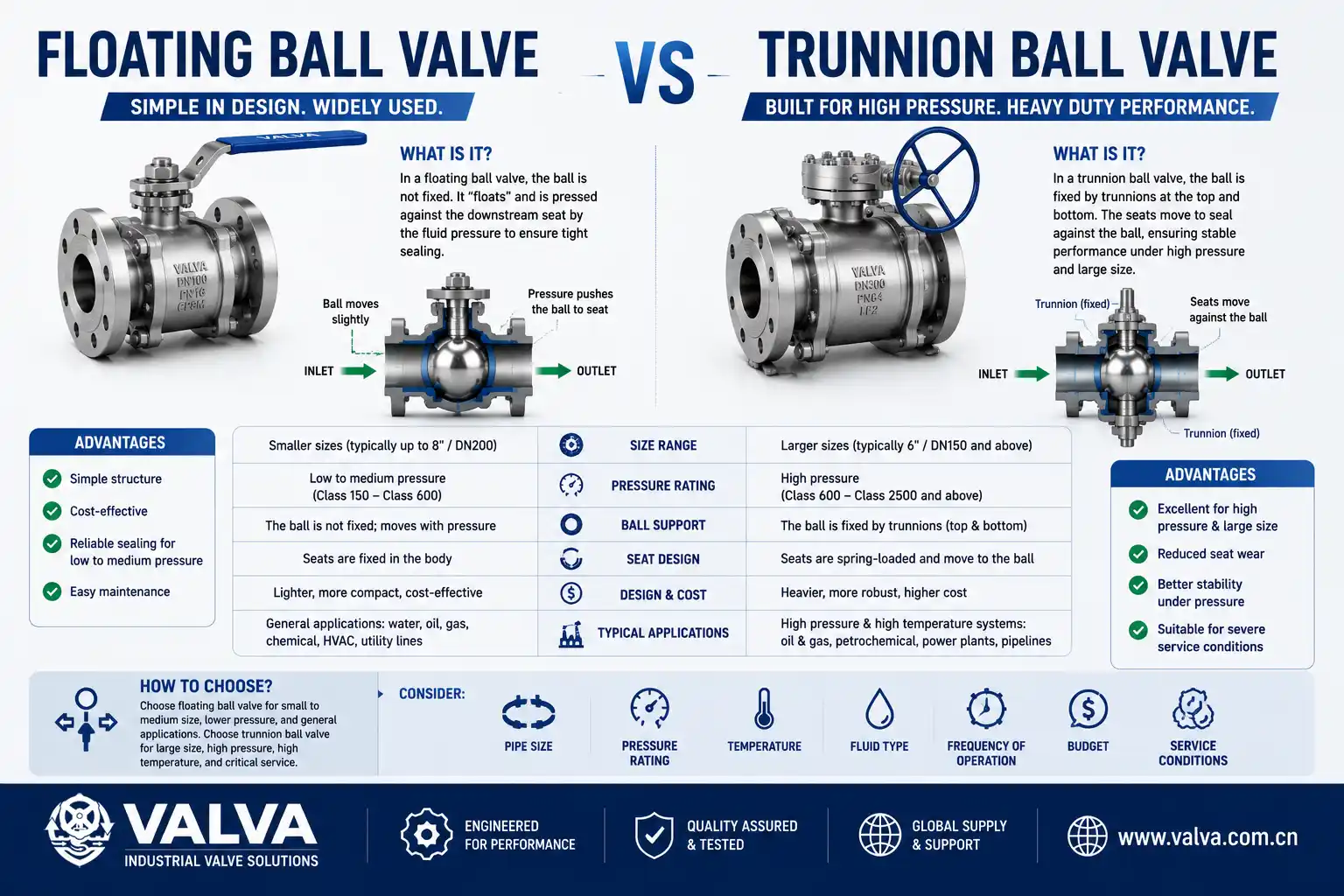
Floating ball valve vs trunnion ball valve—the main difference lies in how the ball is supported. A floating ball valve allows the ball to move slightly under pressure to create a seal, while a trunnion ball valve secures the ball with upper and lower trunnions, reducing operating torque and improving performance in high-pressure, large-diameter applications.
Choosing between these two designs depends on factors such as pressure, valve size, operating torque, maintenance requirements, and project budget. Understanding the differences helps engineers and buyers select the most suitable valve for their application.
How Does a Floating Ball Valve Work?
A floating ball valve supports the ball using two resilient valve seats instead of fixed bearings.
When the valve closes, line pressure pushes the ball slightly downstream. The ball then presses firmly against the downstream seat, creating a reliable seal.
Because of this simple design, floating ball valves offer:
- Compact construction
- Lower manufacturing cost
- Easy maintenance
- Reliable sealing
- Quick quarter-turn operation
As a result, they are widely used in general industrial services and medium-pressure piping systems.
How Does a Trunnion Ball Valve Work?
Unlike a floating design, a trunnion ball valve fixes the ball in position using upper and lower trunnion supports.
Instead of moving the ball against the seat, line pressure energizes the seats to seal against the stationary ball.
Therefore, trunnion ball valves provide:
- Lower operating torque
- Better stability
- Improved sealing under high pressure
- Longer service life in demanding applications
- Easier automation for large valves
Consequently, industries often install trunnion ball valves in critical pipeline systems.
Key Differences Between Floating and Trunnion Ball Valves
| Feature | Floating Ball Valve | Trunnion Ball Valve |
|---|---|---|
| Ball support | Floating between seats | Fixed by upper and lower trunnions |
| Pressure range | Low to medium | Medium to very high |
| Valve size | Small to medium | Medium to very large |
| Operating torque | Higher on large valves | Lower |
| Initial cost | Lower | Higher |
| Maintenance | Simple | More complex |
| Automation | Suitable for small valves | Ideal for large automated valves |
| Typical industries | Water, HVAC, chemical | Oil & gas, LNG, petrochemical |
Pressure and Size Comparison
Pressure and valve size often determine the best choice.
Floating ball valves perform well in:
- Low-pressure systems
- Medium-pressure systems
- Small and medium pipe sizes
However, operating torque increases as valve diameter grows.
In contrast, trunnion mounted ball valves are specifically designed for:
- High-pressure pipelines
- Large-diameter valves
- Long-distance transmission lines
- Severe industrial service
Therefore, engineers usually specify trunnion designs for demanding operating conditions.
Cost Comparison
Budget also influences valve selection.
Floating ball valves generally cost less because they have fewer components and a simpler internal structure.
In comparison, trunnion ball valves require:
- Precision trunnions
- Additional bearings
- Spring-loaded seats
- More complex machining
Although the initial investment is higher, trunnion valves often reduce operating costs in high-pressure applications through lower torque and longer service life.
Which Valve Provides Better Sealing?
Both valve types provide excellent shut-off when selected correctly.
Floating ball valves create a seal by allowing pressure to push the ball against the downstream seat.
Meanwhile, trunnion ball valves use pressure-assisted seats that seal around the fixed ball.
As operating pressure increases, trunnion designs maintain more consistent sealing performance while reducing seat wear.
Consequently, industries frequently select trunnion valves for critical isolation duties.
Typical Applications
Floating Ball Valve Applications
Floating ball valves are commonly used in:
- Water treatment plants
- HVAC systems
- Compressed air systems
- Chemical processing
- Food and beverage production
- General industrial utilities
Trunnion Ball Valve Applications
Trunnion ball valves are widely installed in:
- Oil and gas pipelines
- LNG terminals
- Refineries
- Petrochemical plants
- Offshore platforms
- Power generation facilities
Because these industries operate under high pressure and demanding conditions, they require the added stability of trunnion-mounted designs.
How to Choose Between a Floating and Trunnion Ball Valve
Before making a purchasing decision, consider:
- Operating pressure
- Valve size
- Media type
- Operating frequency
- Automation requirements
- Budget
- Maintenance expectations
- Applicable industry standards
If your application involves low to medium pressure and moderate pipe sizes, a floating ball valve is usually the most economical option.
However, if you need reliable performance in high-pressure or large-diameter pipelines, a trunnion ball valve is generally the better investment.
Conclusion
When comparing floating ball valve vs trunnion ball valve, there is no universal winner. Floating ball valves offer a simple, cost-effective solution for general industrial applications, while trunnion ball valves deliver superior performance in high-pressure and large-diameter systems. Selecting the right design depends on your operating conditions, performance requirements, and long-term maintenance goals.
Frequently Asked Questions
Which is better, a floating ball valve or a trunnion ball valve?
It depends on the application.
Floating ball valves are ideal for low- to medium-pressure systems, while trunnion ball valves are better suited for high-pressure, large-diameter pipelines.
Why do trunnion ball valves require less operating torque?
Because the ball is mechanically supported.
The trunnions hold the ball in place, allowing the seats to move toward the ball instead of forcing the ball against the seats. This design significantly reduces operating torque.
Are trunnion ball valves more expensive?
Yes.
Trunnion ball valves generally have a higher purchase price because of their more complex construction. However, they often provide better long-term value in demanding industrial applications.
Related Articles
Technical & Design Insights
- What Is a Ball Valve
- How Does a Ball Valve Work
- Different Types of Ball Valves
- Floating vs Trunnion Ball Valve
- Full Port vs Reduced Port Ball Valve
- Top Entry vs Side Entry Ball Valve
- V Port vs Standard Ball Valve
- What Are Ball Valves Used For
- One Piece vs Two Piece Ball Valve
- Two Piece vs Three Piece Ball Valve
- What Are the Different Types of Ball Valves