Direct Answer:
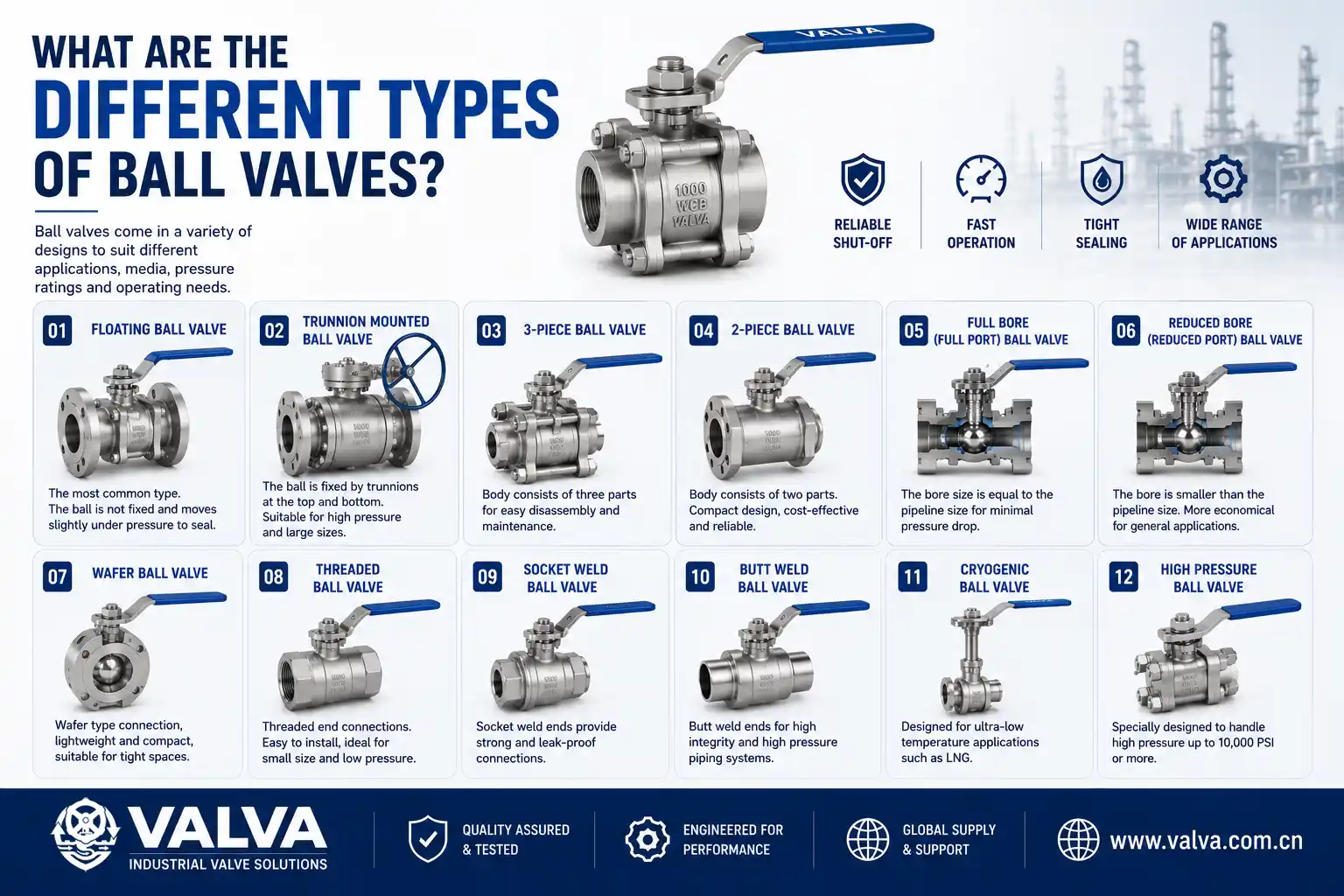
What are the different types of ball valves? The main types of ball valves include floating ball valves, trunnion mounted ball valves, full port ball valves, reduced port ball valves, V-port ball valves, multi-port ball valves, top entry ball valves, side entry ball valves, welded body ball valves, and split body ball valves. Each type serves different pressure ratings, flow requirements, and industrial applications.
Ball valves are among the most versatile valves used in industrial piping systems. Understanding what are the different types of ball valves helps engineers, contractors, and buyers choose the right valve for reliable performance, safety, and long service life.
Ball Valves Classified by Ball Support
One of the most common ways to classify ball valves is by how the ball is supported inside the valve body.
Floating Ball Valve
A floating ball valve uses two valve seats to support the ball. When pressure builds, the ball moves slightly downstream and presses tightly against the seat, creating an effective seal.
Floating ball valves are commonly used for:
- Low- and medium-pressure systems
- Water treatment
- Chemical processing
- General industrial services
Because of their simple construction, they are economical and easy to maintain.
Trunnion Mounted Ball Valve
A trunnion mounted ball valve supports the ball with upper and lower trunnions instead of allowing it to float.
As a result, operating torque decreases significantly, especially in large-diameter and high-pressure applications.
Trunnion ball valves are widely used in:
- Oil and gas pipelines
- LNG facilities
- Refineries
- Petrochemical plants
- High-pressure transmission systems
Ball Valves Classified by Port Design
The port design affects flow capacity and pressure loss.
Full Port Ball Valve
A full port ball valve has a bore diameter that matches the pipe’s inside diameter.
Therefore, it provides:
- Minimal pressure drop
- Maximum flow capacity
- Easy pipeline pigging
- Reduced turbulence
Many pipeline systems prefer full port designs.
Reduced Port Ball Valve
A reduced port ball valve has a smaller internal bore than the pipeline.
Its advantages include:
- Lower cost
- Smaller size
- Reduced weight
However, it produces a slightly higher pressure drop than a full port valve.
Ball Valves Classified by Flow Function
Some ball valves perform specialized flow control functions.
V-Port Ball Valve
Unlike standard ball valves, a V-port ball valve features a V-shaped opening in the ball.
Consequently, it provides more accurate flow regulation.
Industries often install V-port valves in:
- Chemical dosing systems
- Water treatment plants
- Process automation
- Flow control applications
Multi-Port Ball Valve
A multi-port ball valve contains three or four ports instead of two.
It allows operators to:
- Divert flow
- Mix fluids
- Change flow direction
As a result, one multi-port valve can often replace several standard valves.
Ball Valves Classified by Body Construction
The valve body design influences maintenance and installation.
Split Body Ball Valve
A split body valve consists of two or more sections bolted together.
Advantages include:
- Lower manufacturing cost
- Easier maintenance
- Convenient seat replacement
Many general industrial applications use split body valves.
Top Entry Ball Valve
A top entry ball valve allows maintenance from the top without removing the valve from the pipeline.
Therefore, it minimizes downtime and simplifies repairs.
These valves are common in:
- Offshore platforms
- Oil refineries
- Pipeline stations
Side Entry Ball Valve
Side entry ball valves assemble from the side of the valve body.
Manufacturers widely produce them because they offer:
- Cost-effective manufacturing
- Flexible sizing
- Easy replacement
- Broad availability
Welded Body Ball Valve
A welded body ball valve uses a fully welded construction instead of bolted joints.
Because there are fewer potential leak paths, these valves are ideal for:
- District heating
- Natural gas distribution
- Underground pipelines
- Long-term buried service
Which Type of Ball Valve Is Best?
The best ball valve depends entirely on your application.
For example:
- Floating ball valves suit general industrial services.
- Trunnion mounted valves handle high-pressure pipelines.
- Full port valves maximize flow efficiency.
- Reduced port valves reduce installation costs.
- V-port valves improve flow control.
- Multi-port valves simplify piping layouts.
- Top entry valves make maintenance easier.
- Welded body valves provide maximum leak protection.
Therefore, buyers should evaluate pressure, temperature, media, valve size, and operating conditions before making a selection.
How to Choose the Right Ball Valve
Before purchasing a ball valve, consider the following factors:
- Operating pressure
- Working temperature
- Fluid characteristics
- Valve size
- Pressure class
- Port design
- Body construction
- End connection
- Manual or automated operation
- Industry standards
Choosing the appropriate valve improves safety, extends service life, and reduces maintenance costs.
Conclusion
Now you know what are the different types of ball valves. Each design offers unique advantages for specific operating conditions. By understanding the differences between floating, trunnion, full port, reduced port, V-port, multi-port, and various body constructions, you can select the most suitable ball valve for your industrial application.
Frequently Asked Questions
Which ball valve is best for high-pressure applications?
Trunnion mounted ball valves.
They reduce operating torque and provide reliable sealing under high pressure, making them the preferred choice for large industrial pipelines.
What is the difference between a full port and a reduced port ball valve?
The bore size.
A full port ball valve has the same inside diameter as the pipeline, while a reduced port valve has a smaller bore that creates a slight pressure drop.
Which ball valve requires the least maintenance?
Welded body and top entry ball valves.
Welded body valves minimize external leak paths, while top entry valves allow easier maintenance without removing the valve from the pipeline.
Related Articles
Technical & Design Insights
- What Is a Ball Valve
- How Does a Ball Valve Work
- Different Types of Ball Valves
- Floating vs Trunnion Ball Valve
- Full Port vs Reduced Port Ball Valve
- Top Entry vs Side Entry Ball Valve
- V Port vs Standard Ball Valve
- What Are Ball Valves Used For
- One Piece vs Two Piece Ball Valve
- Two Piece vs Three Piece Ball Valve
- What Are the Different Types of Ball Valves