
Direct Answer:
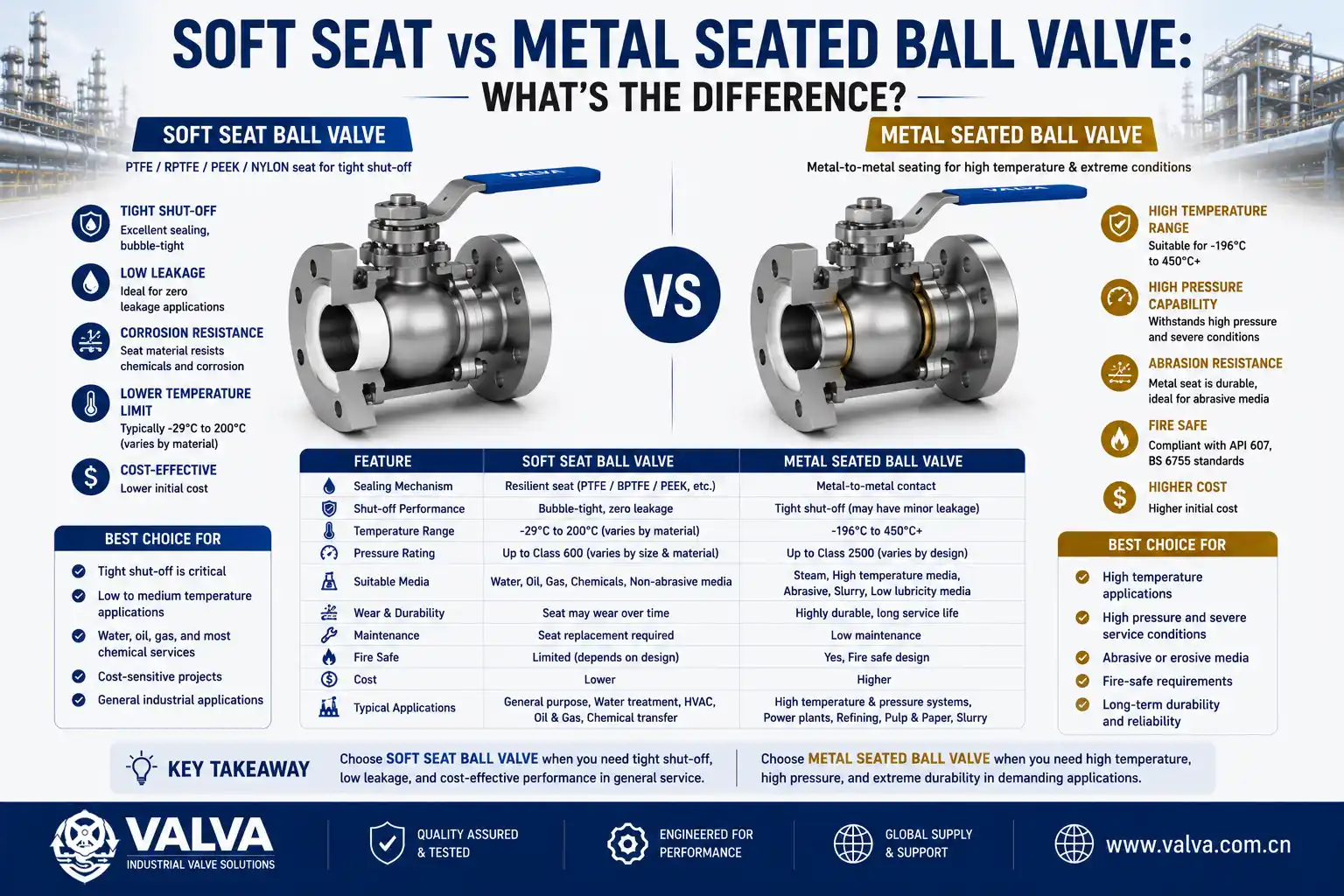
Soft seat vs metal seated ball valve—the key difference is the sealing material. A soft seat ball valve uses polymer materials such as PTFE to achieve tight sealing and low leakage, while a metal seated ball valve uses metal-to-metal contact for extreme temperature, pressure, and abrasive service conditions.
Understanding soft seat vs metal seated ball valve is essential for selecting the correct valve type based on temperature range, media abrasiveness, pressure level, and required sealing performance.
What Is a Soft Seat Ball Valve?
A soft seat ball valve uses non-metallic sealing materials such as:
- PTFE (Teflon)
- RPTFE
- PEEK (in advanced designs)
- Elastomer-based materials
When the valve closes:
- The ball presses into the soft seat.
- The material deforms slightly to create a tight seal.
Because of this structure, soft seat ball valves provide:
- Bubble-tight sealing (zero leakage potential)
- Low operating torque
- Excellent performance in clean fluids
- Cost-effective manufacturing
- Smooth operation
However, soft seats have material limitations under extreme conditions.
What Is a Metal Seated Ball Valve?
A metal seated ball valve uses hardened metal materials for both the ball and seat surfaces.
Common materials include:
- Stainless steel (hardened)
- Stellite overlay
- Tungsten carbide coatings
- Nickel-based alloys
When closing:
- Metal surfaces compress directly against each other.
- Precision machining ensures sealing contact.
Therefore, metal seated ball valves provide:
- High-temperature resistance
- Excellent abrasion resistance
- Long service life in harsh environments
- Suitable for slurry and solid-laden media
- Stability under extreme pressure conditions
Soft Seat vs Metal Seated Ball Valve: Key Differences
| Feature | Soft Seat Ball Valve | Metal Seated Ball Valve |
|---|---|---|
| Sealing material | PTFE / RPTFE / polymers | Metal-to-metal (hardened alloys) |
| Leakage performance | Bubble-tight (excellent) | Very low but not always zero |
| Temperature range | Limited (typically <200°C) | Very high (up to extreme industrial levels) |
| Abrasion resistance | Low | High |
| Pressure capability | Medium | High to very high |
| Service life in harsh media | Limited | Long |
| Cost | Lower | Higher |
| Maintenance | Easier | More demanding |
| Typical applications | Clean fluids | Slurry, steam, high-temp media |
Sealing Performance Comparison
Soft seat ball valves achieve superior sealing because polymer materials conform tightly to the ball surface.
As a result:
- Leakage risk is extremely low.
- They perform well in sanitary and clean systems.
- They are ideal for shut-off applications.
However, under high temperature or abrasive flow:
- Soft materials degrade quickly.
- Seat deformation may occur over time.
Metal seated valves behave differently.
Instead of deformation:
- Metal surfaces rely on precision grinding.
- Sealing depends on tight machining tolerances.
Therefore:
- They tolerate extreme conditions better.
- But they may not achieve absolute bubble-tight sealing in every case.
Temperature and Pressure Capability
Soft seat ball valves are best suited for:
- Low to medium pressure systems
- Moderate temperature applications
- Clean water, oil, and gas services
Metal seated ball valves are designed for:
- High-pressure pipelines
- High-temperature steam systems
- Thermal cycling environments
- Abrasive or corrosive slurry systems
Because metal maintains strength under heat, it performs reliably where polymers fail.
Abrasive and Corrosive Media Performance
Soft seat valves perform poorly in:
- Sand-laden fluids
- Slurry pipelines
- Crystallizing chemicals
Because soft materials wear quickly.
Metal seated valves perform well in:
- Mining slurry
- Cement production
- Refinery residue systems
- High-solid content fluids
Their hardened surfaces resist erosion and mechanical damage.
Cost Comparison
Soft seat ball valves are more economical due to:
- Lower material cost
- Simpler manufacturing
- Widely available components
Metal seated ball valves are more expensive because:
- Hardfacing processes are required
- Precision machining is critical
- Specialized alloys increase cost
However, metal seated designs reduce long-term maintenance costs in harsh environments.
Typical Applications
Soft Seat Ball Valve Applications
- Water treatment systems
- Food and beverage processing
- HVAC systems
- Light chemical services
- General industrial isolation
Metal Seated Ball Valve Applications
- Oil and gas production
- High-temperature steam systems
- Mining and slurry pipelines
- Petrochemical processing
- Power plants and boiler systems
How to Choose Between Soft Seat and Metal Seated Ball Valves
Before selecting a valve, evaluate:
- Operating temperature
- Pressure level
- Fluid cleanliness
- Abrasiveness of media
- Required sealing performance
- Maintenance capability
- Lifecycle cost expectations
If your system is clean and moderate in conditions, soft seat valves provide excellent value.
If your system is harsh, high-temperature, or abrasive, metal seated valves are the safer long-term solution.
Conclusion
In the comparison of soft seat vs metal seated ball valve, soft seat valves deliver superior sealing performance for clean and moderate applications, while metal seated valves provide unmatched durability in extreme temperature, pressure, and abrasive conditions. The correct choice depends on operating environment rather than initial cost.
Frequently Asked Questions
Which provides better sealing, soft seat or metal seated ball valve?
Soft seat valves.
Soft seat materials deform slightly to create bubble-tight sealing, making them ideal for clean fluid systems.
Can metal seated ball valves achieve zero leakage?
In most cases, nearly zero—but not always absolute.
Metal-to-metal sealing depends on machining precision and operating conditions, so performance is excellent but not always perfectly bubble-tight.
When should I use a metal seated ball valve?
In harsh environments.
Use metal seated valves for high-temperature, high-pressure, or abrasive media such as slurry, steam, and petrochemical systems.
Related Articles
Technical & Design Insights
- What Is a Ball Valve
- How Does a Ball Valve Work
- Different Types of Ball Valves
- Floating vs Trunnion Ball Valve
- Full Port vs Reduced Port Ball Valve
- Top Entry vs Side Entry Ball Valve
- V Port vs Standard Ball Valve
- What Are Ball Valves Used For
- One Piece vs Two Piece Ball Valve
- Two Piece vs Three Piece Ball Valve
- What Are the Different Types of Ball Valves