
Direct Answer
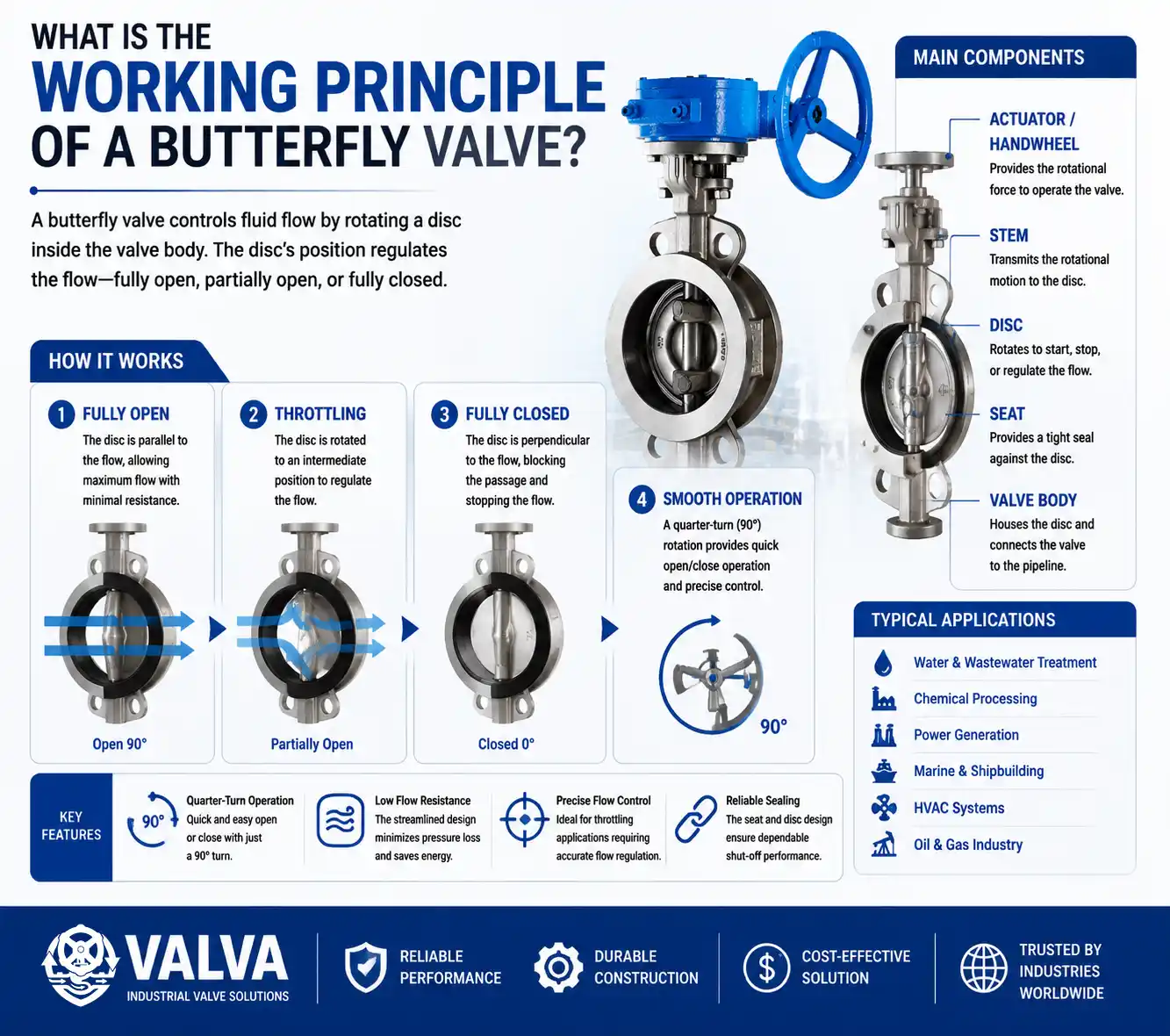
The working principle of a butterfly valve is based on a rotating disc mounted on a central shaft. Turning the valve stem 90 degrees rotates the disc to either allow, restrict, or completely stop fluid flow. This simple quarter-turn operation enables fast, efficient flow control in industrial piping systems.
How a Butterfly Valve Controls Flow
A butterfly valve regulates flow by changing the position of its disc inside the pipeline.
When the valve handle, gearbox, or actuator rotates the stem, the disc turns with it.
The disc position determines how much fluid can pass through the valve:
- 0° (Closed): The disc is perpendicular to the flow, blocking the pipeline.
- 45° (Partially Open): The disc allows partial flow for throttling.
- 90° (Fully Open): The disc is parallel to the flow, minimizing flow resistance.
Because only a quarter turn is required, butterfly valves operate much faster than multi-turn valves such as gate or globe valves.
Main Components Involved in the Working Principle
Several components work together to control fluid flow.
Valve Body
The body houses all internal components and connects to the pipeline.
Disc
The disc is the primary flow-control element. Its rotation opens or closes the valve.
Stem (Shaft)
The stem transfers torque from the operator or actuator to the disc.
Seat
The seat creates a seal between the disc and the valve body, preventing leakage when the valve is closed.
Actuator or Handle
The valve can be operated manually using a lever or gearbox, or automatically using electric, pneumatic, or hydraulic actuators.
Butterfly Valve Operating Positions
A butterfly valve has three primary operating positions.
Fully Closed
The disc blocks the entire flow path, creating a tight shutoff.
Partially Open
The disc is positioned at an angle, allowing controlled flow for throttling applications.
Fully Open
The disc aligns with the flow direction, reducing pressure loss while allowing maximum flow.
Why Quarter-Turn Operation Is Efficient
The butterfly valve’s quarter-turn design offers several operational advantages.
These include:
- Fast opening and closing
- Simple operating mechanism
- Easy automation
- Lower operating torque
- Reduced maintenance
- Compact installation space
These characteristics make butterfly valves popular in large-diameter piping systems.
Types of Butterfly Valves Based on Sealing Design
Although all butterfly valves share the same basic working principle, their sealing mechanisms differ.
Resilient-Seated Butterfly Valve
Uses a rubber or elastomer seat to provide bubble-tight sealing in low- and medium-pressure applications.
High-Performance Butterfly Valve
Features a double-offset disc design that reduces seat wear and improves sealing under higher pressures and temperatures.
Triple-Offset Butterfly Valve
Uses a metal-to-metal sealing system with triple-offset geometry for severe service applications involving high pressure, high temperature, and corrosive media.
Advantages of the Butterfly Valve Working Principle
The simple operating mechanism provides numerous benefits.
These include:
- Quick quarter-turn operation
- Lightweight construction
- Lower installation costs
- Excellent flow regulation
- Easy maintenance
- Suitable for manual and automated systems
- Ideal for large pipeline diameters
Typical Industrial Applications
Because of their efficient operating principle, butterfly valves are widely used in industries such as:
- Water treatment
- Water distribution
- HVAC systems
- Chemical processing
- Oil and gas
- Power generation
- Marine engineering
- Food and beverage processing
- Mining
- Pulp and paper
Factors Affecting Butterfly Valve Performance
Several factors influence how effectively a butterfly valve operates.
These include:
- Valve size
- Disc design
- Seat material
- Body material
- Operating pressure
- Operating temperature
- Fluid type
- Actuator selection
Proper valve selection ensures long service life and reliable performance.
Conclusion
The working principle of a butterfly valve relies on a rotating disc that opens, throttles, or closes fluid flow through a simple 90-degree rotation. Its quarter-turn operation, compact design, and ease of automation make butterfly valves one of the most efficient and widely used flow-control valves in modern industrial piping systems.
Frequently Asked Questions
Why is a butterfly valve called a quarter-turn valve?
Because the disc rotates only 90 degrees from fully closed to fully open, allowing quick and efficient operation.
Can a butterfly valve be used for throttling?
Yes. Butterfly valves can regulate flow by positioning the disc between fully open and fully closed, making them suitable for many throttling applications.
What rotates inside a butterfly valve?
The disc rotates around the central stem. As the disc turns, it changes the flow area inside the pipeline to control or stop fluid flow.
Related Articles
Technical & Design Insights
- How Does a Butterfly Valve Work
- Working Principle of Butterfly Valve
- Butterfly Valve Components
- Butterfly Valve Materials
- Wafer vs Lug Butterfly Valve
- Wafer vs Lug vs Flanged Butterfly Valve
- High Performance vs Concentric Butterfly Valve
- Double Offset vs Triple Offset Butterfly Valve
- Soft Seat vs Metal Seat Butterfly Valve
- Rubber Lined vs PTFE Butterfly Valve
- Manual vs Automated Butterfly Valve
- Electric vs Pneumatic Butterfly Valve
Commercial & Purchasing Topics
- Wafer Butterfly Valve Wholesale Price
- Stainless Steel Butterfly Valve Factory Direct Supplier
- API 609 Butterfly Valve Manufacturer in China Guide
- Electric Butterfly Valve Price List DN50 DN200
- Pneumatic Butterfly Valve Bulk Order Supplier
- High Performance Butterfly Valve Export Supplier
- Industrial Butterfly Valve Quotation Fast Delivery
- Butterfly Valve OEM Manufacturer Oil & Gas Industry
- Butterfly Valve Supplier Water Treatment Project
- Butterfly Valve Supplier Industrial Applications