Direct Answer
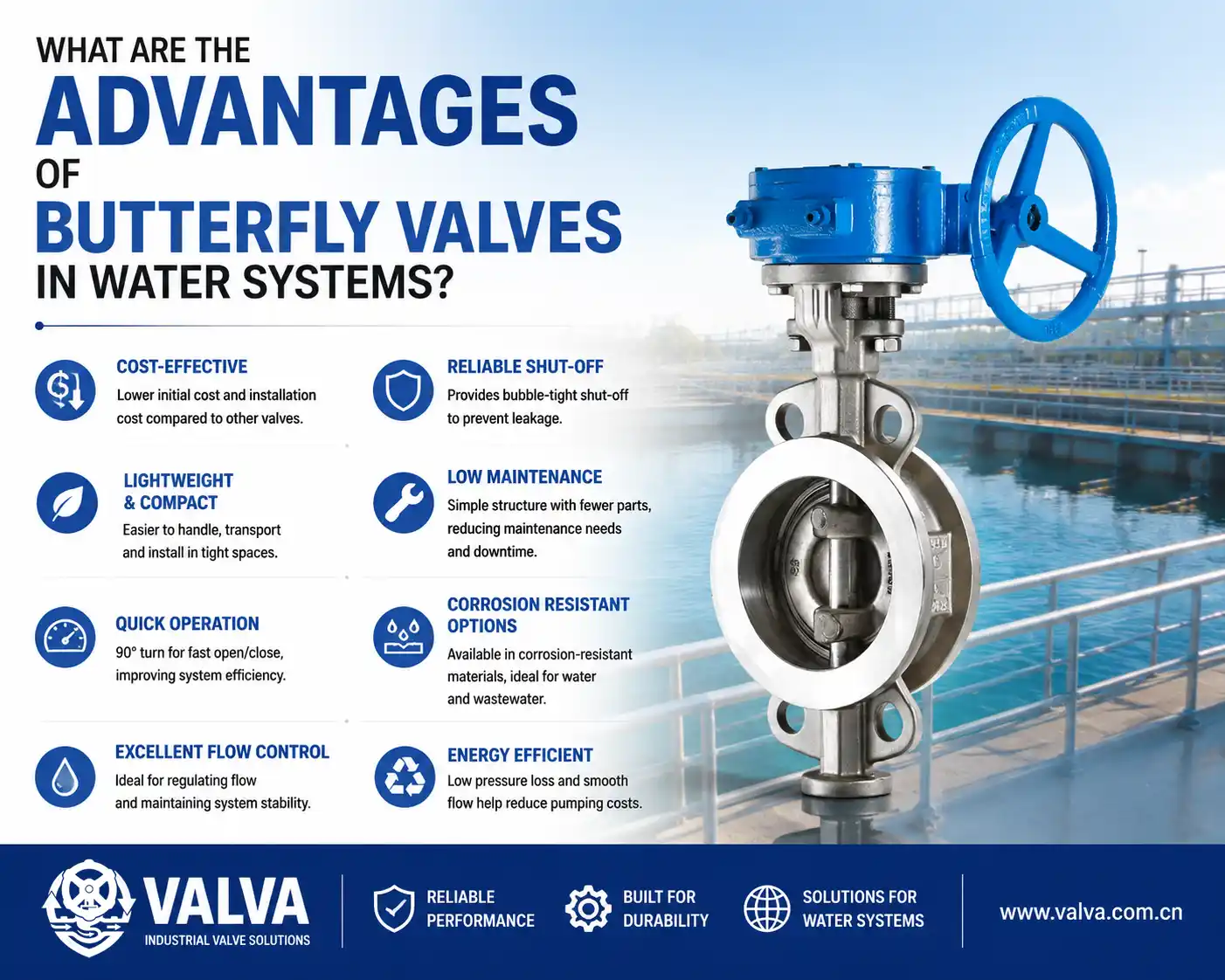
Butterfly valves are widely used in water systems because they are compact, lightweight, cost-effective, and easy to operate. They provide reliable shut-off and flow regulation, require minimal installation space, and are well suited for municipal water supply, wastewater treatment, irrigation, HVAC, and industrial water pipelines. Their simple quarter-turn operation also makes them ideal for automated control systems.
Lower Installation and Equipment Costs
One of the biggest advantages of butterfly valves is their affordability.
Compared with other valve types, butterfly valves generally:
- Cost less to manufacture
- Require less installation labor
- Use smaller actuators
- Reduce transportation costs due to their lighter weight
For large-diameter water pipelines, these savings can significantly reduce the overall project budget.
Compact and Lightweight Design
Butterfly valves have a simple body structure that occupies less space than many other industrial valves.
Benefits include:
- Easier installation in confined spaces
- Reduced structural support requirements
- Lower pipe loading
- Easier maintenance and replacement
This makes them particularly suitable for underground pipelines and water treatment facilities.
Fast Quarter-Turn Operation
A butterfly valve opens or closes with only a 90-degree rotation.
Advantages include:
- Faster system isolation
- Quick emergency shutdown
- Reduced operator effort
- Improved process efficiency
The simple operating mechanism also minimizes wear during frequent operation.
Excellent Flow Control
Unlike some isolation valves, butterfly valves can regulate flow by partially opening the disc.
This makes them ideal for:
- Water distribution systems
- Pump stations
- Irrigation networks
- Cooling water circuits
- Water treatment processes
Operators can easily adjust flow rates without installing additional control equipment in many applications.
Suitable for Large-Diameter Pipelines
Butterfly valves are especially economical in larger pipe sizes.
They are commonly installed in pipelines ranging from:
- DN50 (2″)
- DN100 (4″)
- DN300 (12″)
- DN600 (24″)
- DN1200 (48″) and larger
As pipe diameter increases, butterfly valves become increasingly more practical than many alternative valve types.
Easy Automation
Modern water systems often rely on automatic control.
Butterfly valves can be fitted with:
- Electric actuators
- Pneumatic actuators
- Hydraulic actuators
Automation enables:
- Remote monitoring
- Automatic flow regulation
- Emergency shutdown
- Integration with SCADA and control systems
Reliable Performance with Low Maintenance
Butterfly valves contain relatively few moving parts.
This provides several maintenance benefits:
- Reduced wear
- Easy seal replacement
- Lower maintenance costs
- Long service intervals
- Reliable long-term operation
Routine inspection and seal maintenance are generally sufficient to keep the valve operating efficiently.
Versatile for Different Water Applications
Butterfly valves are widely used across various water systems.
Typical applications include:
Municipal Water Supply
- Distribution pipelines
- Reservoir outlets
- Pump stations
Wastewater Treatment
- Treatment plants
- Sludge handling
- Effluent discharge
Irrigation Systems
- Agricultural irrigation
- Canal control
- Pump installations
HVAC Systems
- Chilled water
- Cooling water
- Heating water circulation
Industrial Water Systems
- Process water
- Cooling towers
- Fire protection systems
Environmentally Friendly Operation
Butterfly valves contribute to efficient water management by:
- Reducing leakage
- Lowering pumping energy consumption
- Supporting automated flow optimization
- Minimizing maintenance-related waste
These advantages help improve the overall sustainability of modern water infrastructure.
Conclusion
Butterfly valves offer numerous advantages in water systems, including compact construction, low installation costs, fast operation, effective flow control, and easy automation. Their lightweight design, reliable performance, and suitability for large-diameter pipelines make them one of the most widely used valve types in municipal, industrial, and commercial water applications.
Frequently Asked Questions
Why are butterfly valves commonly used in water treatment plants?
Butterfly valves are widely used because they are economical, easy to automate, require little installation space, and provide reliable shut-off and flow regulation for large water pipelines.
Are butterfly valves suitable for drinking water systems?
Yes. Butterfly valves made from approved materials and coatings are commonly used in potable water systems and municipal water distribution networks.
Can butterfly valves regulate water flow?
Yes. Butterfly valves can be partially opened to control water flow, making them suitable for many flow regulation applications in water treatment and distribution systems.
Related Articles
Technical & Design Insights
- How Does a Butterfly Valve Work
- Working Principle of Butterfly Valve
- Butterfly Valve Components
- Butterfly Valve Materials
- Wafer vs Lug Butterfly Valve
- Wafer vs Lug vs Flanged Butterfly Valve
- High Performance vs Concentric Butterfly Valve
- Double Offset vs Triple Offset Butterfly Valve
- Soft Seat vs Metal Seat Butterfly Valve
- Rubber Lined vs PTFE Butterfly Valve
- Manual vs Automated Butterfly Valve
- Electric vs Pneumatic Butterfly Valve
Commercial & Purchasing Topics
- Wafer Butterfly Valve Wholesale Price
- Stainless Steel Butterfly Valve Factory Direct Supplier
- API 609 Butterfly Valve Manufacturer in China Guide
- Electric Butterfly Valve Price List DN50 DN200
- Pneumatic Butterfly Valve Bulk Order Supplier
- High Performance Butterfly Valve Export Supplier
- Industrial Butterfly Valve Quotation Fast Delivery
- Butterfly Valve OEM Manufacturer Oil & Gas Industry
- Butterfly Valve Supplier Water Treatment Project
- Butterfly Valve Supplier Industrial Applications