
Direct Answer
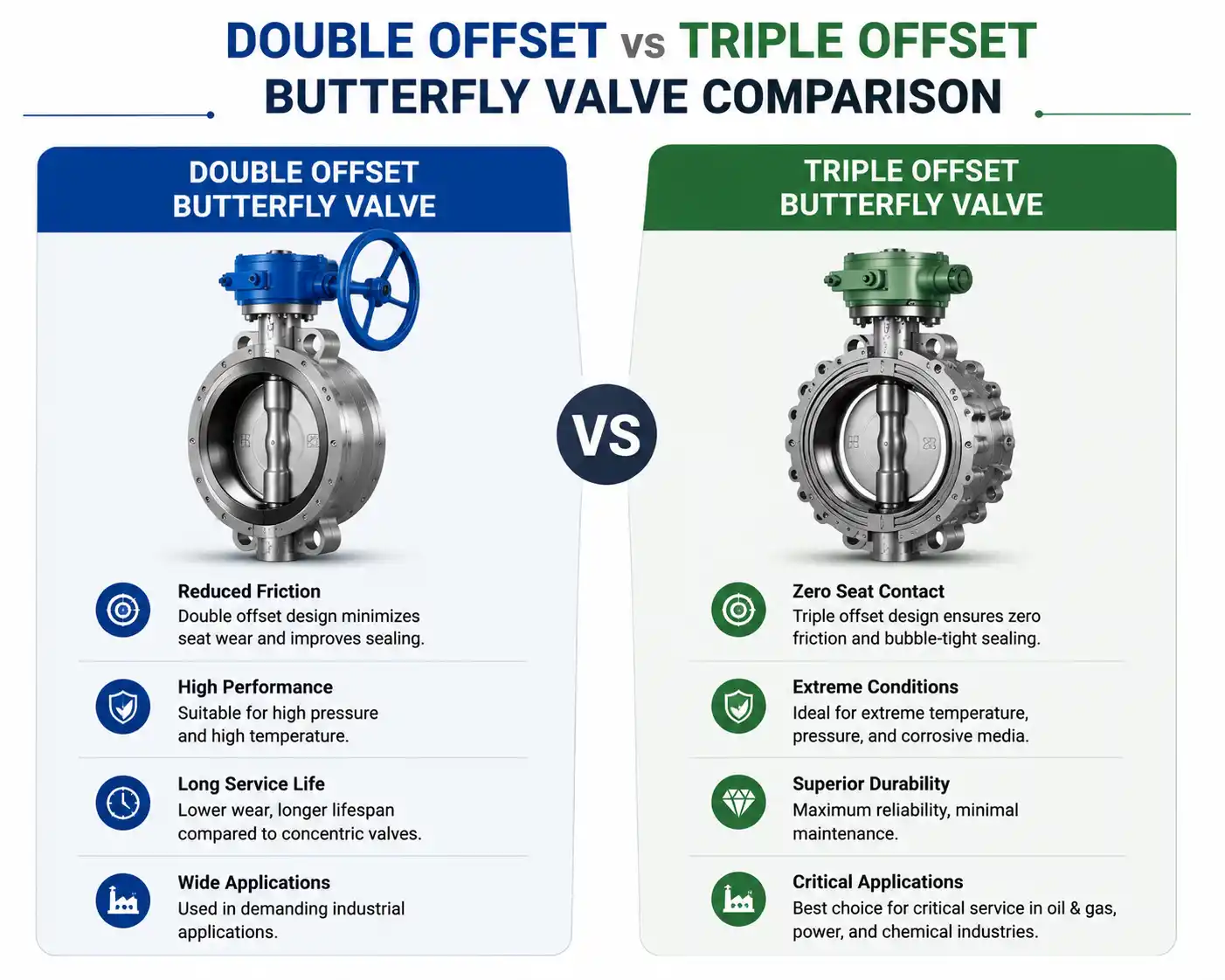
A double offset butterfly valve is designed for medium-duty industrial applications with reduced seat friction and improved sealing, while a triple offset butterfly valve is engineered for severe service with metal-to-metal sealing, higher temperature resistance, and superior performance in high-pressure systems. The main difference is sealing geometry and application severity level.
Design Structure Difference
Double Offset Butterfly Valve
A double offset valve (also called high-performance butterfly valve) has two offsets:
- Shaft offset from pipe centerline
- Disc offset from seat centerline
This design reduces friction between disc and seat during operation.
Key features:
- Soft or reinforced seats
- Lower wear than concentric design
- Quarter-turn operation
- Suitable for medium-duty service
Triple Offset Butterfly Valve
A triple offset valve adds a third geometric offset:
- Cone-shaped sealing surface (metal seat design)
This eliminates rubbing between disc and seat until final closure.
Key features:
- Metal-to-metal sealing
- Zero leakage potential
- No seat friction during operation
- Designed for severe service conditions
Sealing Performance
Double Offset
- Soft or laminated seats
- Good sealing performance
- Some wear over time
- Suitable for frequent operation
Triple Offset
- Metal-to-metal sealing
- Excellent tight shutoff
- Minimal wear due to no friction
- Ideal for critical isolation
Pressure and Temperature Capability
Double Offset
- Medium pressure range
- Typically up to Class 300
- Moderate temperature resistance
Triple Offset
- High pressure capability (Class 300–600+)
- High temperature steam service
- Suitable for extreme conditions
Cost Comparison
Double Offset
- Lower cost
- Widely used in industrial water and process systems
- Economical high-performance option
Triple Offset
- Higher cost
- Precision manufacturing required
- Long-term lifecycle value in severe service
Maintenance and Service Life
Double Offset
- Moderate maintenance
- Seat may require replacement over time
- Good for general industrial cycles
Triple Offset
- Very low maintenance
- No elastomer seat in many designs
- Long service life in harsh conditions
Applications
Double Offset Butterfly Valve Applications
- Water treatment
- HVAC systems
- Chemical processing
- Oil and gas (moderate conditions)
- Industrial utility pipelines
Triple Offset Butterfly Valve Applications
- Steam systems
- Refineries
- Power generation plants
- LNG and cryogenic systems
- High-pressure gas pipelines
- Severe corrosive or abrasive service
When to Choose Each Type
Choose Double Offset Butterfly Valve if you need:
- Cost-effective high-performance valve
- Medium pressure applications
- General industrial service
- Frequent operation with moderate conditions
Choose Triple Offset Butterfly Valve if you need:
- Zero-leakage sealing requirement
- High temperature or steam service
- High-pressure critical systems
- Long-term severe industrial environments
Conclusion
Double offset butterfly valves are ideal for general industrial and medium-duty applications, while triple offset butterfly valves are designed for high-pressure, high-temperature, and zero-leakage critical service conditions. The choice depends on performance requirements, not just cost.
Frequently Asked Questions
Is triple offset better than double offset butterfly valve?
Yes in severe service conditions. Triple offset offers better sealing, higher temperature resistance, and longer service life in critical applications.
Why are triple offset butterfly valves more expensive?
They require precision machining, metal-to-metal sealing surfaces, and advanced design geometry, which increases manufacturing cost.
Can double offset butterfly valves handle steam?
Only limited low-pressure steam applications. For high-temperature steam, triple offset valves are the preferred choice.
Related Articles
Technical & Design Insights
- How Does a Butterfly Valve Work
- Working Principle of Butterfly Valve
- Butterfly Valve Components
- Butterfly Valve Materials
- Wafer vs Lug Butterfly Valve
- Wafer vs Lug vs Flanged Butterfly Valve
- High Performance vs Concentric Butterfly Valve
- Double Offset vs Triple Offset Butterfly Valve
- Soft Seat vs Metal Seat Butterfly Valve
- Rubber Lined vs PTFE Butterfly Valve
- Manual vs Automated Butterfly Valve
- Electric vs Pneumatic Butterfly Valve
Commercial & Purchasing Topics
- Wafer Butterfly Valve Wholesale Price
- Stainless Steel Butterfly Valve Factory Direct Supplier
- API 609 Butterfly Valve Manufacturer in China Guide
- Electric Butterfly Valve Price List DN50 DN200
- Pneumatic Butterfly Valve Bulk Order Supplier
- High Performance Butterfly Valve Export Supplier
- Industrial Butterfly Valve Quotation Fast Delivery
- Butterfly Valve OEM Manufacturer Oil & Gas Industry
- Butterfly Valve Supplier Water Treatment Project
- Butterfly Valve Supplier Industrial Applications