
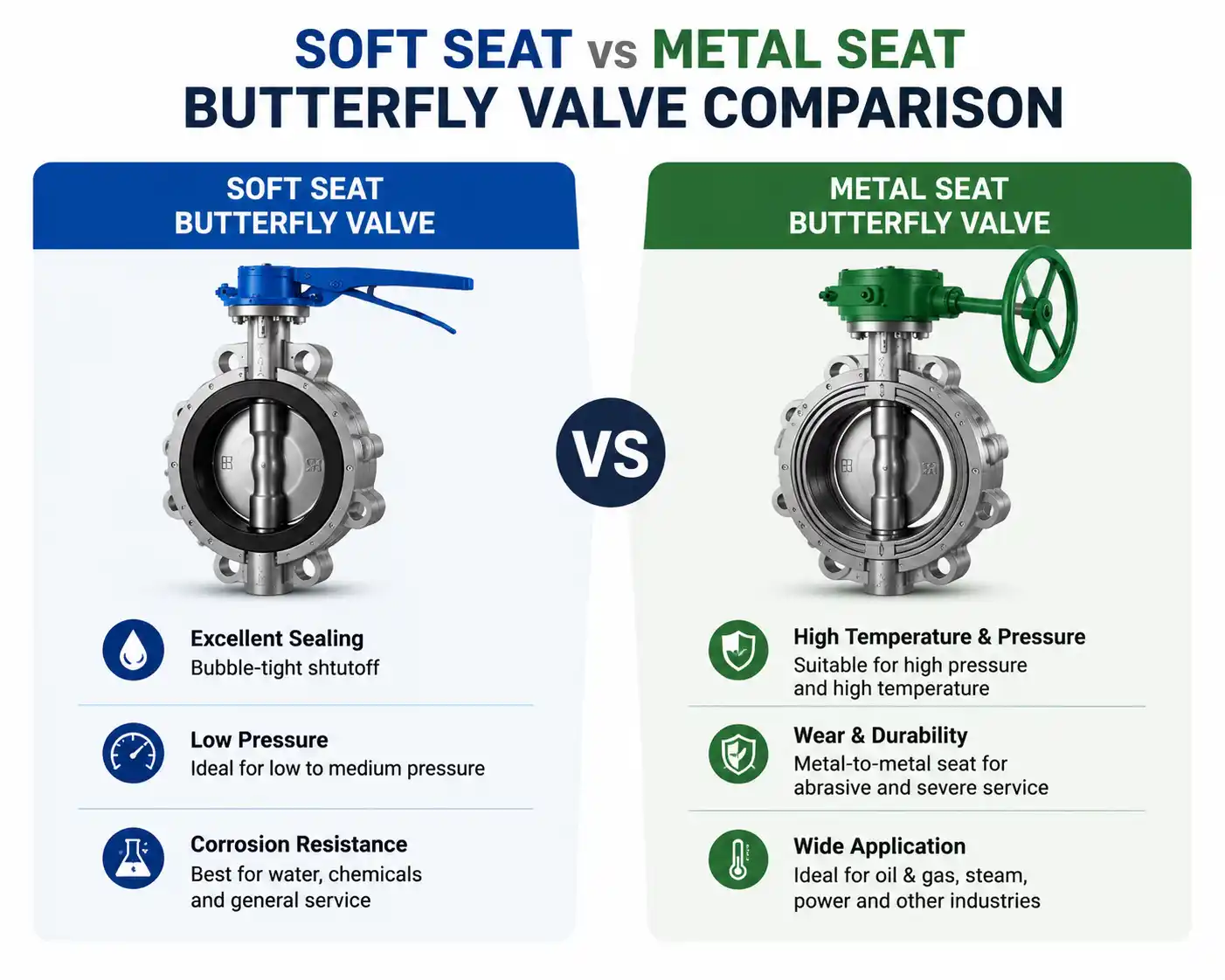
Direct Answer
Soft seat butterfly valves use elastomer or PTFE seats for tight shutoff in low to medium temperature and pressure applications, while metal seat butterfly valves use metal-to-metal sealing for high temperature, high pressure, and abrasive or severe service conditions. The key difference is sealing material and operating environment suitability.
Sealing Mechanism Difference
Soft Seat Butterfly Valve
Soft seat valves use resilient materials such as EPDM, NBR, or PTFE.
Key features:
- Elastic sealing contact between disc and seat
- Bubble-tight shutoff capability
- Lower torque requirement
- High sealing performance at low pressure
Metal Seat Butterfly Valve
Metal seat valves use metal-to-metal sealing surfaces.
Key features:
- Hard sealing contact between disc and seat
- Designed for severe service conditions
- No soft elastomer sealing element
- Requires higher machining precision
Temperature Capability
Soft Seat
- Limited temperature range
- Typically up to 120–200°C depending on material
- Not suitable for steam or extreme heat
Metal Seat
- Suitable for high-temperature service
- Can handle steam and thermal cycling
- Ideal for power plants and refinery systems
Pressure Performance
Soft Seat
- Low to medium pressure
- Common in PN10–PN16 / Class 150 systems
- Seat deformation limits high-pressure use
Metal Seat
- Medium to high pressure capability
- Suitable for Class 150–600+ designs (depending on structure)
- Better resistance to pressure spikes
Durability and Wear Resistance
Soft Seat
- Excellent sealing but wears faster
- Sensitive to abrasion and chemicals
- Requires periodic seat replacement
Metal Seat
- High durability in harsh environments
- Resistant to erosion and abrasion
- Longer service life in severe conditions
Applications
Soft Seat Butterfly Valve Applications
- Water treatment systems
- HVAC systems
- Irrigation
- Fire protection systems
- Low-pressure chemical service
Metal Seat Butterfly Valve Applications
- Steam systems
- Oil and gas pipelines
- Power generation plants
- High-temperature chemical processing
- Slurry and abrasive media
Cost Comparison
Soft Seat
- Lower cost
- Widely used in general industry
- Economical for large-scale water systems
Metal Seat
- Higher cost
- More complex manufacturing
- Higher lifecycle value in severe service
Maintenance Requirements
Soft Seat
- Easier maintenance
- Seat replacement may be required more frequently
- Sensitive to wear and deformation
Metal Seat
- Lower replacement frequency
- Requires precision machining for repair
- Better long-term reliability
When to Choose Each Type
Choose Soft Seat Butterfly Valve if you need:
- Tight shutoff in water or HVAC systems
- Low pressure applications
- Cost-effective solution
- Simple operation and maintenance
Choose Metal Seat Butterfly Valve if you need:
- High temperature resistance
- High pressure service
- Abrasive or corrosive media
- Long-term durability in harsh environments
Conclusion
Soft seat butterfly valves are ideal for low to medium pressure applications requiring tight sealing, while metal seat butterfly valves are designed for high temperature, high pressure, and severe industrial conditions. The correct choice depends on operating conditions rather than sealing preference alone.
Frequently Asked Questions
Which valve provides better sealing, soft seat or metal seat?
Soft seat butterfly valves generally provide better bubble-tight sealing, especially in low-pressure systems.
Can metal seat butterfly valves achieve zero leakage?
Yes, but only when precision-machined and properly designed. Soft seats more easily achieve tight shutoff in standard conditions.
When should I avoid soft seat butterfly valves?
Avoid soft seats in high-temperature, high-pressure, or abrasive media applications, as the seat material can degrade or deform.
Related Articles
Technical & Design Insights
- How Does a Butterfly Valve Work
- Working Principle of Butterfly Valve
- Butterfly Valve Components
- Butterfly Valve Materials
- Wafer vs Lug Butterfly Valve
- Wafer vs Lug vs Flanged Butterfly Valve
- High Performance vs Concentric Butterfly Valve
- Double Offset vs Triple Offset Butterfly Valve
- Soft Seat vs Metal Seat Butterfly Valve
- Rubber Lined vs PTFE Butterfly Valve
- Manual vs Automated Butterfly Valve
- Electric vs Pneumatic Butterfly Valve
Commercial & Purchasing Topics
- Wafer Butterfly Valve Wholesale Price
- Stainless Steel Butterfly Valve Factory Direct Supplier
- API 609 Butterfly Valve Manufacturer in China Guide
- Electric Butterfly Valve Price List DN50 DN200
- Pneumatic Butterfly Valve Bulk Order Supplier
- High Performance Butterfly Valve Export Supplier
- Industrial Butterfly Valve Quotation Fast Delivery
- Butterfly Valve OEM Manufacturer Oil & Gas Industry
- Butterfly Valve Supplier Water Treatment Project
- Butterfly Valve Supplier Industrial Applications