
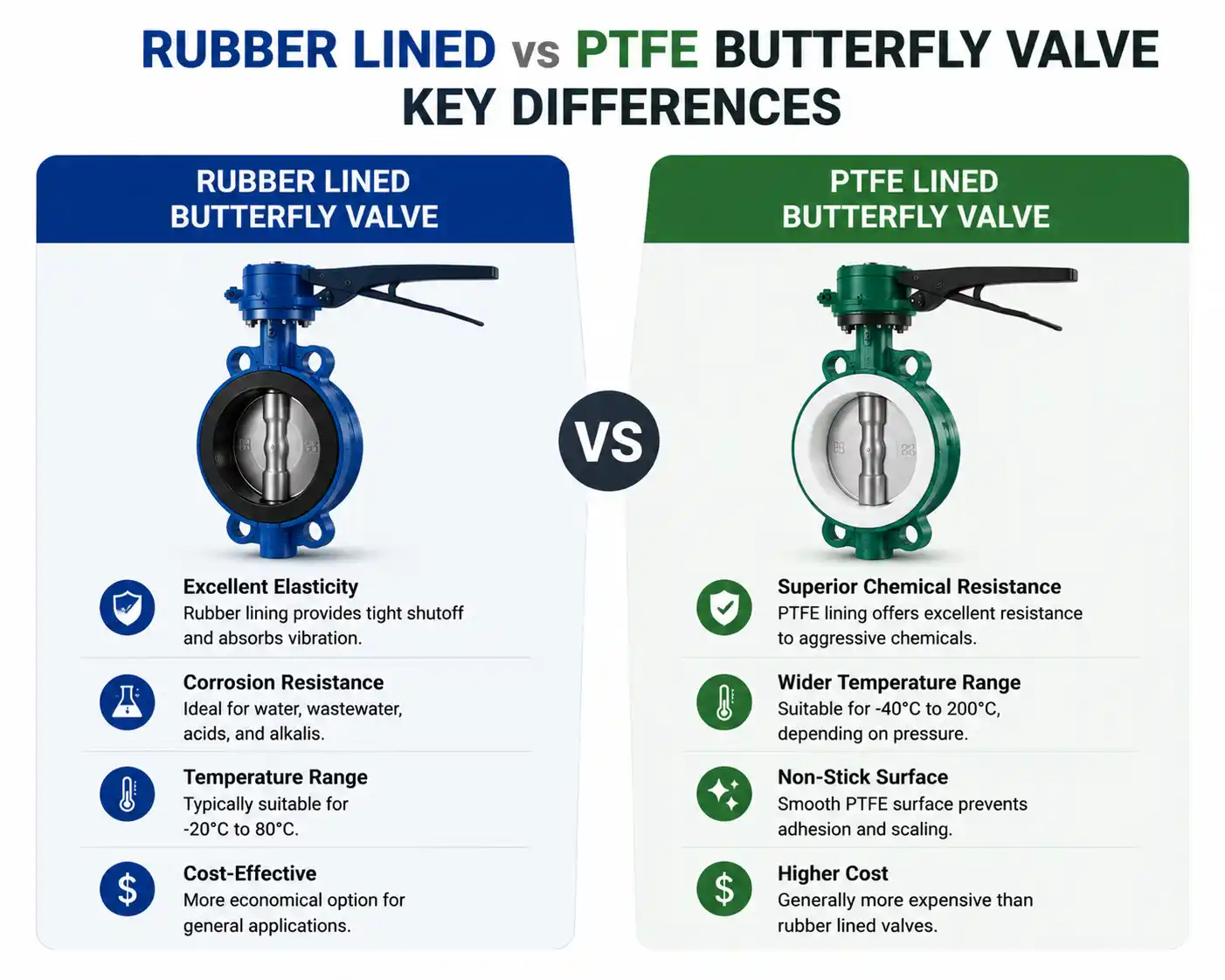
Direct Answer
Rubber lined butterfly valves use elastomer linings (such as EPDM or NBR) for cost-effective sealing in water and mild service, while PTFE butterfly valves use polytetrafluoroethylene lining for superior chemical resistance and wider temperature compatibility in corrosive industrial applications. The key difference is chemical resistance versus cost efficiency.
Sealing Material Difference
Rubber Lined Butterfly Valve
Rubber lined valves use elastic materials such as:
- EPDM
- NBR (Buna-N)
- Natural rubber
These materials provide flexible sealing and good elasticity.
Key characteristics:
- Tight shutoff in water service
- Good elasticity and recovery
- Lower cost
- Limited chemical resistance
PTFE Butterfly Valve
PTFE (Teflon) lining provides a chemically inert sealing surface.
Key characteristics:
- Excellent chemical resistance
- Low friction surface
- Suitable for aggressive media
- More rigid than rubber seats
Chemical Resistance
Rubber Lined
- Suitable for clean water
- Mild acids and alkalis
- HVAC and utility systems
- Not suitable for strong solvents or aggressive chemicals
PTFE Lined
- Strong acids
- Strong alkalis
- Solvents and corrosive chemicals
- Chemical processing industries
PTFE clearly outperforms rubber in harsh chemical environments.
Temperature Performance
Rubber Lined
- Typically -20°C to 120°C (up to 150°C for special compounds)
- Performance decreases at high temperature
PTFE
- Typically -20°C to 180–200°C
- Better stability at elevated temperatures
- Suitable for wider process conditions
Durability and Wear Resistance
Rubber Lined
- Good elasticity but wears faster under abrasion
- Can deform under high pressure or temperature
- Requires periodic replacement in harsh service
PTFE
- Excellent wear resistance against chemicals
- Low friction reduces mechanical wear
- Longer service life in corrosive systems
Cost Comparison
Rubber Lined
- Lower cost
- Economical for water systems
- Widely used in municipal projects
PTFE Lined
- Higher cost
- Premium material for chemical applications
- Better long-term value in corrosive service
Pressure Capability
Rubber Lined
- Low to medium pressure (PN10–PN16 / Class 150)
- Limited by elastomer strength
PTFE
- Medium pressure capability
- Better stability under chemical and thermal stress
- Often used in process industries
Applications
Rubber Lined Butterfly Valve Applications
- Water treatment plants
- HVAC systems
- Fire protection
- Irrigation systems
- General industrial utilities
PTFE Butterfly Valve Applications
- Chemical processing plants
- Pharmaceutical industry
- Acid and solvent pipelines
- Petrochemical systems
- Aggressive fluid handling systems
When to Choose Each Type
Choose Rubber Lined Butterfly Valve if you need:
- Low cost solution
- Clean water service
- HVAC or utility systems
- General industrial applications
Choose PTFE Butterfly Valve if you need:
- Strong chemical resistance
- High corrosion protection
- Aggressive fluid handling
- Longer service life in harsh environments
Conclusion
Rubber lined butterfly valves are ideal for economical water and utility applications, while PTFE butterfly valves are designed for chemical resistance and harsh industrial environments. The best choice depends on whether cost efficiency or chemical performance is the priority.
Frequently Asked Questions
Is PTFE better than rubber lining in butterfly valves?
Yes, PTFE performs better in chemical resistance and temperature stability, but rubber lining is more cost-effective for water systems.
Can rubber lined butterfly valves be used for chemicals?
Only for mild chemicals. Strong acids, solvents, and aggressive media require PTFE-lined valves.
Why are PTFE butterfly valves more expensive?
Because PTFE material offers higher chemical resistance, longer service life, and more complex manufacturing compared to rubber linings.
Related Articles
Technical & Design Insights
- How Does a Butterfly Valve Work
- Working Principle of Butterfly Valve
- Butterfly Valve Components
- Butterfly Valve Materials
- Wafer vs Lug Butterfly Valve
- Wafer vs Lug vs Flanged Butterfly Valve
- High Performance vs Concentric Butterfly Valve
- Double Offset vs Triple Offset Butterfly Valve
- Soft Seat vs Metal Seat Butterfly Valve
- Rubber Lined vs PTFE Butterfly Valve
- Manual vs Automated Butterfly Valve
- Electric vs Pneumatic Butterfly Valve
Commercial & Purchasing Topics
- Wafer Butterfly Valve Wholesale Price
- Stainless Steel Butterfly Valve Factory Direct Supplier
- API 609 Butterfly Valve Manufacturer in China Guide
- Electric Butterfly Valve Price List DN50 DN200
- Pneumatic Butterfly Valve Bulk Order Supplier
- High Performance Butterfly Valve Export Supplier
- Industrial Butterfly Valve Quotation Fast Delivery
- Butterfly Valve OEM Manufacturer Oil & Gas Industry
- Butterfly Valve Supplier Water Treatment Project
- Butterfly Valve Supplier Industrial Applications