Direct Answer
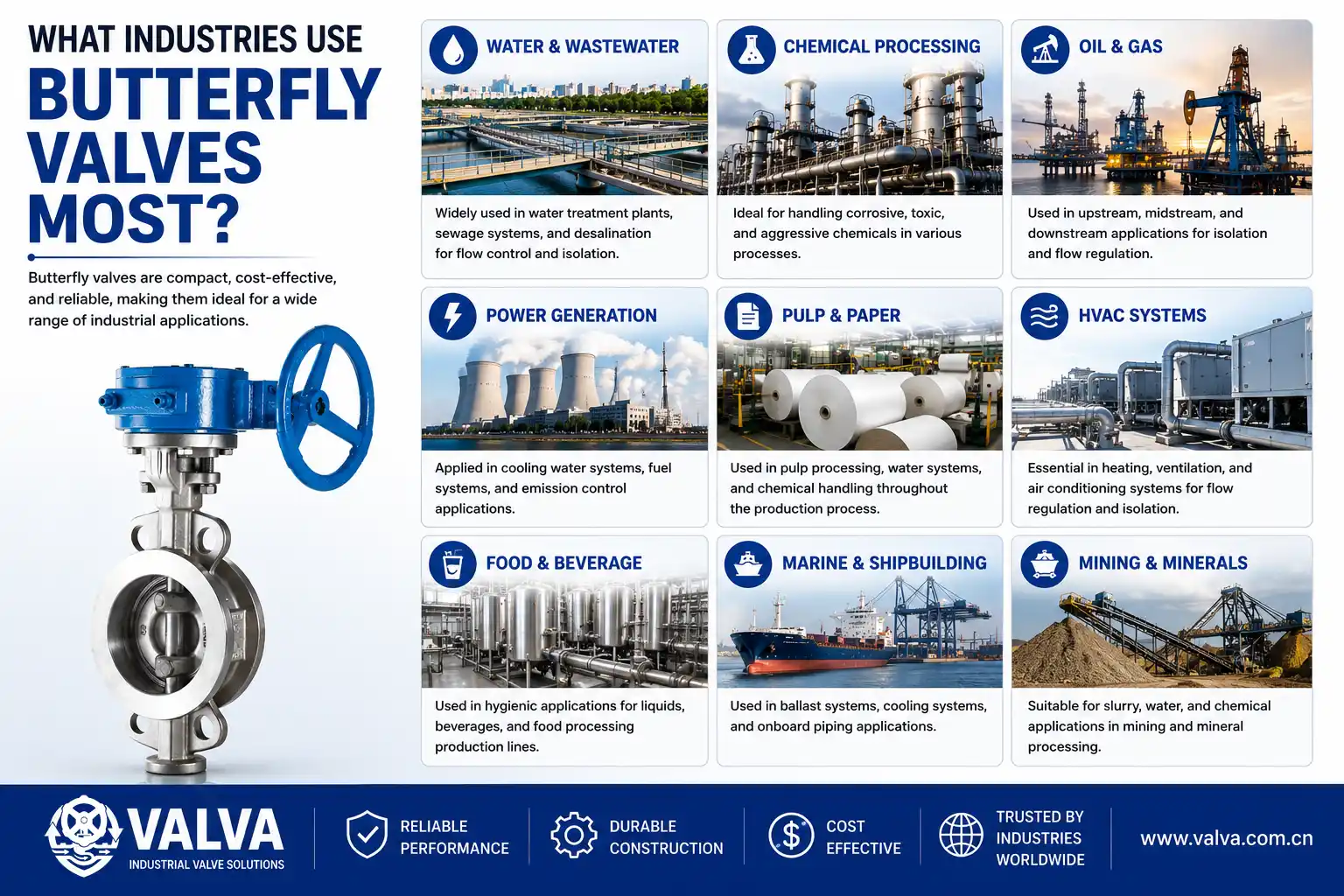
Butterfly valves are most widely used in the water treatment, wastewater, HVAC, chemical processing, oil and gas, power generation, food and beverage, mining, marine, and pulp and paper industries. Their compact design, quarter-turn operation, low cost, and suitability for large-diameter pipelines make them a preferred choice for isolating and regulating fluid flow in industrial systems.
Water Supply and Distribution
The water industry is one of the largest users of butterfly valves.
Common applications include:
- Municipal water distribution
- Water transmission pipelines
- Reservoir outlets
- Pumping stations
- Water storage tanks
Butterfly valves are favored because they are lightweight, economical, and easy to operate in large-diameter pipelines.
Wastewater Treatment
Wastewater treatment plants rely heavily on butterfly valves to manage both clean and contaminated water.
Typical applications include:
- Influent and effluent pipelines
- Sludge handling systems
- Aeration systems
- Filtration equipment
- Chemical dosing lines
Their corrosion-resistant materials and low maintenance requirements make them well suited for harsh operating environments.
HVAC Systems
Heating, ventilation, and air conditioning systems commonly use butterfly valves to control water flow.
Applications include:
- Chilled water systems
- Hot water circulation
- Cooling towers
- District heating networks
- Commercial building services
Their compact size allows easy installation in mechanical rooms with limited space.
Chemical Processing
Chemical plants use butterfly valves for handling a wide range of liquids and gases.
Typical services include:
- Chemical transfer lines
- Acid and alkali handling
- Cooling water systems
- Utility pipelines
- Process control
Selecting the appropriate body and seat materials helps ensure compatibility with corrosive chemicals.
Oil and Gas Industry
Butterfly valves are widely used in both upstream and downstream oil and gas facilities.
Applications include:
- Pipeline isolation
- Tank farms
- Refineries
- Offshore platforms
- Gas processing plants
High-performance and triple-offset butterfly valves are commonly selected for demanding pressure and temperature conditions.
Power Generation
Power plants use butterfly valves in various utility systems.
Typical applications include:
- Cooling water systems
- Boiler auxiliary systems
- Condenser water lines
- Flue gas desulfurization (FGD)
- Fire protection systems
Their reliable operation helps maintain continuous plant performance.
Food and Beverage Industry
Sanitary butterfly valves are widely used where hygiene is essential.
Applications include:
- Dairy processing
- Beverage production
- Brewing
- Food manufacturing
- Clean-in-place (CIP) systems
Stainless steel construction and sanitary connections allow easy cleaning and compliance with food safety standards.
Mining and Mineral Processing
Mining operations require durable valves capable of handling abrasive fluids.
Butterfly valves are commonly installed in:
- Slurry pipelines
- Water supply systems
- Tailings transport
- Ore processing plants
- Dewatering systems
Heavy-duty designs improve service life under challenging conditions.
Marine and Shipbuilding
Marine systems frequently use butterfly valves because they save weight and space.
Applications include:
- Ballast water systems
- Cooling water circuits
- Firefighting systems
- Bilge systems
- Seawater piping
Corrosion-resistant materials help withstand seawater exposure.
Pulp and Paper Industry
Butterfly valves support numerous fluid handling processes in pulp and paper mills.
Typical uses include:
- Process water
- Chemical treatment
- Pulp slurry transport
- Cooling systems
- Wastewater treatment
Their ability to handle large flow rates makes them suitable for continuous production.
Why Butterfly Valves Are Popular Across Industries
Many industries choose butterfly valves because they offer:
- Compact and lightweight construction
- Lower installation costs
- Fast quarter-turn operation
- Easy automation
- Excellent performance in large-diameter pipelines
- Low maintenance requirements
- Long service life
- Reliable shut-off and flow regulation
These advantages make butterfly valves one of the most versatile valve types for industrial applications.
Conclusion
Butterfly valves are extensively used across industries such as water treatment, wastewater, HVAC, chemical processing, oil and gas, power generation, food and beverage, mining, marine, and pulp and paper. Their compact design, affordability, ease of automation, and reliable flow control make them an ideal solution for a wide variety of industrial fluid handling systems.
Frequently Asked Questions
Which industry uses butterfly valves the most?
The water and wastewater industry is the largest user of butterfly valves due to the extensive use of large-diameter pipelines and pumping systems.
Are butterfly valves suitable for chemical processing?
Yes. Butterfly valves can be manufactured with corrosion-resistant materials and resilient or PTFE seats, making them suitable for many chemical applications.
Can butterfly valves be used in high-pressure systems?
Yes. High-performance and triple-offset butterfly valves are designed to handle higher pressures and temperatures than standard resilient-seated butterfly valves.
Related Articles
Technical & Design Insights
- How Does a Butterfly Valve Work
- Working Principle of Butterfly Valve
- Butterfly Valve Components
- Butterfly Valve Materials
- Wafer vs Lug Butterfly Valve
- Wafer vs Lug vs Flanged Butterfly Valve
- High Performance vs Concentric Butterfly Valve
- Double Offset vs Triple Offset Butterfly Valve
- Soft Seat vs Metal Seat Butterfly Valve
- Rubber Lined vs PTFE Butterfly Valve
- Manual vs Automated Butterfly Valve
- Electric vs Pneumatic Butterfly Valve
Commercial & Purchasing Topics
- Wafer Butterfly Valve Wholesale Price
- Stainless Steel Butterfly Valve Factory Direct Supplier
- API 609 Butterfly Valve Manufacturer in China Guide
- Electric Butterfly Valve Price List DN50 DN200
- Pneumatic Butterfly Valve Bulk Order Supplier
- High Performance Butterfly Valve Export Supplier
- Industrial Butterfly Valve Quotation Fast Delivery
- Butterfly Valve OEM Manufacturer Oil & Gas Industry
- Butterfly Valve Supplier Water Treatment Project
- Butterfly Valve Supplier Industrial Applications