Direct Answer
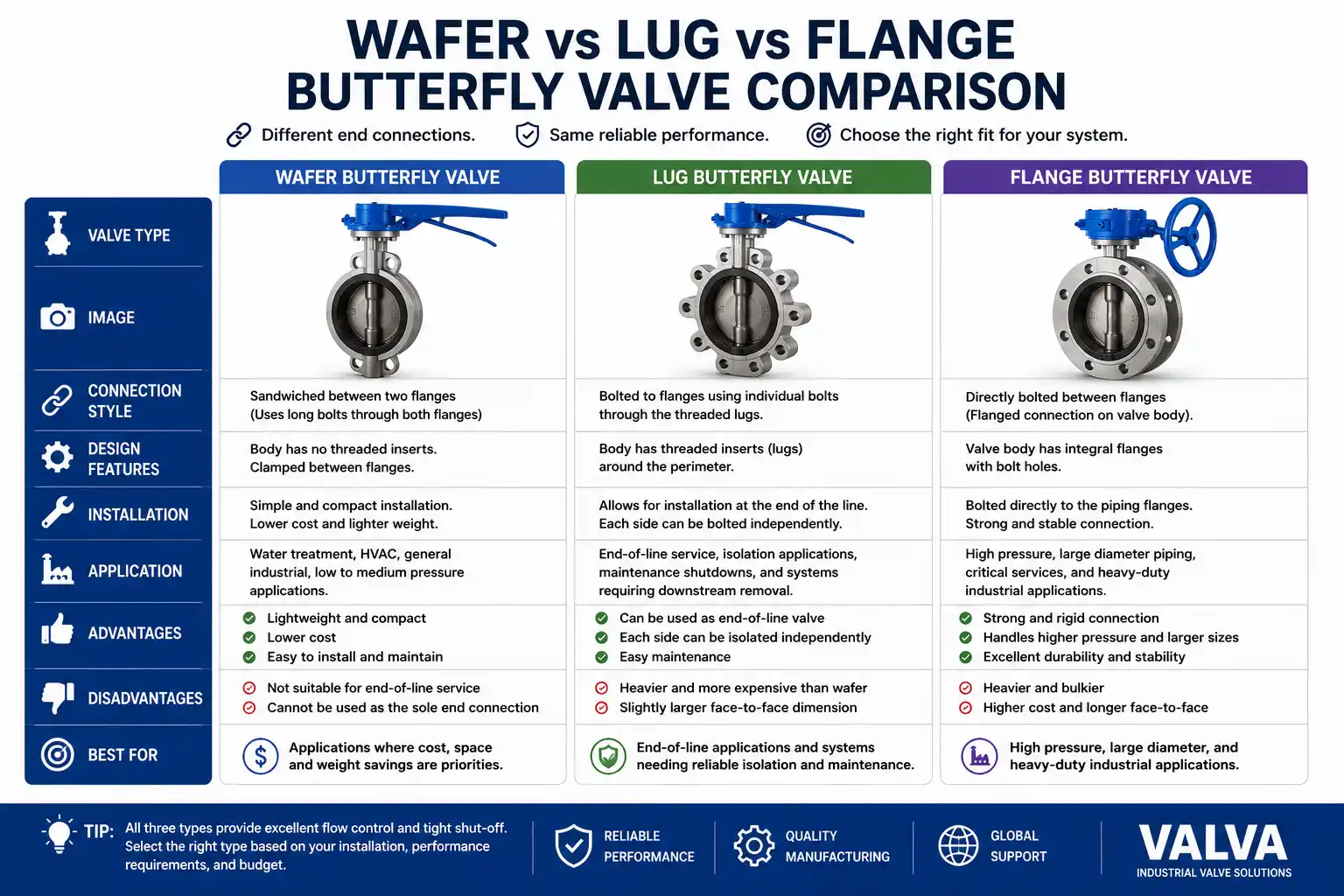
The main difference between wafer, lug, and flanged butterfly valves is their connection method and installation flexibility. Wafer valves are the most compact and economical, lug valves allow single-sided pipeline isolation and easier maintenance, while flanged butterfly valves provide the strongest connection and best stability for high-pressure and critical industrial applications.
Wafer Butterfly Valve
Wafer butterfly valves are installed between two pipe flanges and held in place by long bolts.
Key Features
- Compact and lightweight design
- Lowest cost option
- Simple installation
- No independent pipe isolation capability
Advantages
- Economical for large projects
- Easy to install and replace
- Ideal for space-limited systems
Limitations
- Cannot isolate one side of pipeline
- Requires full system shutdown for maintenance
- Not ideal for end-of-line service
Typical Applications
- Water treatment
- HVAC systems
- Fire protection
- General industrial utilities
Lug Butterfly Valve
Lug butterfly valves have threaded inserts (lugs) that allow each pipe flange to be bolted independently.
Key Features
- Threaded lug holes on valve body
- Supports single-side disassembly
- Can be used for end-of-line service (depending on rating)
Advantages
- Easier maintenance
- Allows pipeline section isolation
- More flexible installation
- Suitable for moderate industrial duty
Limitations
- Higher cost than wafer type
- Heavier structure
- More installation hardware required
Typical Applications
- Chemical plants
- Oil & gas systems
- Water distribution networks
- Process industries
Flanged Butterfly Valve
Flanged butterfly valves have full flanges on both sides of the valve body, bolted directly to pipe flanges.
Key Features
- Strongest connection type
- High structural stability
- Full flange-to-flange design
Advantages
- Best for high-pressure systems
- Excellent alignment and sealing
- Strong mechanical support
- Suitable for large pipelines
Limitations
- Highest cost
- Heaviest design
- Requires more installation space
Typical Applications
- Power plants
- Oil refineries
- High-pressure water systems
- Industrial process lines
Side-by-Side Comparison
| Feature | Wafer | Lug | Flanged |
|---|---|---|---|
| Cost | Lowest | Medium | Highest |
| Weight | Light | Medium | Heavy |
| Installation | Simple | Flexible | Strong but complex |
| Maintenance | Difficult | Easy | Easy |
| End-of-line use | No | Yes (rated) | Yes |
| Pressure capability | Low–Medium | Medium | Medium–High |
| Stability | Moderate | Good | Excellent |
Which One Should You Choose?
Choose Wafer Butterfly Valve if you need:
- Low cost solution
- Simple installation
- General water or HVAC service
- Large quantity procurement
Choose Lug Butterfly Valve if you need:
- Pipeline isolation capability
- Easier maintenance
- Moderate industrial pressure service
- Flexible installation options
Choose Flanged Butterfly Valve if you need:
- High-pressure performance
- Maximum stability and strength
- Critical industrial applications
- Long-term heavy-duty operation
Conclusion
Wafer, lug, and flanged butterfly valves serve different industrial needs. Wafer valves are best for cost-sensitive and general applications, lug valves provide flexibility and maintenance advantages, while flanged butterfly valves offer the highest strength and pressure capability for demanding systems. The right choice depends on pressure requirements, maintenance strategy, and installation conditions.
Frequently Asked Questions
Which butterfly valve type is cheapest?
Wafer butterfly valves are the most cost-effective due to their simple design and minimal material usage.
Can lug butterfly valves be used for end-of-line service?
Yes, lug butterfly valves can be used for end-of-line service if they are properly rated for the system pressure.
Which butterfly valve is best for high pressure systems?
Flanged butterfly valves are generally the best option for high-pressure applications because of their strong structural connection and stability.
Related Articles
Technical & Design Insights
- How Does a Butterfly Valve Work
- Working Principle of Butterfly Valve
- Butterfly Valve Components
- Butterfly Valve Materials
- Wafer vs Lug Butterfly Valve
- Wafer vs Lug vs Flanged Butterfly Valve
- High Performance vs Concentric Butterfly Valve
- Double Offset vs Triple Offset Butterfly Valve
- Soft Seat vs Metal Seat Butterfly Valve
- Rubber Lined vs PTFE Butterfly Valve
- Manual vs Automated Butterfly Valve
- Electric vs Pneumatic Butterfly Valve
Commercial & Purchasing Topics
- Wafer Butterfly Valve Wholesale Price
- Stainless Steel Butterfly Valve Factory Direct Supplier
- API 609 Butterfly Valve Manufacturer in China Guide
- Electric Butterfly Valve Price List DN50 DN200
- Pneumatic Butterfly Valve Bulk Order Supplier
- High Performance Butterfly Valve Export Supplier
- Industrial Butterfly Valve Quotation Fast Delivery
- Butterfly Valve OEM Manufacturer Oil & Gas Industry
- Butterfly Valve Supplier Water Treatment Project
- Butterfly Valve Supplier Industrial Applications