
Direct Answer
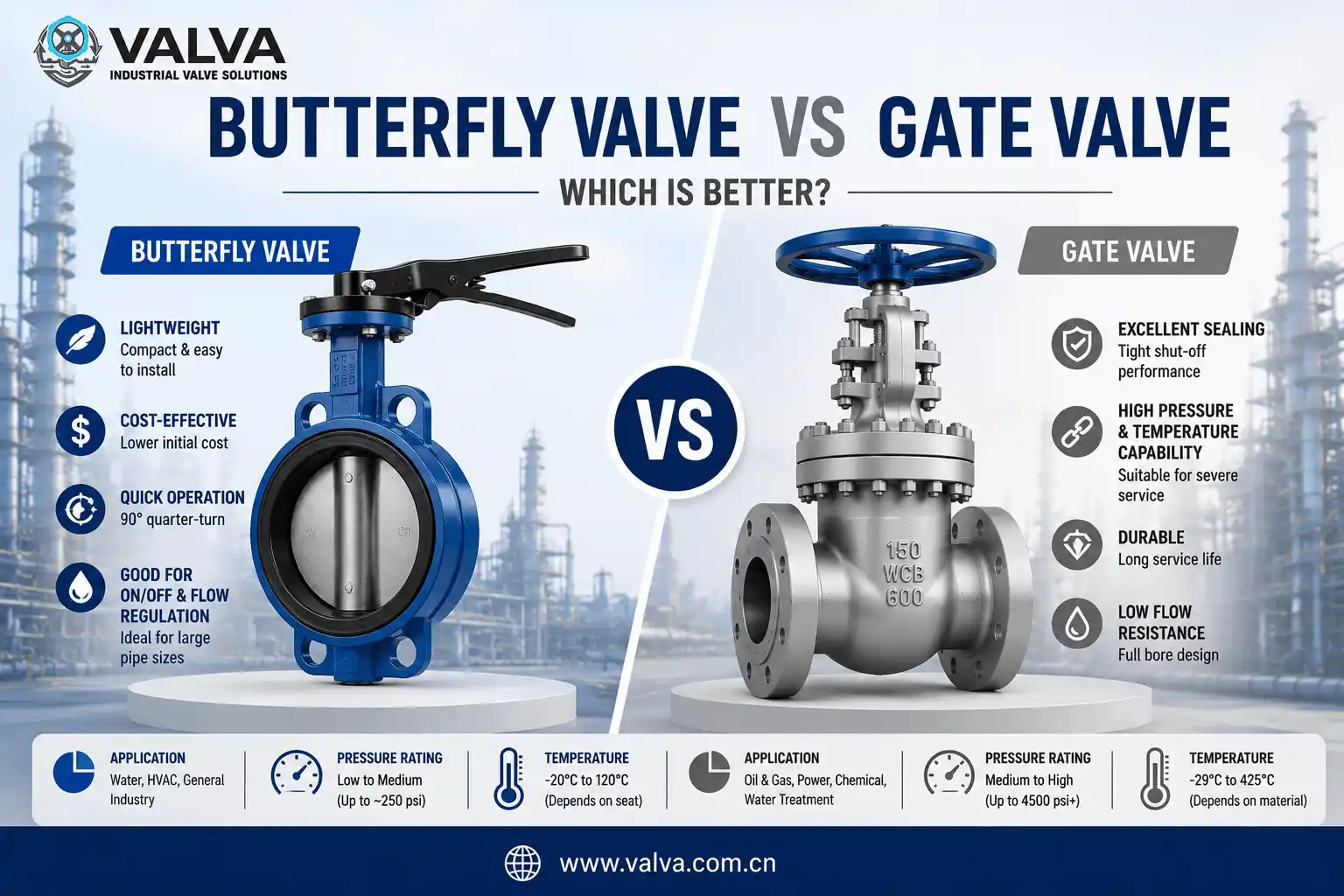
Neither butterfly valves nor gate valves are universally “better.” Butterfly valves are better for compact design, fast operation, and flow control in large pipelines, while gate valves are better for full open/close service with minimal pressure loss in high-pressure and high-temperature systems. The best choice depends on pressure, temperature, fluid type, and system requirements.
Key Differences Between Butterfly Valve and Gate Valve
Operating Principle
A butterfly valve uses a rotating disc (quarter-turn, 90°) to control flow.
A gate valve uses a rising or lowering gate (multi-turn operation) to fully open or close the pipeline.
Butterfly valves operate faster due to their simple rotation mechanism.
Flow Control Performance
Butterfly valves can regulate flow by partial opening of the disc.
Gate valves are designed mainly for on/off isolation only.
Using a gate valve for throttling can cause:
- Gate vibration
- Seat damage
- Erosion
- Reduced lifespan
Butterfly valves handle throttling better in most industrial water and utility systems.
Pressure Loss
Gate valves provide very low pressure drop when fully open because the gate retracts completely from the flow path.
Butterfly valves create some flow obstruction due to the disc remaining in the flow stream.
For long-distance pipelines, gate valves may be preferred when pressure loss must be minimized.
Size and Weight
Butterfly valves are significantly more compact.
They offer:
- Lower weight
- Smaller installation space
- Easier pipeline support
- Lower structural cost
Gate valves are heavier and require more installation space, especially in large diameters.
Cost Comparison
Butterfly valves are generally more cost-effective.
They require:
- Less material
- Simpler design
- Smaller actuators
Gate valves are typically more expensive due to their complex internal structure and heavier construction.
Maintenance Requirements
Butterfly valves have fewer internal components, making them easier to maintain.
Gate valves may require:
- More maintenance effort
- Longer repair time
- More complex disassembly
However, gate valves often provide longer service life in high-pressure isolation applications.
Speed of Operation
Butterfly valves operate with a 90-degree quarter-turn, making them much faster.
Gate valves require multiple rotations, making them slower and less suitable for emergency shut-off.
Typical Applications
Butterfly Valve Applications
- Water treatment systems
- HVAC systems
- Fire protection systems
- Chemical utilities
- Cooling water circuits
- Large-diameter pipelines
Gate Valve Applications
- Oil and gas transmission
- Steam systems
- High-pressure pipelines
- Power plants
- Refinery systems
- Critical isolation services
When to Choose Butterfly Valves
Choose butterfly valves if you need:
- Fast operation
- Lower cost
- Compact design
- Flow regulation capability
- Large-diameter piping solutions
- Easy automation
When to Choose Gate Valves
Choose gate valves if you need:
- Minimal pressure loss
- Full bore flow
- High-pressure resistance
- High-temperature performance
- Long-distance pipeline efficiency
- Strict on/off isolation
Conclusion
Butterfly valves are better for cost efficiency, compact installation, and flow control, while gate valves are better for high-pressure systems requiring full open flow with minimal pressure loss. The best valve depends entirely on system conditions and performance requirements rather than a universal superiority of one design.
Frequently Asked Questions
Can a butterfly valve replace a gate valve?
In many low- to medium-pressure water and HVAC systems, yes. However, in high-pressure or high-temperature pipelines, gate valves are often still required.
Why are butterfly valves more popular in water systems?
Because they are lightweight, cost-effective, easy to install, and suitable for large-diameter pipelines with frequent operation.
Which valve lasts longer, butterfly or gate valve?
Both can last many years depending on application. Gate valves often perform better in high-pressure isolation, while butterfly valves perform well in frequent-operation systems.
Related Articles
Technical & Design Insights
- How Does a Butterfly Valve Work
- Working Principle of Butterfly Valve
- Butterfly Valve Components
- Butterfly Valve Materials
- Wafer vs Lug Butterfly Valve
- Wafer vs Lug vs Flanged Butterfly Valve
- High Performance vs Concentric Butterfly Valve
- Double Offset vs Triple Offset Butterfly Valve
- Soft Seat vs Metal Seat Butterfly Valve
- Rubber Lined vs PTFE Butterfly Valve
- Manual vs Automated Butterfly Valve
- Electric vs Pneumatic Butterfly Valve
Commercial & Purchasing Topics
- Wafer Butterfly Valve Wholesale Price
- Stainless Steel Butterfly Valve Factory Direct Supplier
- API 609 Butterfly Valve Manufacturer in China Guide
- Electric Butterfly Valve Price List DN50 DN200
- Pneumatic Butterfly Valve Bulk Order Supplier
- High Performance Butterfly Valve Export Supplier
- Industrial Butterfly Valve Quotation Fast Delivery
- Butterfly Valve OEM Manufacturer Oil & Gas Industry
- Butterfly Valve Supplier Water Treatment Project
- Butterfly Valve Supplier Industrial Applications