Direct Answer:
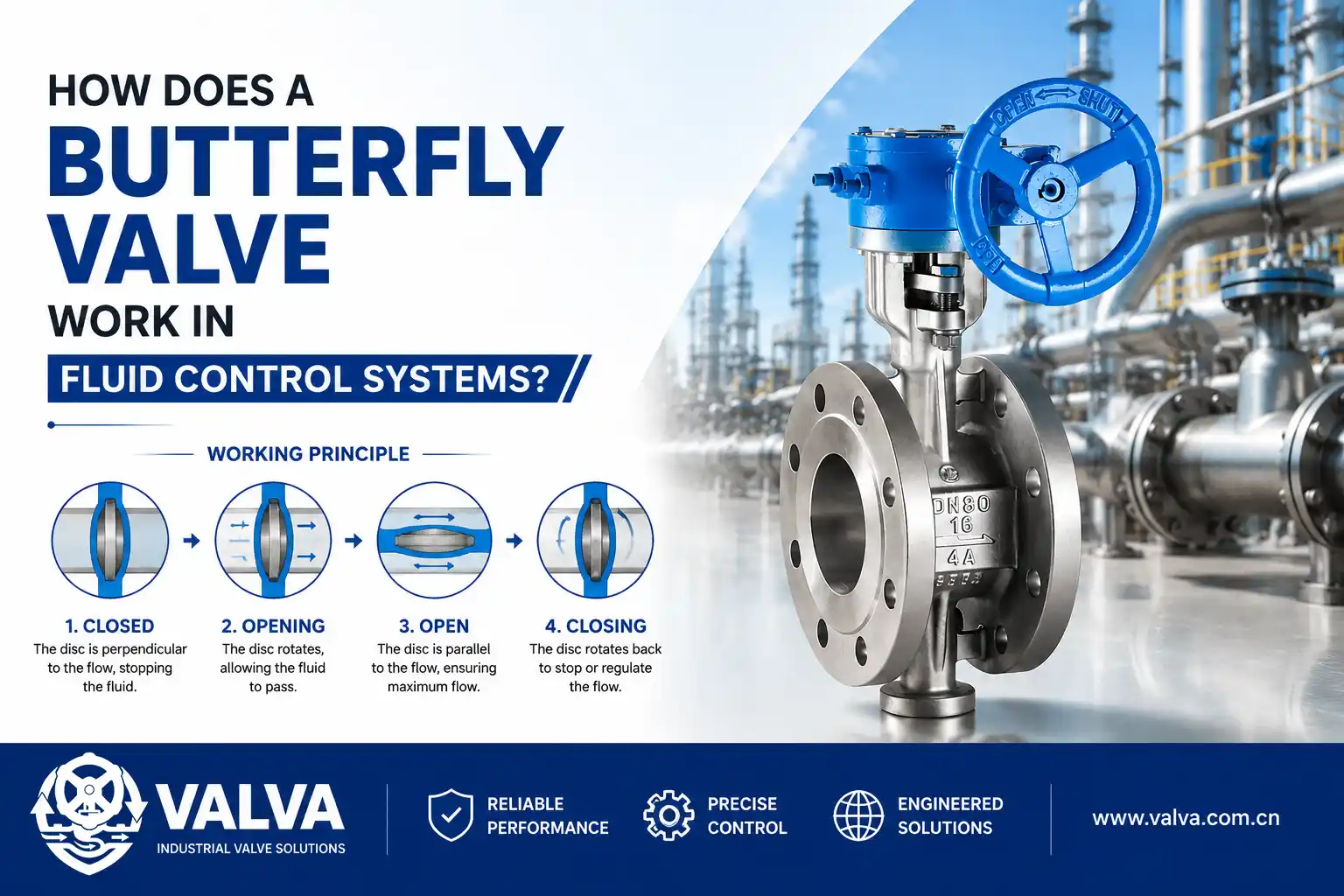
A butterfly valve works by rotating a circular disc mounted on a shaft inside the pipeline. When the actuator or handle turns the shaft, the disc rotates between fully open and fully closed positions, allowing the valve to start, stop, or regulate fluid flow. Its simple quarter-turn operation makes butterfly valves one of the most efficient and economical flow control solutions for industrial piping systems.
The Basic Working Principle
A butterfly valve controls fluid by changing the position of a disc located at the center of the pipe.
When the operator turns the handle or actuator:
- The shaft rotates 90 degrees.
- The disc rotates with the shaft.
- The opening area inside the pipe changes.
- The flow rate increases or decreases accordingly.
Unlike gate valves, which require multiple turns to open or close, a butterfly valve completes its operation with just a quarter turn.
Main Components of a Butterfly Valve
Understanding the valve’s components makes its operation easier to visualize.
Valve Body
The body houses all internal parts and connects to the piping system. Common connection types include wafer, lug, and flanged designs.
Disc
The disc is the primary flow control element. As it rotates, it either blocks or allows fluid to pass through the pipeline.
Stem (Shaft)
The stem connects the actuator or handle to the disc, transmitting rotational force.
Seat
The seat creates a seal between the disc and the valve body when the valve is closed, preventing leakage.
Actuator
Butterfly valves may be operated by:
- Manual lever
- Gear operator
- Pneumatic actuator
- Electric actuator
- Hydraulic actuator
How the Valve Opens and Closes
The disc position determines the amount of flow passing through the valve.
| Disc Position | Valve Status | Flow Condition |
|---|---|---|
| 0° | Fully Closed | No flow |
| 25° | Partially Open | Low flow |
| 45° | Half Open | Moderate flow |
| 70° | Mostly Open | High flow |
| 90° | Fully Open | Maximum flow |
Because the disc remains inside the flow path even when fully open, butterfly valves create slightly more pressure drop than full-port ball valves.
Flow Regulation and Throttling
Butterfly valves are not limited to on/off service.
By stopping the disc at intermediate positions, they can regulate flow rate, making them suitable for:
- Cooling water systems
- HVAC circulation
- Water treatment plants
- Irrigation systems
- Industrial utility pipelines
However, for applications requiring extremely precise flow control, globe valves or dedicated control valves are often preferred.
Types of Butterfly Valve Operating Mechanisms
Manual Butterfly Valve
A hand lever or gear operator rotates the disc directly. This is the most economical option for small and medium-sized valves.
Pneumatic Butterfly Valve
Compressed air powers the actuator for fast, reliable automation in manufacturing and processing plants.
Electric Butterfly Valve
An electric motor rotates the disc, allowing remote operation and integration with automated control systems.
Hydraulic Butterfly Valve
Hydraulic actuators generate high operating torque for large-diameter or high-pressure valves.
Why Butterfly Valves Are Popular in Fluid Control Systems
Butterfly valves have become a standard choice because they offer several practical advantages.
Fast Quarter-Turn Operation
Only a 90-degree rotation is needed to fully open or close the valve, reducing operating time.
Compact Design
Their slim profile requires less installation space than gate or globe valves.
Lightweight Construction
Butterfly valves are significantly lighter than many other industrial valve types, reducing transportation and installation costs.
Cost-Effective Solution
They are generally less expensive than ball valves or gate valves of the same size, especially in large diameters.
Easy Automation
The simple rotary motion makes butterfly valves well suited for electric and pneumatic actuators.
Common Industrial Applications
Butterfly valves are widely used across many industries.
Water Treatment
They regulate water flow in:
- Filtration systems
- Pump stations
- Distribution networks
- Wastewater treatment plants
HVAC Systems
Butterfly valves control chilled water, hot water, and condenser water circulation in commercial buildings.
Chemical Processing
Corrosion-resistant butterfly valves handle various chemicals under low to medium pressure conditions.
Oil and Gas
Butterfly valves are commonly installed in:
- Cooling water systems
- Utility pipelines
- Fire protection systems
- Tank farms
- Auxiliary process lines
Food and Beverage
Sanitary butterfly valves control liquids while meeting hygienic requirements for food processing.
Limitations of Butterfly Valves
Although versatile, butterfly valves are not ideal for every application.
Some limitations include:
- The disc remains inside the flow path, creating pressure loss.
- Soft seats may wear under abrasive service.
- Standard concentric designs are less suitable for very high-pressure applications.
- Bubble-tight sealing at extreme temperatures often requires double-offset or triple-offset designs.
Selecting the appropriate valve type depends on pressure, temperature, media, and operating conditions.
Conclusion
A butterfly valve works by rotating a disc inside the pipeline to control, regulate, or stop fluid flow. Its quarter-turn operation, compact design, and affordability make it one of the most widely used valves in water treatment, HVAC, chemical processing, and many industrial piping systems. By choosing the correct valve design and seat material, engineers can achieve reliable performance across a wide range of applications.
Frequently Asked Questions
Can a butterfly valve regulate flow?
Yes. Butterfly valves can be partially opened to regulate flow, making them suitable for throttling applications. However, they are generally less precise than globe valves for fine flow control.
Why is a butterfly valve called a quarter-turn valve?
It is called a quarter-turn valve because the disc rotates only 90 degrees from the fully closed position to the fully open position.
What is the difference between a butterfly valve and a ball valve?
A butterfly valve uses a rotating disc to control flow and is typically lighter and more economical for large pipelines. A ball valve uses a rotating ball with a bore, offering tighter shutoff and lower pressure drop, especially in high-pressure applications.
Related Articles
Technical & Design Insights
- How Does a Butterfly Valve Work
- Working Principle of Butterfly Valve
- Butterfly Valve Components
- Butterfly Valve Materials
- Wafer vs Lug Butterfly Valve
- Wafer vs Lug vs Flanged Butterfly Valve
- High Performance vs Concentric Butterfly Valve
- Double Offset vs Triple Offset Butterfly Valve
- Soft Seat vs Metal Seat Butterfly Valve
- Rubber Lined vs PTFE Butterfly Valve
- Manual vs Automated Butterfly Valve
- Electric vs Pneumatic Butterfly Valve
Commercial & Purchasing Topics
- Wafer Butterfly Valve Wholesale Price
- Stainless Steel Butterfly Valve Factory Direct Supplier
- API 609 Butterfly Valve Manufacturer in China Guide
- Electric Butterfly Valve Price List DN50 DN200
- Pneumatic Butterfly Valve Bulk Order Supplier
- High Performance Butterfly Valve Export Supplier
- Industrial Butterfly Valve Quotation Fast Delivery
- Butterfly Valve OEM Manufacturer Oil & Gas Industry
- Butterfly Valve Supplier Water Treatment Project
- Butterfly Valve Supplier Industrial Applications