
Direct Answer
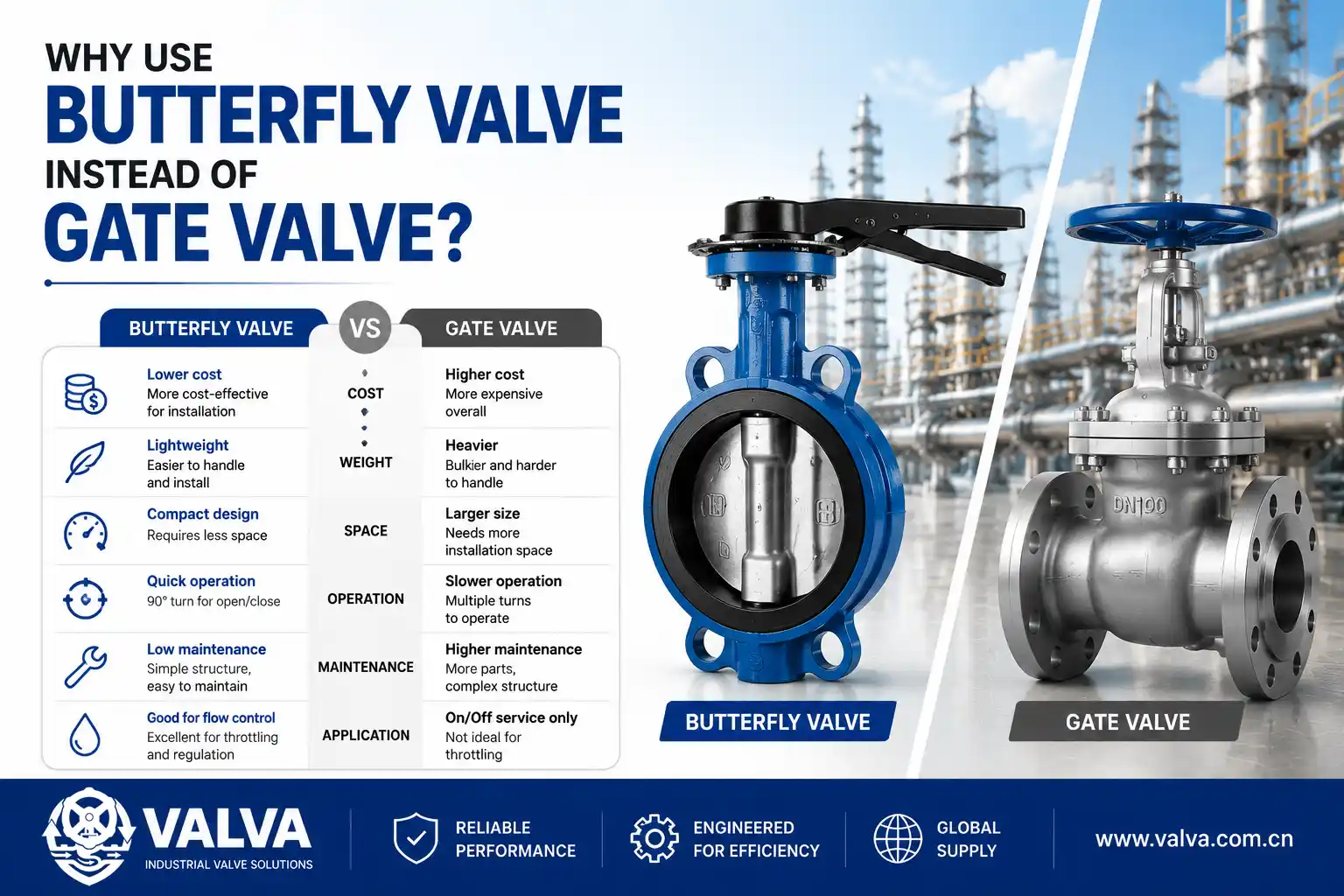
A butterfly valve is often used instead of a gate valve because it is more compact, lighter, less expensive, and operates much faster. Butterfly valves are ideal for flow regulation and on/off control in large-diameter pipelines, while gate valves are better suited for applications requiring full, unrestricted flow and minimal pressure loss. The best choice depends on the operating conditions, pressure, temperature, and maintenance requirements.
Quick Comparison
| Feature | Butterfly Valve | Gate Valve |
|---|---|---|
| Operation | Quarter-turn (90°) | Multi-turn |
| Opening Speed | Fast | Slow |
| Weight | Lightweight | Heavy |
| Installation Space | Compact | Requires more space |
| Cost | Lower | Higher |
| Flow Regulation | Excellent | Not recommended |
| Pressure Drop | Moderate | Very low when fully open |
| Maintenance | Easier | More complex |
| Best Pipe Sizes | Medium to very large | Small to very large |
| Typical Applications | Water, HVAC, chemical, marine | Oil & gas, steam, high-pressure pipelines |
Faster Operation
A butterfly valve opens or closes with just a 90-degree rotation of the handle or actuator.
Gate valves require multiple turns to fully raise or lower the gate.
The advantages of faster operation include:
- Faster emergency shutdown
- Reduced operating time
- Better compatibility with automated actuators
- Improved process efficiency
For automated industrial systems, quarter-turn valves are often preferred.
Smaller and Lighter Design
Butterfly valves have a compact wafer, lug, or double-flanged body.
Compared with gate valves, they offer:
- Lower weight
- Smaller face-to-face dimensions
- Reduced structural support requirements
- Easier transportation and installation
These advantages become increasingly important in pipelines larger than DN200 (8 inches).
Lower Overall Cost
Butterfly valves generally cost less because they use:
- Less body material
- Simpler internal components
- Smaller actuators
- Lower installation labor
For large-diameter pipelines, the cost savings can be substantial across an entire project.
Better for Flow Regulation
Butterfly valves can be partially opened to regulate flow.
This makes them suitable for:
- Cooling water systems
- Water treatment plants
- HVAC systems
- Chemical dosing
- Process control
Gate valves are designed primarily for fully open or fully closed service.
Operating a gate valve partially open can cause:
- Gate vibration
- Seat erosion
- Excessive wear
- Reduced service life
Easier Automation
Because butterfly valves require only a quarter-turn movement, they work well with:
- Electric actuators
- Pneumatic actuators
- Hydraulic actuators
Benefits include:
- Faster response times
- Lower actuator torque
- Simpler automation
- Reduced energy consumption
This is why butterfly valves are widely used in automated industrial plants.
Where Gate Valves Perform Better
Despite the advantages of butterfly valves, gate valves remain the preferred choice in several applications.
High-Pressure Service
Gate valves can withstand higher pressures in many industrial designs.
Typical industries include:
- Oil and gas transmission
- Steam systems
- Power plants
- Refining
High-Temperature Applications
Gate valves are commonly selected for:
- Steam lines
- Boiler systems
- Thermal oil systems
- High-temperature process units
Their seating design performs reliably under elevated temperatures.
Minimal Pressure Loss
When fully open, the gate is completely withdrawn from the flow path.
Benefits include:
- Nearly full-bore flow
- Very low pressure drop
- Minimal turbulence
- Reduced energy loss
This is especially important in long-distance pipeline systems.
Typical Industrial Applications
Butterfly Valve Applications
Butterfly valves are commonly used in:
- Water treatment plants
- HVAC systems
- Fire protection systems
- Marine pipelines
- Food and beverage processing
- Chemical plants
- Cooling water circuits
Gate Valve Applications
Gate valves are widely used in:
- Oil and gas pipelines
- Power generation
- Steam distribution
- Petrochemical plants
- Mining operations
- High-pressure process systems
Which Valve Should You Choose?
Choose a butterfly valve if you need:
- Fast operation
- Lower project cost
- Lightweight equipment
- Compact installation
- Flow regulation
- Automated control
Choose a gate valve if you need:
- Minimal pressure loss
- High-pressure capability
- High-temperature performance
- Full-port flow
- Reliable isolation in critical services
Conclusion
Both butterfly valves and gate valves play essential roles in industrial piping systems. Butterfly valves are generally preferred for their compact size, lower cost, faster operation, and excellent suitability for automation and flow control. Gate valves remain the better choice for high-pressure, high-temperature, and full-bore isolation applications where pressure loss must be minimized. Selecting the correct valve requires evaluating the specific operating conditions and system requirements.
Frequently Asked Questions
Is a butterfly valve cheaper than a gate valve?
Yes. Butterfly valves are generally less expensive because they use less material, have a simpler design, and require smaller actuators and lower installation costs.
Can a butterfly valve replace a gate valve?
In many water, HVAC, and general industrial applications, yes. However, gate valves are still preferred for high-pressure, high-temperature, and full-port isolation services.
Which valve lasts longer?
Service life depends on operating conditions, maintenance, and media. Both valve types can provide decades of reliable service when correctly selected, installed, and maintained.
Related Articles
Technical & Design Insights
- How Does a Butterfly Valve Work
- Working Principle of Butterfly Valve
- Butterfly Valve Components
- Butterfly Valve Materials
- Wafer vs Lug Butterfly Valve
- Wafer vs Lug vs Flanged Butterfly Valve
- High Performance vs Concentric Butterfly Valve
- Double Offset vs Triple Offset Butterfly Valve
- Soft Seat vs Metal Seat Butterfly Valve
- Rubber Lined vs PTFE Butterfly Valve
- Manual vs Automated Butterfly Valve
- Electric vs Pneumatic Butterfly Valve
Commercial & Purchasing Topics
- Wafer Butterfly Valve Wholesale Price
- Stainless Steel Butterfly Valve Factory Direct Supplier
- API 609 Butterfly Valve Manufacturer in China Guide
- Electric Butterfly Valve Price List DN50 DN200
- Pneumatic Butterfly Valve Bulk Order Supplier
- High Performance Butterfly Valve Export Supplier
- Industrial Butterfly Valve Quotation Fast Delivery
- Butterfly Valve OEM Manufacturer Oil & Gas Industry
- Butterfly Valve Supplier Water Treatment Project
- Butterfly Valve Supplier Industrial Applications