Direct Answer
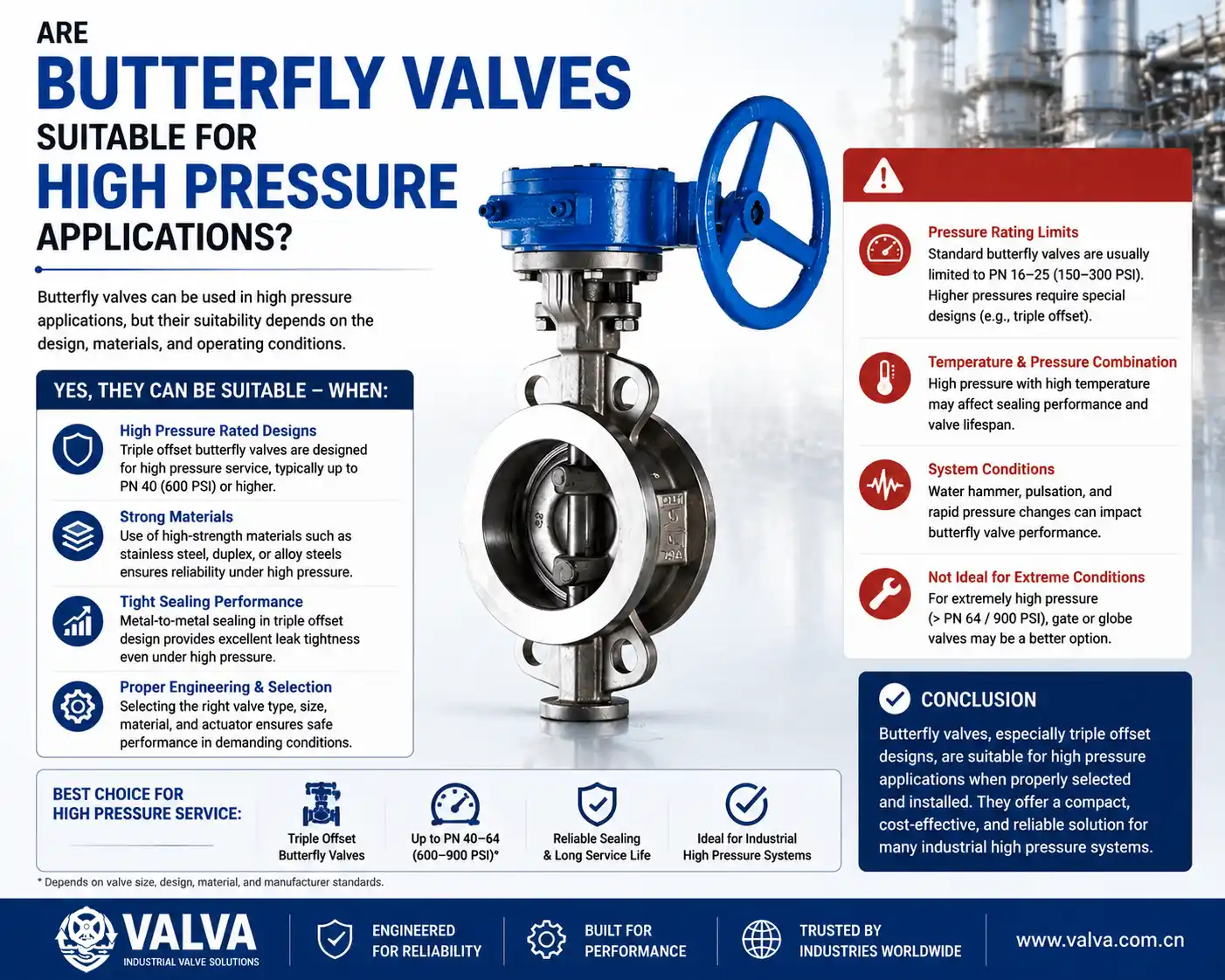
Yes, butterfly valves can be suitable for high pressure applications, but only when the correct valve design is selected. While standard resilient-seated butterfly valves are typically used in low- to medium-pressure systems, high-performance and triple-offset butterfly valves are specifically engineered to withstand higher pressures, elevated temperatures, and demanding industrial services.
Not All Butterfly Valves Are Designed for High Pressure
Many people assume every butterfly valve performs the same, but pressure capability depends on its design.
Generally, butterfly valves fall into three categories:
- Resilient-seated butterfly valves – Best for low to medium pressure services such as water distribution and HVAC.
- High-performance butterfly valves (double-offset) – Suitable for higher pressure and temperature applications.
- Triple-offset butterfly valves – Designed for severe service involving high pressure, high temperature, steam, gas, and critical process fluids.
Choosing the correct valve type is essential for safe and reliable operation.
Pressure Ratings of Different Butterfly Valves
Pressure ratings vary depending on valve construction and applicable standards.
| Valve Type | Typical Pressure Range | Common Applications |
|---|---|---|
| Resilient-Seated | PN10–PN16 (Class 150) | Water, HVAC, irrigation |
| High-Performance | Class 150–300 | Oil & gas, chemical processing |
| Triple-Offset | Class 300–900+ | Steam, power plants, refineries |
Actual pressure ratings depend on valve size, materials, manufacturer specifications, and operating temperature.
Why High-Performance Butterfly Valves Handle Higher Pressure
High-performance butterfly valves incorporate several design improvements.
These include:
- Double-offset disc geometry
- Reduced seat friction
- Metal or reinforced soft seats
- Stronger shafts and bearings
- Improved sealing performance
As a result, they maintain tight shutoff while reducing wear during repeated operation.
Triple-Offset Butterfly Valves for Severe Service
Triple-offset butterfly valves are specifically developed for the most demanding industrial applications.
They are commonly used in:
- Steam systems
- High-pressure gas pipelines
- LNG terminals
- Refineries
- Petrochemical plants
- Power generation facilities
- Offshore platforms
Unlike resilient-seated valves, triple-offset designs use a metal-to-metal seal that performs reliably under extreme pressure and temperature.
Factors That Affect Pressure Capability
Several factors determine whether a butterfly valve is suitable for a high-pressure application.
These include:
Valve Design
Offset geometry significantly improves sealing performance under pressure.
Seat Material
Metal seats tolerate higher pressure and temperature than rubber seats.
Body Material
Carbon steel, stainless steel, and alloy steel bodies provide greater mechanical strength.
Operating Temperature
Higher temperatures reduce allowable pressure ratings for most valves.
Fluid Type
Steam, gas, slurry, and corrosive chemicals may require specialized materials and sealing systems.
Advantages of Butterfly Valves in High Pressure Systems
When properly selected, butterfly valves offer several benefits.
These include:
- Compact and lightweight construction
- Lower installation costs
- Faster quarter-turn operation
- Reduced actuator size
- Easy automation
- Lower maintenance requirements
- Reliable sealing in large-diameter pipelines
These advantages make them attractive alternatives to gate and globe valves in many industrial systems.
When Butterfly Valves May Not Be the Best Choice
Although modern butterfly valves perform well in many high-pressure applications, they are not always the ideal solution.
Other valve types may be preferable when applications require:
- Extremely high pressure
- Ultra-high temperatures
- Severe erosion
- Abrasive solids
- Bubble-tight isolation under extreme service conditions
In these cases, engineers often evaluate gate valves, ball valves, or specialized severe-service valves.
How to Select the Right Butterfly Valve
Before choosing a butterfly valve, evaluate:
- Maximum working pressure
- Operating temperature
- Fluid characteristics
- Required shutoff performance
- Valve size
- Automation requirements
- Applicable standards (API, ASME, ISO, EN)
Working with an experienced valve manufacturer helps ensure the valve meets both performance and safety requirements.
Conclusion
Butterfly valves are suitable for many high-pressure applications when the appropriate design is selected. Standard resilient-seated valves are intended for lower pressures, while high-performance and triple-offset butterfly valves provide reliable operation in demanding industries such as oil and gas, chemical processing, power generation, and steam systems. Selecting the correct materials, seat design, and pressure rating is the key to long-term performance.
Frequently Asked Questions
Can butterfly valves be used for steam service?
Yes. Triple-offset butterfly valves with metal seats are widely used in steam systems because they can withstand high temperatures and pressures.
What is the highest pressure butterfly valves can handle?
High-performance and triple-offset butterfly valves can be manufactured for pressure ratings up to ASME Class 900 or higher, depending on the manufacturer and application.
Are butterfly valves better than gate valves for high pressure?
It depends on the application. Butterfly valves are lighter, more compact, and easier to automate, while gate valves are often preferred for certain very high-pressure isolation services.
Related Articles
Technical & Design Insights
- How Does a Butterfly Valve Work
- Working Principle of Butterfly Valve
- Butterfly Valve Components
- Butterfly Valve Materials
- Wafer vs Lug Butterfly Valve
- Wafer vs Lug vs Flanged Butterfly Valve
- High Performance vs Concentric Butterfly Valve
- Double Offset vs Triple Offset Butterfly Valve
- Soft Seat vs Metal Seat Butterfly Valve
- Rubber Lined vs PTFE Butterfly Valve
- Manual vs Automated Butterfly Valve
- Electric vs Pneumatic Butterfly Valve
Commercial & Purchasing Topics
- Wafer Butterfly Valve Wholesale Price
- Stainless Steel Butterfly Valve Factory Direct Supplier
- API 609 Butterfly Valve Manufacturer in China Guide
- Electric Butterfly Valve Price List DN50 DN200
- Pneumatic Butterfly Valve Bulk Order Supplier
- High Performance Butterfly Valve Export Supplier
- Industrial Butterfly Valve Quotation Fast Delivery
- Butterfly Valve OEM Manufacturer Oil & Gas Industry
- Butterfly Valve Supplier Water Treatment Project
- Butterfly Valve Supplier Industrial Applications