Direct Answer
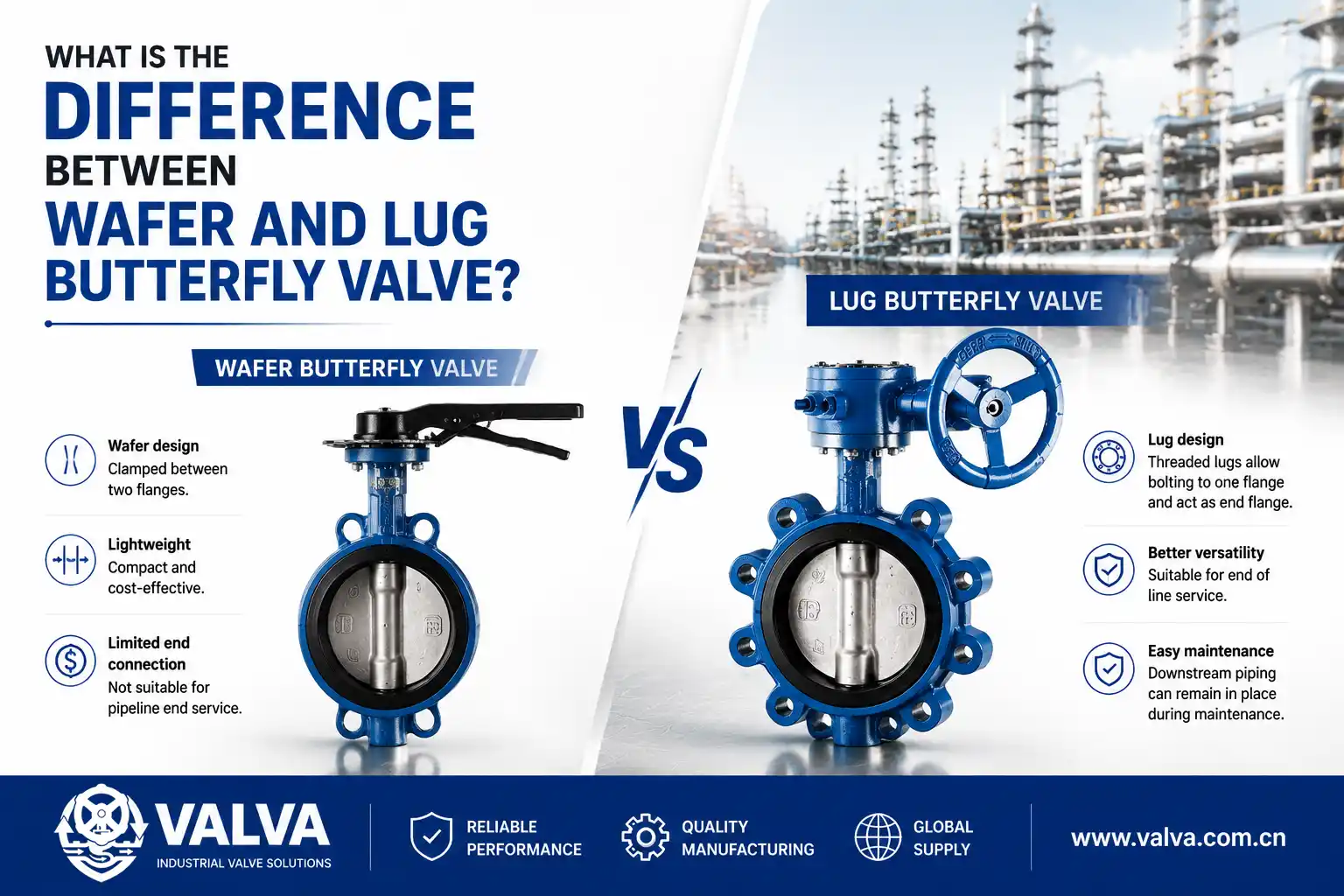
The main difference between a wafer and a lug butterfly valve is how they are mounted to the pipeline. A wafer butterfly valve is clamped between two pipe flanges using long bolts that pass through both flanges, while a lug butterfly valve has threaded lugs that allow each flange to be bolted independently. Lug valves are easier to maintain and can isolate one side of a pipeline, whereas wafer valves are lighter, more economical, and commonly used in general industrial services.
Quick Comparison
| Feature | Wafer Butterfly Valve | Lug Butterfly Valve |
|---|---|---|
| Installation | Clamped between two flanges | Bolted separately to each flange |
| Mounting | Long through-bolts | Threaded lug holes |
| End-of-Line Service | Not recommended | Suitable (depending on pressure rating) |
| Maintenance | Requires removing both pipe sections | One pipeline side can remain connected |
| Weight | Lighter | Heavier |
| Cost | Lower | Higher |
| Typical Applications | Water, HVAC, general industry | Oil & gas, chemical plants, process industries |
What Is a Wafer Butterfly Valve?
A wafer butterfly valve is designed to fit between two pipe flanges.
Long bolts pass through one flange, across the valve body, and into the opposite flange, holding the valve securely in place.
Advantages
- Lower purchase cost
- Lightweight construction
- Compact design
- Easy installation
- Suitable for most low- and medium-pressure systems
Limitations
Because the valve depends on both flanges for support, removing one side of the pipeline usually requires shutting down the entire system.
Wafer valves are generally not intended for end-of-line service unless specifically designed and rated for that application.
What Is a Lug Butterfly Valve?
A lug butterfly valve has threaded lugs cast into the valve body.
Each pipeline flange is bolted directly to the valve independently, eliminating the need for through-bolts.
This design offers greater installation flexibility.
Advantages
- Easier pipeline maintenance
- Individual pipe sections can be removed
- Suitable for end-of-line service (when properly rated)
- Stronger mechanical support
- Better for critical industrial systems
Limitations
- Higher manufacturing cost
- Slightly larger and heavier
- More expensive installation hardware
Installation Differences
Wafer Valve Installation
Installation involves:
- Positioning the valve between two flanges
- Aligning bolt holes
- Installing long through-bolts
- Tightening bolts evenly
The valve body itself does not contain threaded mounting holes.
Lug Valve Installation
Each flange is bolted directly into the threaded lugs on the valve body.
Benefits include:
- Independent flange attachment
- Easier removal of downstream piping
- Simplified maintenance
- Improved structural stability
Maintenance Comparison
Maintenance is often the deciding factor when selecting between these two valve types.
Wafer Butterfly Valve
If maintenance is required:
- The pipeline usually must be depressurized.
- Both flanges are separated.
- The valve is removed completely.
Lug Butterfly Valve
With a lug-style design:
- One side of the pipeline can remain connected.
- Equipment downstream can often be removed independently.
- Downtime is reduced.
For facilities where continuous production is important, this can significantly reduce maintenance costs.
Pressure Performance
Both wafer and lug butterfly valves are available in similar pressure classes.
However, lug valves generally provide:
- Better mechanical support
- Improved flange loading
- Greater stability in larger pipe sizes
The actual pressure capability depends more on the valve design and applicable standards than on the connection type alone.
Which Valve Costs More?
Lug butterfly valves are typically 20–50% more expensive than comparable wafer valves because they require:
- More material
- Machined threaded lugs
- Higher manufacturing complexity
Wafer valves are often preferred when minimizing project costs is a priority.
Typical Industrial Applications
Wafer Butterfly Valves
Commonly used in:
- Water treatment plants
- HVAC systems
- Fire protection systems
- Irrigation
- General industrial utilities
- Cooling water systems
Lug Butterfly Valves
Frequently selected for:
- Oil and gas facilities
- Chemical processing plants
- Power generation
- Mining operations
- Marine systems
- Process isolation applications
Which One Should You Choose?
Choose a wafer butterfly valve if you need:
- Lower cost
- Lightweight installation
- Standard pipeline isolation
- General-purpose service
- Space-saving design
Choose a lug butterfly valve if you need:
- Easier maintenance
- End-of-line capability
- Frequent equipment servicing
- Higher mechanical strength
- Critical industrial operation
Conclusion
While both wafer and lug butterfly valves perform the same basic function of controlling fluid flow, their connection methods make them suitable for different applications. Wafer butterfly valves are economical, lightweight, and ideal for general service, whereas lug butterfly valves provide greater installation flexibility, easier maintenance, and support for end-of-line service. Selecting the right type depends on your maintenance requirements, budget, and operating conditions.
Frequently Asked Questions
Can a wafer butterfly valve be used for end-of-line service?
In most cases, no. Standard wafer butterfly valves rely on both pipe flanges for support and are generally not intended for end-of-line service unless specifically designed and certified for that purpose.
Why are lug butterfly valves more expensive?
Lug valves require additional material, threaded mounting lugs, and more complex machining, which increases manufacturing costs compared to wafer valves.
Which butterfly valve is better for industrial plants?
For facilities that require frequent maintenance or equipment isolation, lug butterfly valves are usually the better choice. For general utility systems where cost is a key consideration, wafer butterfly valves are often the preferred option.
Related Articles
Technical & Design Insights
- How Does a Butterfly Valve Work
- Working Principle of Butterfly Valve
- Butterfly Valve Components
- Butterfly Valve Materials
- Wafer vs Lug Butterfly Valve
- Wafer vs Lug vs Flanged Butterfly Valve
- High Performance vs Concentric Butterfly Valve
- Double Offset vs Triple Offset Butterfly Valve
- Soft Seat vs Metal Seat Butterfly Valve
- Rubber Lined vs PTFE Butterfly Valve
- Manual vs Automated Butterfly Valve
- Electric vs Pneumatic Butterfly Valve
Commercial & Purchasing Topics
- Wafer Butterfly Valve Wholesale Price
- Stainless Steel Butterfly Valve Factory Direct Supplier
- API 609 Butterfly Valve Manufacturer in China Guide
- Electric Butterfly Valve Price List DN50 DN200
- Pneumatic Butterfly Valve Bulk Order Supplier
- High Performance Butterfly Valve Export Supplier
- Industrial Butterfly Valve Quotation Fast Delivery
- Butterfly Valve OEM Manufacturer Oil & Gas Industry
- Butterfly Valve Supplier Water Treatment Project
- Butterfly Valve Supplier Industrial Applications