
Direct Answer
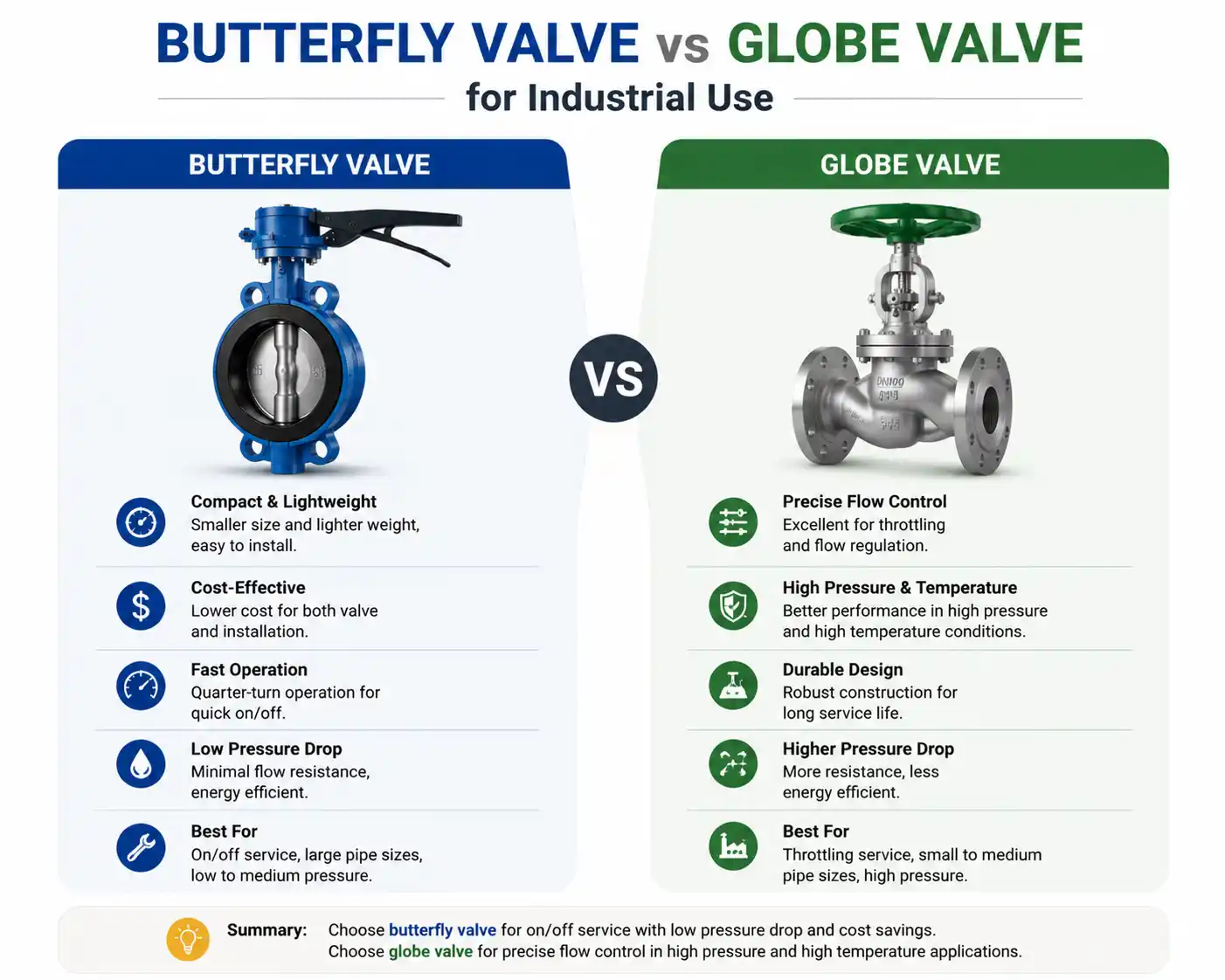
Butterfly valves are better for fast operation, low cost, and large-diameter pipelines, while globe valves are better for precise flow control and throttling in high-pressure systems. The choice depends on whether the priority is efficient isolation and size (butterfly) or accurate regulation (globe).
Operating Principle Difference
Butterfly Valve
A butterfly valve uses a rotating disc (quarter-turn, 90°) to control flow.
- Quick open/close operation
- Suitable for large pipelines
- Simple structure
It is mainly designed for isolation and basic flow regulation.
Globe Valve
A globe valve uses a linear moving plug or disc that seats against an internal baffle.
- Multi-turn operation
- Designed for throttling
- Precise flow adjustment
It is mainly designed for flow regulation and control.
Flow Control Performance
Butterfly Valve
- Good for basic throttling
- Less precise at low opening angles
- Better for on/off control in large systems
Globe Valve
- Excellent throttling capability
- High precision flow control
- Stable performance under varying conditions
Pressure Drop Comparison
Butterfly Valve
- Moderate pressure drop due to disc in flow path
- Acceptable in water and HVAC systems
- Efficient in large-diameter pipelines
Globe Valve
- Higher pressure drop due to zig-zag flow path
- Less efficient for long-distance flow transport
- Used where control matters more than efficiency
Pressure and Temperature Capability
Butterfly Valve
- Medium pressure (depends on design)
- Suitable for water, HVAC, and process utilities
- High-performance types handle more severe service
Globe Valve
- Strong performance in high-pressure systems
- Suitable for steam and high-temperature service
- Common in industrial process control
Size and Installation
Butterfly Valve
- Compact and lightweight
- Ideal for large-diameter pipelines
- Easy installation and automation
Globe Valve
- Bulkier and heavier
- Requires more installation space
- More complex internal structure
Cost Comparison
Butterfly Valve
- Lower cost
- Economical for large pipelines
- Less material usage
Globe Valve
- Higher cost
- More complex machining
- Higher maintenance cost
Maintenance Requirements
Butterfly Valve
- Simple design
- Easier maintenance
- Seat may wear in throttling service
Globe Valve
- More internal components
- Higher maintenance complexity
- Better durability in throttling applications
Typical Industrial Applications
Butterfly Valve Applications
- Water treatment
- HVAC systems
- Fire protection
- Cooling water systems
- Large industrial pipelines
Globe Valve Applications
- Steam systems
- Boiler feedwater
- Chemical dosing
- Process control systems
- High-pressure regulation lines
When to Choose Each Valve
Choose Butterfly Valve if you need:
- Low cost solution
- Fast operation
- Large pipe diameter
- Basic flow control or isolation
- Easy automation
Choose Globe Valve if you need:
- Precise flow regulation
- High-pressure throttling
- Stable control performance
- Steam or process control systems
Conclusion
Butterfly valves are best for cost-efficient, large-scale, and fast-operating systems, while globe valves are best for precise flow control in high-pressure and high-temperature industrial applications. The correct choice depends on whether system efficiency or control accuracy is the priority.
Frequently Asked Questions
Is a butterfly valve better than a globe valve?
Not universally. Butterfly valves are better for large pipelines and cost efficiency, while globe valves are better for precise flow control and throttling.
Can a butterfly valve replace a globe valve?
Only in basic water and HVAC systems. For accurate flow regulation in high-pressure service, globe valves are still preferred.
Why do globe valves have higher pressure drop?
Because fluid must change direction inside the valve body, creating resistance and energy loss compared to the straight-through flow in butterfly valves.
Related Articles
Technical & Design Insights
- How Does a Butterfly Valve Work
- Working Principle of Butterfly Valve
- Butterfly Valve Components
- Butterfly Valve Materials
- Wafer vs Lug Butterfly Valve
- Wafer vs Lug vs Flanged Butterfly Valve
- High Performance vs Concentric Butterfly Valve
- Double Offset vs Triple Offset Butterfly Valve
- Soft Seat vs Metal Seat Butterfly Valve
- Rubber Lined vs PTFE Butterfly Valve
- Manual vs Automated Butterfly Valve
- Electric vs Pneumatic Butterfly Valve
Commercial & Purchasing Topics
- Wafer Butterfly Valve Wholesale Price
- Stainless Steel Butterfly Valve Factory Direct Supplier
- API 609 Butterfly Valve Manufacturer in China Guide
- Electric Butterfly Valve Price List DN50 DN200
- Pneumatic Butterfly Valve Bulk Order Supplier
- High Performance Butterfly Valve Export Supplier
- Industrial Butterfly Valve Quotation Fast Delivery
- Butterfly Valve OEM Manufacturer Oil & Gas Industry
- Butterfly Valve Supplier Water Treatment Project
- Butterfly Valve Supplier Industrial Applications