Direct Answer:
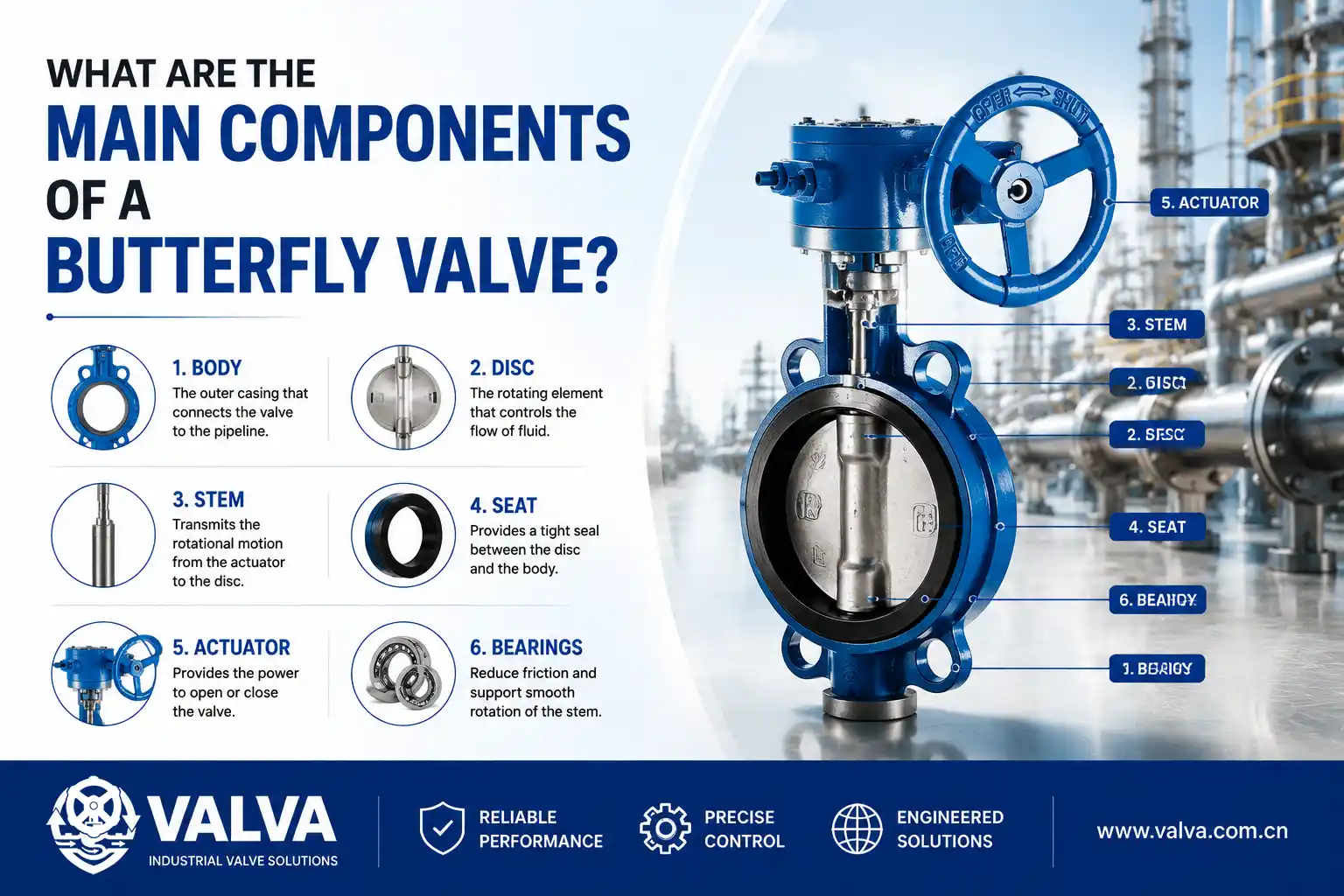
The main components of a butterfly valve are the valve body, disc, stem (shaft), seat, actuator, and sealing elements. Together, these parts enable the valve to start, stop, or regulate fluid flow with a simple quarter-turn operation. The design of each component affects the valve’s pressure rating, sealing performance, durability, and suitability for different industrial applications.
Valve Body
The valve body forms the outer shell of the butterfly valve and connects it to the piping system.
Its primary functions are to:
- Support all internal components
- Withstand system pressure
- Connect to pipeline flanges or fittings
- Protect the internal sealing surfaces
Common body connection types include:
- Wafer type
- Lug type
- Double-flanged type
Typical body materials include:
- Ductile iron
- Cast iron
- Carbon steel
- Stainless steel
- Duplex stainless steel
- Bronze
The body material is selected based on pressure, temperature, corrosion resistance, and the process fluid.
Disc
The disc is the moving component that directly controls fluid flow.
Mounted in the center of the valve, it rotates approximately 90 degrees to open or close the flow passage.
Depending on the application, discs may be manufactured from:
- Stainless steel
- Ductile iron with protective coating
- Aluminum bronze
- Duplex stainless steel
- Nickel alloy
The disc design significantly affects:
- Pressure drop
- Flow capacity
- Cavitation resistance
- Wear resistance
Stem (Shaft)
The stem connects the actuator or manual handle to the disc.
When the actuator rotates the stem, the stem turns the disc inside the valve.
A high-quality stem provides:
- Smooth operation
- High torque transmission
- Corrosion resistance
- Long service life
Most industrial stems are manufactured from stainless steel to resist corrosion and mechanical fatigue.
Seat
The seat forms the sealing surface between the disc and the valve body.
When the valve closes, the disc presses against the seat to prevent fluid leakage.
Seat materials vary according to operating conditions.
Soft Seats
Common materials include:
- EPDM
- NBR
- PTFE
- FKM (Viton)
Soft seats provide:
- Bubble-tight shutoff
- Excellent sealing
- Lower operating torque
Metal Seats
Metal-seated butterfly valves are used for:
- High temperatures
- Abrasive media
- Steam service
- Severe industrial applications
Although they may not always achieve zero leakage like soft seats, they offer much longer service life under extreme conditions.
Actuator
The actuator provides the force needed to rotate the disc.
Several actuator types are available depending on automation requirements.
Manual Lever
Best suited for smaller valves requiring occasional operation.
Gear Operator
Used on larger valves where additional operating torque is required.
Pneumatic Actuator
Powered by compressed air for fast and reliable automatic control.
Electric Actuator
Uses an electric motor for remote operation and integration with PLC or DCS systems.
Hydraulic Actuator
Provides high torque output for large-diameter or high-pressure valves.
Bearings and Bushings
Bearings and bushings support the stem and reduce friction during operation.
Their functions include:
- Maintaining stem alignment
- Reducing wear
- Improving operating efficiency
- Extending service life
High-quality bearings are especially important for valves that cycle frequently.
O-Rings and Seals
Secondary sealing elements help prevent leakage around the stem and other moving components.
Depending on the valve design, sealing elements may include:
- O-rings
- Stem seals
- Packing
- Gaskets
Proper sealing protects the valve from external leakage while maintaining smooth operation.
Fasteners
Bolts, nuts, retaining pins, and keys secure the valve components together.
Although relatively small, these parts play an important role in maintaining structural integrity, especially in high-pressure applications.
Nameplate
Every industrial butterfly valve includes a nameplate containing essential identification information.
Typical information includes:
- Manufacturer
- Valve size
- Pressure class
- Material grade
- Temperature rating
- Serial number
- Manufacturing standard
The nameplate allows engineers to verify that the valve meets project specifications.
How These Components Work Together
During operation, the actuator rotates the stem, which turns the disc inside the valve body.
As the disc rotates:
- The opening inside the pipe increases or decreases.
- The seat creates a seal when the valve closes.
- Bearings support smooth rotation.
- Stem seals prevent leakage.
- The body withstands internal pressure while connecting the valve to the pipeline.
Together, these components provide reliable flow control with minimal maintenance.
Material Selection Matters
Different industries require different material combinations.
| Application | Typical Body | Disc | Seat |
|---|---|---|---|
| Water Treatment | Ductile Iron | Stainless Steel | EPDM |
| HVAC | Cast Iron | Stainless Steel | EPDM |
| Chemical Processing | Stainless Steel | Stainless Steel | PTFE |
| Food & Beverage | Stainless Steel | Stainless Steel | PTFE |
| Oil & Gas | Carbon Steel | Stainless Steel | Metal or PTFE |
| Seawater | Duplex Stainless Steel | Duplex Stainless Steel | EPDM |
Selecting the proper material combination improves service life and reduces maintenance costs.
Conclusion
A butterfly valve consists of several essential components, including the body, disc, stem, seat, actuator, bearings, seals, and fasteners. Each part performs a specific function that contributes to the valve’s sealing capability, flow control, and long-term reliability. Understanding these components helps engineers choose the right butterfly valve for industrial applications while ensuring safe and efficient pipeline operation.
Frequently Asked Questions
Which component actually controls the flow in a butterfly valve?
The disc is the component that directly controls fluid flow. As it rotates inside the valve body, it changes the opening area and regulates the flow rate.
What is the purpose of the seat in a butterfly valve?
The seat creates a seal between the disc and the valve body, preventing fluid leakage when the valve is fully closed.
Which material is best for butterfly valve seats?
The best seat material depends on the application. EPDM is commonly used for water service, PTFE offers excellent chemical resistance, and metal seats are preferred for high-temperature and abrasive applications.
Related Articles
Technical & Design Insights
- How Does a Butterfly Valve Work
- Working Principle of Butterfly Valve
- Butterfly Valve Components
- Butterfly Valve Materials
- Wafer vs Lug Butterfly Valve
- Wafer vs Lug vs Flanged Butterfly Valve
- High Performance vs Concentric Butterfly Valve
- Double Offset vs Triple Offset Butterfly Valve
- Soft Seat vs Metal Seat Butterfly Valve
- Rubber Lined vs PTFE Butterfly Valve
- Manual vs Automated Butterfly Valve
- Electric vs Pneumatic Butterfly Valve
Commercial & Purchasing Topics
- Wafer Butterfly Valve Wholesale Price
- Stainless Steel Butterfly Valve Factory Direct Supplier
- API 609 Butterfly Valve Manufacturer in China Guide
- Electric Butterfly Valve Price List DN50 DN200
- Pneumatic Butterfly Valve Bulk Order Supplier
- High Performance Butterfly Valve Export Supplier
- Industrial Butterfly Valve Quotation Fast Delivery
- Butterfly Valve OEM Manufacturer Oil & Gas Industry
- Butterfly Valve Supplier Water Treatment Project
- Butterfly Valve Supplier Industrial Applications