
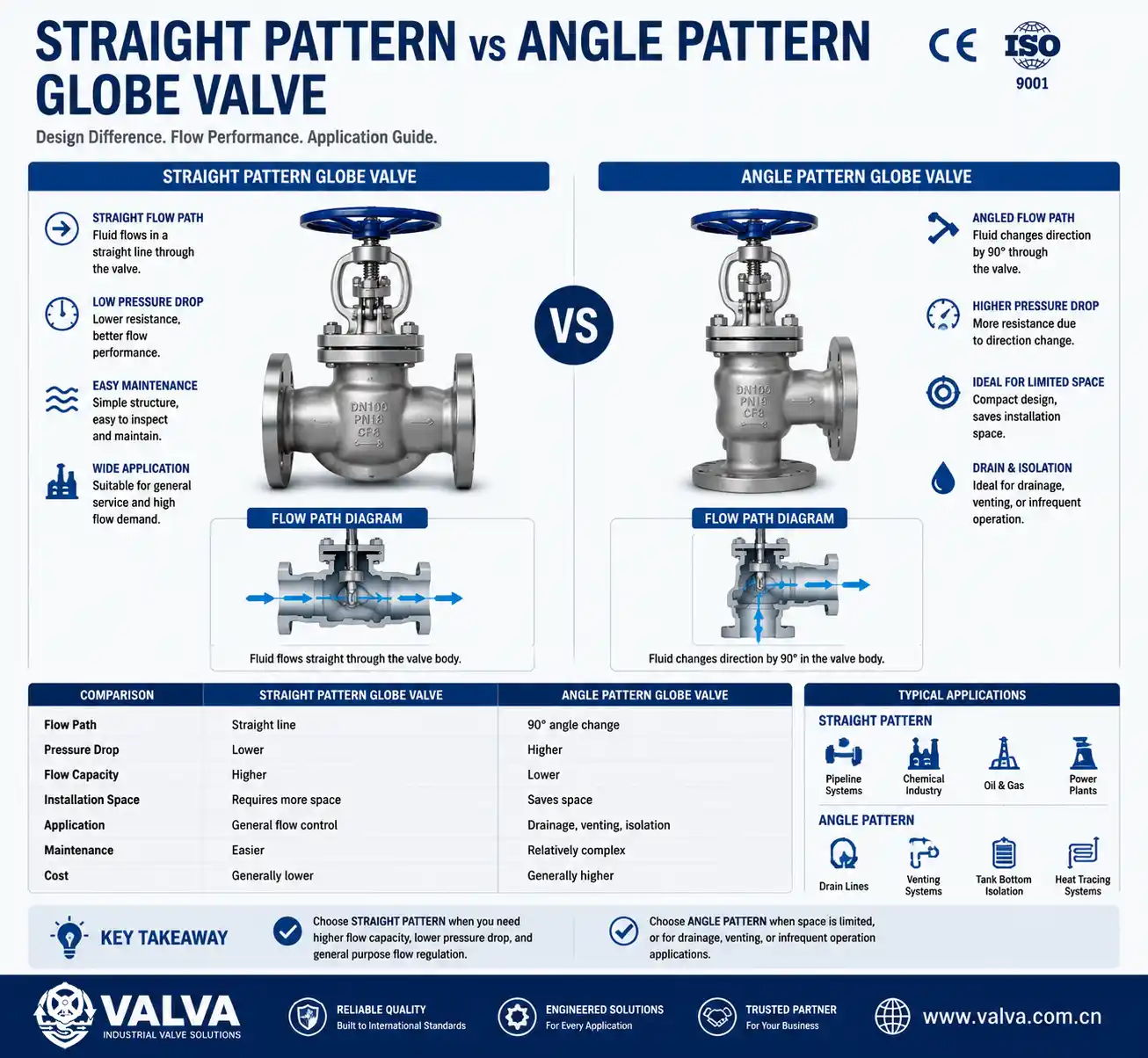
Direct Answer
Straight pattern globe valves maintain a linear or Z-shaped flow path, while angle pattern globe valves change the flow direction by 90 degrees inside the valve body. As a result, straight pattern valves are more common for general flow control, while angle pattern valves are used where piping layout or space constraints require a directional change.
What Is a Straight Pattern Globe Valve?
A straight pattern globe valve (also called a T-type globe valve) uses a traditional internal design where:
- Fluid enters and exits in a straight line (with internal direction change)
- The disc moves vertically to control flow
- The flow path is more restrictive
Key characteristics:
- Higher pressure drop
- Excellent throttling performance
- Most commonly used globe valve type
- Standard design in industrial pipelines
Typical applications:
- Steam systems
- Oil and gas process lines
- Chemical plants
- Water treatment systems
What Is an Angle Pattern Globe Valve?
An angle pattern globe valve is designed so that:
- Inlet and outlet are at a 90° angle
- Flow changes direction inside the valve body
- Fewer fittings are needed in piping layout
Key characteristics:
- Directional flow change (90° turn)
- Lower piping complexity
- Moderate pressure drop (can be lower than straight pattern in some systems)
- Compact installation design
Typical applications:
- Space-limited piping systems
- Boiler and condensate lines
- High-pressure steam applications
- Systems requiring direction change without elbows
Straight Pattern vs Angle Pattern Comparison
| Feature | Straight Pattern Globe Valve | Angle Pattern Globe Valve |
|---|---|---|
| Flow direction | Inline (with internal Z-path) | 90° directional change |
| Pressure drop | Higher | Moderate (often lower system loss) |
| Installation space | Requires more piping space | More compact layout |
| Throttling ability | Excellent | Good |
| Pipe fittings needed | More elbows required | Fewer fittings needed |
| Best use case | Standard flow control | Space-saving + directional flow |
Flow Performance Difference
Straight Pattern
- Creates stronger turbulence inside valve body
- Provides very precise throttling control
- Best for stable process regulation
Angle Pattern
- Reduces external pipe elbows
- Improves system layout efficiency
- Suitable for directional flow systems
When to Use Straight Pattern Globe Valve
Choose straight pattern when:
- Precise flow control is required
- System design is standard and space is available
- High throttling accuracy is needed
- Pressure drop is acceptable
When to Use Angle Pattern Globe Valve
Choose angle pattern when:
- Pipe layout requires a 90° direction change
- Installation space is limited
- Reducing fittings is important
- Steam or condensate systems are involved
Industrial Applications
Straight Pattern Applications
- Chemical processing
- Oil and gas pipelines
- Water treatment systems
- Industrial steam control
Angle Pattern Applications
- Boiler condensate systems
- Marine piping systems
- HVAC compact layouts
- High-pressure utility lines
Conclusion
Straight pattern globe valves are best for precise flow control in standard pipelines, while angle pattern globe valves are ideal for compact systems where flow direction needs to change by 90 degrees. The choice depends on whether your priority is control accuracy or piping layout efficiency.
Frequently Asked Questions
Which has higher pressure drop, straight or angle pattern globe valve?
Straight pattern typically has higher pressure drop due to internal flow resistance, while angle pattern can reduce system losses by optimizing piping layout.
Is angle pattern globe valve better than straight pattern?
Neither is better overall. Angle pattern is better for space-saving designs, while straight pattern is better for precise flow control.
Where is angle pattern globe valve commonly used?
It is commonly used in steam, condensate, and compact industrial piping systems where direction change is required.
Related Articles
Technical & Design Insights
Materials & Standards
Maintenance & Operation
Commercial & Purchasing Topics
- Globe Valve Manufacturer China
- Industrial Globe Valve Supplier Oil & Gas
- Stainless Steel Globe Valve Factory Direct Supplier
- Globe Valve Price List DN15 to DN200
- High Pressure Globe Valve Supplier
- Globe Valve Quotation Request Fast Delivery
- Cast Steel Globe Valve Supplier Power Plant
- Globe Valve Bulk Order OEM Manufacturer
- Globe Valve Wholesale Price Industrial Use