
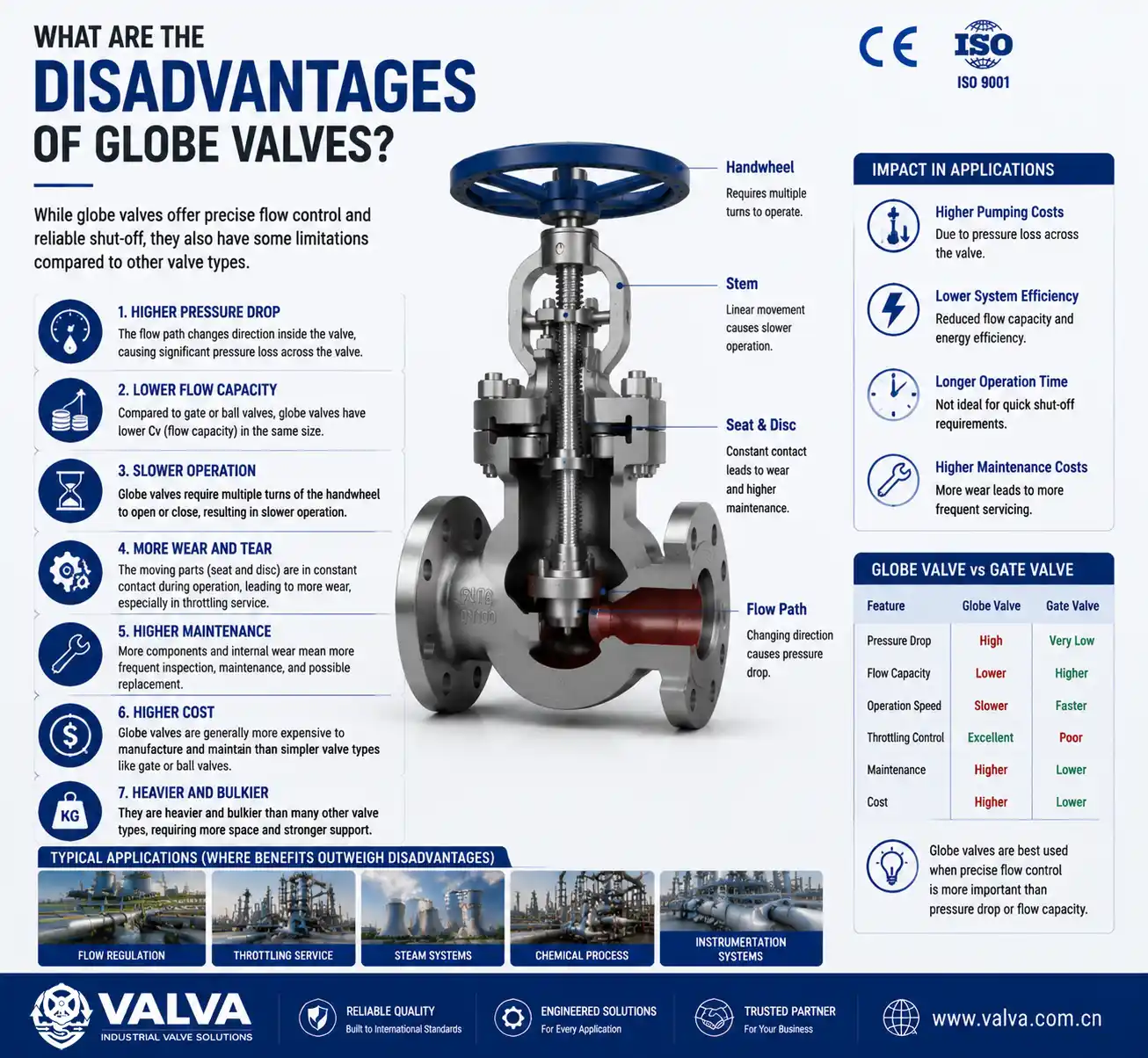
Direct Answer
The main disadvantages of globe valves are higher pressure drop, slower operation, greater operating force, and higher cost compared with some other valve types. While they excel at flow regulation, they are not always the best option for applications requiring unrestricted flow or quick shut-off.
Higher Pressure Drop
One of the biggest drawbacks of a globe valve is its relatively high pressure drop.
Unlike gate or ball valves, a globe valve forces the fluid to change direction as it passes through the valve body. As a result, friction increases and pressure decreases.
This can lead to:
- Reduced flow efficiency
- Higher energy consumption
- Increased pump operating costs
- Lower system performance in high-flow applications
Therefore, globe valves are generally not recommended where minimizing pressure loss is critical.
Slower Operation
A globe valve requires multiple turns of the handwheel to move the disc from fully open to fully closed.
Compared with quarter-turn valves such as ball or butterfly valves, globe valves:
- Open more slowly
- Close more slowly
- Require more operator effort
- Respond less quickly during emergencies
Consequently, they are less suitable for applications requiring rapid isolation.
Greater Operating Force
As valve size and operating pressure increase, more force is needed to move the disc against fluid pressure.
Large globe valves often require:
- Gear operators
- Pneumatic actuators
- Electric actuators
- Hydraulic actuators
These additional components can increase both installation costs and maintenance requirements.
Higher Initial Cost
Globe valves usually cost more than simple isolation valves because of their more complex internal design.
The higher price reflects:
- Additional internal components
- Precision-machined seating surfaces
- More robust construction
- Greater manufacturing complexity
However, their superior flow control often justifies the investment in process control applications.
Less Suitable for Full-Flow Applications
When fully open, a globe valve still creates more flow resistance than a gate or full-port ball valve.
For this reason, globe valves are not the best choice for systems that require:
- Maximum flow capacity
- Minimal pressure loss
- High-volume fluid transfer
- Low pumping costs
In these situations, gate or ball valves are usually more efficient.
Larger and Heavier Design
Globe valves generally have a bulkier body than many other valve types.
This can result in:
- More installation space
- Higher transportation costs
- Increased support requirements
- More challenging maintenance in confined areas
These factors become more significant as valve size increases.
More Wear During Throttling
Although globe valves are designed for throttling, frequent operation under severe conditions can gradually wear the disc and seat.
Wear may increase when handling:
- High-velocity fluids
- Abrasive particles
- Flashing liquids
- Cavitating flow
Proper material selection and routine maintenance help reduce this wear and extend service life.
When Are Globe Valves Still the Best Choice?
Despite these disadvantages, globe valves remain the preferred option whenever precise flow regulation is more important than achieving the lowest pressure drop.
They are widely used in:
- Steam systems
- Chemical processing plants
- Power generation
- Oil and gas facilities
- Water treatment plants
- HVAC systems
In these applications, accurate control often outweighs the disadvantages.
Conclusion
The disadvantages of globe valves include higher pressure drop, slower operation, greater operating force, higher cost, and reduced efficiency in full-flow applications. Even so, their excellent throttling capability and reliable shut-off continue to make them a leading choice for industrial flow control.
Frequently Asked Questions
What is the biggest disadvantage of a globe valve?
The biggest disadvantage is its higher pressure drop, which results from the valve’s internal flow path changing direction.
Why do globe valves require more operating force?
The disc moves against fluid pressure during operation, so larger valves often need more torque or powered actuators.
Are globe valves suitable for high-flow systems?
They can handle high-flow systems, but they are generally less efficient than gate or full-port ball valves because they create greater flow resistance.
Related Articles
Technical & Design Insights
Materials & Standards
Maintenance & Operation
Commercial & Purchasing Topics
- Globe Valve Manufacturer China
- Industrial Globe Valve Supplier Oil & Gas
- Stainless Steel Globe Valve Factory Direct Supplier
- Globe Valve Price List DN15 to DN200
- High Pressure Globe Valve Supplier
- Globe Valve Quotation Request Fast Delivery
- Cast Steel Globe Valve Supplier Power Plant
- Globe Valve Bulk Order OEM Manufacturer
- Globe Valve Wholesale Price Industrial Use