
Direct Answer
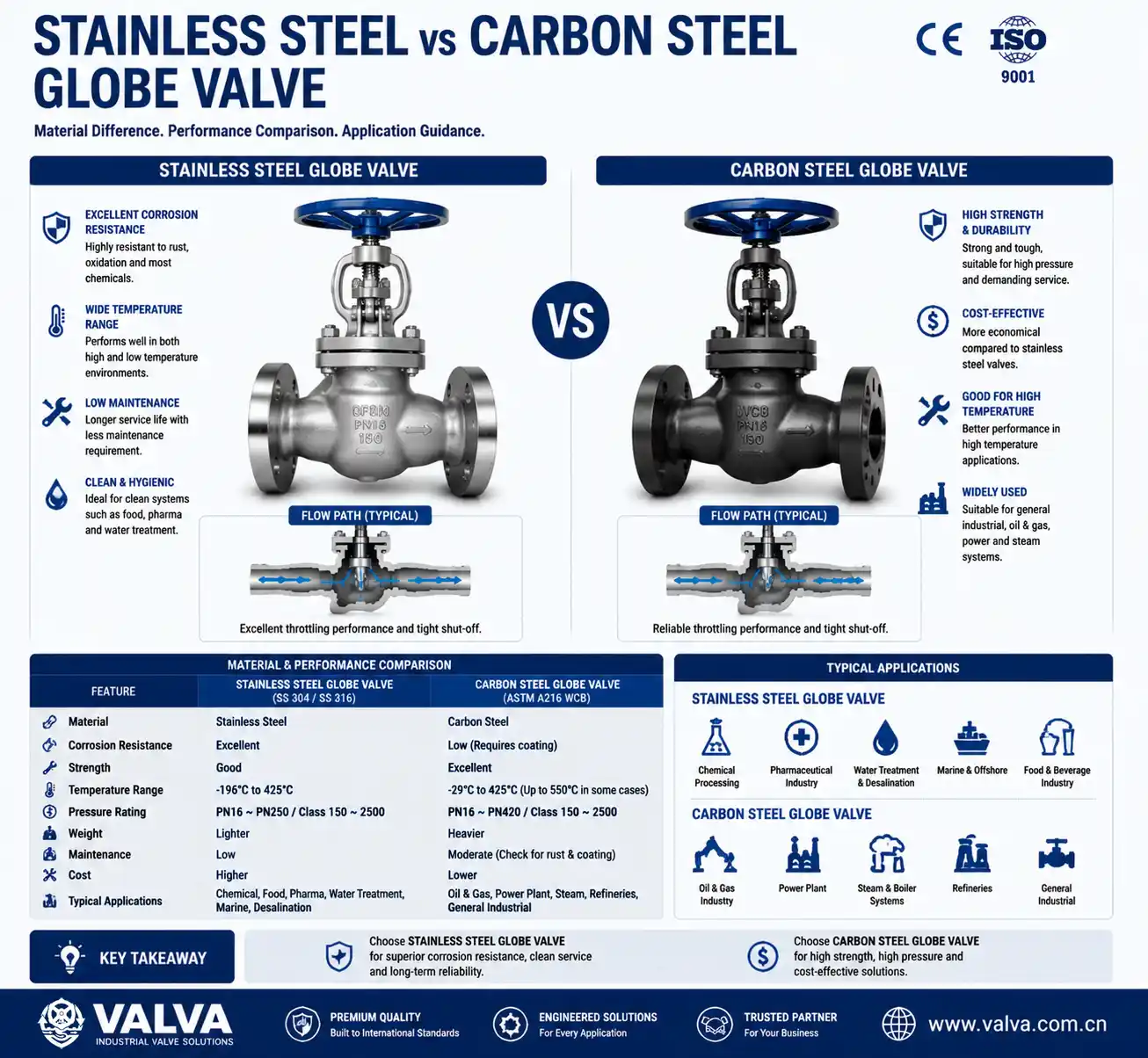
Stainless steel globe valves offer superior corrosion resistance and longer service life, while carbon steel globe valves provide higher strength at a lower cost for general industrial use. The choice depends mainly on whether corrosion resistance or cost-efficiency is the priority.
What Is a Stainless Steel Globe Valve?
A stainless steel globe valve is made from alloys such as 304 or 316 stainless steel.
Key characteristics:
- Excellent corrosion resistance
- Suitable for harsh environments
- Long service life
- Good performance in chemical and marine applications
- Higher cost compared to carbon steel
Common applications:
- Chemical processing plants
- Seawater and marine systems
- Food and beverage industry
- Pharmaceutical systems
- Corrosive fluid pipelines
What Is a Carbon Steel Globe Valve?
A carbon steel globe valve is made primarily from iron and carbon alloys.
Key characteristics:
- High mechanical strength
- Good pressure and temperature resistance
- More affordable than stainless steel
- Requires protective coatings in corrosive environments
Common applications:
- Oil and gas pipelines
- Power plants
- Steam systems
- Industrial water systems
- General-purpose process lines
Stainless Steel vs Carbon Steel Comparison
| Feature | Stainless Steel Globe Valve | Carbon Steel Globe Valve |
|---|---|---|
| Corrosion resistance | Excellent | Low to moderate |
| Strength | High | Very high |
| Cost | Higher | Lower |
| Service life | Long | Medium to long |
| Maintenance needs | Low | Higher in corrosive environments |
| Best environment | Corrosive fluids | Non-corrosive fluids |
Corrosion Resistance Difference
Stainless Steel
- Naturally corrosion-resistant
- Performs well in acidic and saline environments
- No need for heavy coating protection
Carbon Steel
- Prone to rust and corrosion
- Requires coatings or inhibitors
- Best used in controlled environments
Strength and Performance
Both materials provide strong mechanical performance, but:
- Carbon steel has slightly higher raw strength
- Stainless steel maintains strength while resisting corrosion
So the selection depends on service conditions, not just strength.
Cost Difference
Stainless Steel Valves
- Higher material cost
- More expensive machining
- Lower maintenance cost over time
Carbon Steel Valves
- Lower initial cost
- Widely available
- May require higher maintenance in aggressive media
When to Use Stainless Steel Globe Valve
Choose stainless steel if:
- Fluid is corrosive
- System operates in marine environments
- Hygiene is important
- Long service life is required
When to Use Carbon Steel Globe Valve
Choose carbon steel if:
- Fluid is non-corrosive
- High pressure or steam service is required
- Budget efficiency is important
- Industrial general-purpose use
Industrial Applications
Stainless Steel Globe Valve
- Chemical plants
- Offshore platforms
- Food processing
- Pharmaceutical systems
- Desalination plants
Carbon Steel Globe Valve
- Oil and gas pipelines
- Power generation
- Steam distribution
- Industrial water systems
- Refinery utility lines
Conclusion
Stainless steel globe valves are best for corrosion resistance and long-term durability, while carbon steel globe valves are preferred for cost-effective, high-strength industrial applications. The final selection depends on fluid type, environment, and budget.
Frequently Asked Questions
Which lasts longer, stainless steel or carbon steel globe valve?
Stainless steel valves generally last longer due to superior corrosion resistance.
Is carbon steel good for corrosive fluids?
No. Carbon steel is not suitable for corrosive media unless protective coatings are used.
Why is stainless steel more expensive?
Because it contains alloying elements like chromium and nickel that improve corrosion resistance and manufacturing cost.
Related Articles
Technical & Design Insights
Materials & Standards
Maintenance & Operation
Commercial & Purchasing Topics
- Globe Valve Manufacturer China
- Industrial Globe Valve Supplier Oil & Gas
- Stainless Steel Globe Valve Factory Direct Supplier
- Globe Valve Price List DN15 to DN200
- High Pressure Globe Valve Supplier
- Globe Valve Quotation Request Fast Delivery
- Cast Steel Globe Valve Supplier Power Plant
- Globe Valve Bulk Order OEM Manufacturer
- Globe Valve Wholesale Price Industrial Use